|
2. Data for 10.10. Chemistry
of Nickel Ni, Z=28, 1s22s22p63s23p63d84s2
Data comparison of nickel
with the other members of the 3d–block and transition metals
|
Z
and symbol |
21
Sc |
22
Ti |
23
V |
24
Cr |
25
Mn |
26
Fe |
27
Co |
28
Ni |
29
Cu |
30
Zn |
|
property\name |
scandium |
titanium |
vanadium |
chromium |
manganese |
iron |
cobalt |
nickel |
copper |
zinc |
|
melting
point/oC |
1541 |
1668 |
1910 |
1857 |
1246 |
1538 |
1495 |
1455 |
1083 |
420 |
|
density/gcm–3 |
2.99 |
4.54 |
6.11 |
7.19 |
7.33 |
7.87 |
8.90 |
8.90 |
8.92 |
7.13 |
|
atomic
radius/pm |
161 |
145 |
132 |
125 |
124 |
124 |
125 |
125 |
128 |
133 |
|
M2+
ionic radius/pm |
na |
90 |
88 |
84 |
80 |
76 |
74 |
72 |
69 |
74 |
|
M3+
ionic radius/pm |
81 |
76 |
74 |
69 |
66 |
64 |
63 |
62 |
na |
na |
|
common oxidation
states |
+3
only |
+2,3,4 |
+2,3,4,5 |
+2,3,6 |
+2,3,4,6,7 |
+2,3,6 |
+2,3 |
+2,+3 |
+1,2 |
+2
only |
|
outer electron config. [Ar]... |
3d14s2 |
3d24s2 |
3d34s2 |
3d54s1 |
3d54s2 |
3d64s2 |
3d74s2 |
3d84s2 |
3d104s1 |
3d104s2 |
|
EØ M(s)/M2+(aq) |
na |
–1.63V |
–1.18V |
–0.90V |
–1.18V |
–0.44V |
–0.28V |
–0.26V |
+0.34V |
–0.76V |
|
EØ M(s)/M3+(aq) |
–2.03V |
–1.21V |
–0.85V |
–0.74V |
–0.28V |
–0.04V |
+0.40 |
na |
na |
na |
|
EØ M2+(aq)/M3+(aq) |
na |
–0.37V |
–0.26V |
–0.42V |
+1.52V |
+0.77V |
+1.87V |
na |
na |
na |
Elect.
pot. = standard electrode potential data for nickel
(EØ at 298K/25oC, 101kPa/1 atm.)
na = data not applicable to nickel
Extended data table for NICKEL
|
property of nickel/unit |
value for Ni |
|
melting
point Ni/oC |
1455 |
|
boiling
point Ni/oC |
2730 |
|
density Ni/gcm–3 |
8.90 |
|
1st
Ionisation Energy Ni/kJmol–1 |
737 |
|
2nd
IE/kJmol–1 |
1753 |
|
3rd
IE/kJmol–1 |
3393 |
|
4th
IE/kJmol–1 |
5300 |
|
5th
IE/kJmol–1 |
7280 |
|
atomic
radius Ni/pm |
125 |
|
Ni2+
ionic radius/pm |
72 |
|
Relative polarising power Ni2+ ion |
2.8 |
|
Ni3+
ionic radius/pm |
62 |
|
Relative polarising power Ni3+ ion |
4.8 |
|
oxidation
states of Ni,
less common/stable |
+2, +3 |
|
simple electron
configuration of Ni |
2,8,16,2 |
|
outer electrons of Ni [beyond
argon core] |
[Ar]3d84s2 |
|
Electrode potential Ni(s)/Ni2+(aq) |
–0.26V |
|
Electrode potential Ni(s)/Ni3+(aq) |
na |
|
Electrode potential Ni2+(aq)/Ni3+(aq) |
na |
|
Electronegativity of Ni |
1.91 |
3. Uses of NICKEL
-
Nickel is a
moderately hard silvery–white metal, lustrous like most transition
metals and malleable and ductile.
-
Nickel is quite resistant to
corrosion and not affected by water but will dissolve slowly in most
strong acids.
-
Nickel has many uses
from 'silver' coinage metals like cupro–nickel, which is an alloy of
nickel and copper that doesn't readily corrode.
-
Along with chromium, nickel is
used in stainless steels.
-
Alnico alloy (Al + Ni + Co)
is used to make permanent magnets.
-
Nichrome wire (Ni + Cr) is
used to make wire for windings in electric motors.
-
Nickel is a constituent of
monel metal alloy used to make ships propeller shafts and chemical
reactor vessels because of its strength and anti–corrosion properties.
-
Nickel is an important
hydrogenation catalyst in converting unsaturated vegetable oils to
saturated fats like margarine.
-
unsaturated oil +
hydrogen ==> low melting solid more saturated fat
-
Along the carbon
chain of the vegetable oil you get:
–CH=CH– + H2 ===> –CH2–CH2–
-
This reaction is described in detail
at the end of my nickel notes.
-
Solutions of nickel(II)
salts or complexes are used in electroplating nickel onto other metal
surfaces.
-
Nickel(II) oxide, NiO, is
used in pigments.
4. The
Chemistry of
NICKEL - electron configuration,
oxidation states and electrode potentials
|
Pd |
s block |
d blocks
(3d block
nickel) and
f
blocks of
metallic elements |
p block elements |
|
Gp1 |
Gp2 |
Gp3/13 |
Gp4/14 |
|
1 |
1H
|
|
2 |
3Li |
4Be |
Part of the modern Periodic Table of Elements:
ZSymbol, z = atomic or proton
number
Sc to Zn are now
considered the head-top elements of groups 3 to 12
3d
block of metallic elements: Scandium to Zinc
focus on nickel |
5B |
6C |
|
3 |
11Na |
12Mg |
13Al |
14Si |
|
4 |
19K |
20Ca |
21Sc
[Ar]3d14s2
scandium |
22Ti
[Ar]3d24s2
titanium |
23V
[Ar] 3d34s2
vanadium |
24Cr
[Ar] 3d54s1
chromium |
25Mn
[Ar] 3d54s2
manganese |
26Fe
[Ar] 3d64s2
iron |
27Co
[Ar] 3d74s2
cobalt |
28Ni
[Ar] 3d84s2
nickel |
29Cu
[Ar] 3d104s1
copper |
30Zn
[Ar] 3d104s2
zinc |
31Ga |
32Ge |
|
5 |
37Rb |
38Sr |
39Y |
40Zr |
41Nb |
42Mo |
43Tc |
44Ru |
45Rh |
46Pd |
47Ag |
48Cd |
49In |
50Sn |
|
6 |
55Cs |
56Ba |
57,58-71 |
72Hf |
73Ta |
74W |
75Re |
76Os |
77Ir |
78Pt |
79Au |
80Hg |
81Tl |
82Pb |
|
7 |
87Fr |
88Ra |
89,90-103 |
104Rf |
105Db |
106Sg |
107Bh |
108Hs |
109Mt |
110Ds |
111Rg |
112Cn |
113Nh |
114Fl |
|
Summary of
oxidation
states of the 3d block metals (least important) Ti to Cu are true
transition metals |
|
Group 3 |
Group 4 |
Group 5 |
Group 6 |
Group 7 |
Group 8 |
Group 9 |
Group 10 |
Gp 11 |
Group 12 |
|
Sc |
Ti |
V |
Cr |
Mn |
Fe |
Co |
Ni |
Cu |
Zn |
| |
|
|
|
|
|
|
|
+1 |
|
| |
(+2) |
(+2) |
(+2) |
+2 |
+2 |
+2 |
+2
(3d8) |
+2 |
+2 |
|
+3 |
+3 |
+3 |
+3 |
(+3) |
+3 |
+3 |
(+3)
(3d7) |
(+3) |
|
| |
+4 |
+4 |
|
+4 |
|
|
(+4)
(3d6) |
|
|
| |
|
+5 |
|
|
|
|
|
|
|
| |
|
|
+6 |
(+6) |
(+6) |
|
|
|
|
| |
|
|
|
+7 |
|
|
|
|
|
|
3d14s2 |
3d24s2 |
3d34s2 |
3d54s1 |
3d54s2 |
3d64s2 |
3d74s2 |
3d84s2 |
3d104s1 |
3d104s2 |
|
Outer
electron configurations beyond [Ar] for the ground state of the simple
atom (ion configuration)
Note that when 3d block
elements form ions,
the 4s electrons are 'lost' first. |
The oxidation states and electron
configuration of nickel
in the context of the 3d block of elements

The
electrode potential chart highlights the values for various
oxidation states of nickel.
The electrode potentials involving nickel ions
correspond to hydrated complex ions where the ligands are water,
oxide or hydroxide.
If you change either
the ligand or the oxidation state, will also change the
electrode potential for that half-reaction involving a nickel
ion.
PLEASE note: The
electrode potentials (EØ)
for nickel chemistry in the text sometimes vary from the chart above
- apologies, but data sources for nickel chemistry can vary! Any
discrepancy shouldn't significantly affect any electrode potential calculation
outcomes e.g feasibility (email
if concerned?).
5. NICKEL(II) CHEMISTRY
and complexes
-
Electron configuration of Ni2+
is [Ar]3d8
-
In aqueous solution
nickel forms the green stable hexaaquanickel(II) ion,
[Ni(H2O)6]2+(aq) from
eg nickel(II) chloride solution NiCl2(aq) or nickel(II)
sulfate NiSO4(aq), both of which are suitable for laboratory
experiments for investigating the aqueous chemistry of the nickel(II)
ion.
-
 emphasising the octahedral shape of the [Ni(H2O)6]2+
ion or
emphasising the octahedral shape of the [Ni(H2O)6]2+
ion or
![octahedral arrangement of dative covalent bonds in the hexaaquanickel(II) ion Ni2+(aq) [Ni(H2O)6]2+(aq) oxidation state +2 bond angles of 90 and 180](SSquestions/0complexNiH2O6b.gif) emphasising the six dative covalent bonds between the lone electron pair
donating ligand and the central metal ion.
emphasising the six dative covalent bonds between the lone electron pair
donating ligand and the central metal ion.
-
With alkalis sodium
hydroxide or ammonia,
nickel(II) ions produce the hydrated
nickel(II) hydroxide
green?
precipitate. There is no further reaction with excess
of NaOH, but see further down for excess NH3.
-
With alkaline aqueous
sodium carbonate
solutions,
nickel(II) ions produces a precipitate of green ppt. of nickel(II) carbonate.
-
VIEW more on ppts. with OH–, NH3
and CO32–, and complexes,
if any, with
excess reagent.
-
With excess aqueous
ammonia the blue hexaammine complex ion is formed from the
hexaaquanickel(II) ion – a typical ligand substitution reaction giving
the hexaamminenickel(II) ion:
-
 [Ni(H2O)6]2+(aq)
+ 6NH3(aq) [Ni(H2O)6]2+(aq)
+ 6NH3(aq)
 [Ni(NH3)6]2+(aq)
+ 6H2O(l)
[Ni(NH3)6]2+(aq)
+ 6H2O(l)
-
See also the
absorption
spectra and colours of nickel compounds
-
The two nickel(II) complexes are
octahedral in shape with a co-ordination number of 6.
-
The overall charge on the
nickel(II) hydroxide complex remains 2+ because both ligands are
electrically neutral.
-
This is another example of a
nickel complex ligand exchange reaction where six ammonia molecules
replace six water molecules.
-
Kstab = [[Ni(NH3)6]2+(aq)]
/ [[Ni(H2O)6]2+(aq)] [NH3(aq)]6
-
Kstab =
4.8 x 10⁷ mol–6 dm18 [lg(Kstab)
= 7.7]
-
You can also write
the equation of the ammine complex from the dissolving of nickel(II) hydroxide
precipitate.
-
Ligand substitution may be
incomplete, so, with lower
concentrations of ammonia the pale blue complex can also have other structures
e.g.
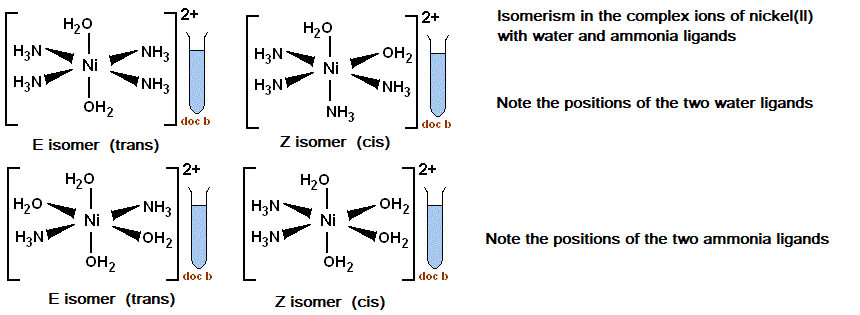
[Ni(H2O)2(NH3)4]2+(aq)
and
[Ni(H2O)4(NH3)2]2+(aq)
![structure of the complex ion [NiEDTA]2- formed between the aqueous nickel(II) ion, Ni2+(aq) and the EDTA anion [EDTA]4-](SSquestions/EDTA-complex-Ni.gif)
The structure of the complex ion
[NiEDTA]2-
formed between the aqueous nickel(II) ion, Ni2+(aq) and
the EDTA anion [EDTA]4-
The process is called a chelation of the central
nickel(II) ion.
TOP OF PAGE
6. Nickel(III) and nickel(IV) oxidation
state chemistry
Higher oxidation state compounds of nickel can ve
stabilised by electronegative elements like oxygen or fluorine.
e.g. nickel(III) oxide, Ni2O3, a
grey-black solid
nickel(III) fluoride, NiF3, forms complex
ions e.g. the hexafluoronickelate(III) ion, [NiF6]3-
in the salt K3NiF6
The nickel(IV) oxidation state occurs in the salt K2NiF6
which contains the hexafluoronickelate(II) ion,
[NiF6]2-
TOP OF PAGE
7. An example of the
heterogeneous catalytic action
of nickel metal - hydrogenation
-

-
An example of nickel acting as a
heterogeneous catalysis is illustrated above, the hydrogenation of alkenes
(e.g. ethene + hydrogen ===> ethane).
-
Hydrogenation is an extremely important process
in the food industry or converting unsaturated oils into low melting hydrogenated solid
fats to make the more spreadable margarine.
-
For more details see
Natural esters - triglyceride fats and oils,
manufacture of margarine and biodiesel
-
Nickel is the solid phase catalyst and
the reactant gases in the different gaseous phase.
-
In terms of activation energies, with
reference to the reaction profile below:
-
(1) ==> (2) is represented by
Ea1, the
absorption of the reactant molecules onto the catalyst surface to form the
intermediate state between nickel and the adsorbed gases..
-
(3) represents the minimum potential
energy trough where the molecules are adsorbed onto the catalyst surface.
-
(2) ==> (3-5) is represented by
Ea2 the
formation of the products form the intermediate adsorbed states of the
molecules.
-

-
The red line represents the catalysed reaction profile (the
catalysed pathway)
-
The blue line represents the uncatalysed
reaction profile (the uncatalysed pathway)
-
A two stage reaction profile for a
catalytic cycle (Ea = activation energy)
-
Note the two transition state
'humps' for the catalysed reaction.
-
This sort of diagram is most
applicable to homogeneous catalysis where definite intermediates are
formed, but in general principle it applies to heterogeneous catalysis
too where the adsorption (particularly chemical) is equivalent to
forming a transition state or complex.
-
Ea1 is the activation energy leading to the formation of an
intermediate complex between nickel and the adsorbed gases.
-
Ea2 is the activation energy for the change of the
intermediate complex into product (ethane).
-
Ea3
is the activation energy of the uncatalysed reaction
between nickel and hydrogen.
8.
The vertical connection of nickel with the other d-block elements of Group
10 (IUPAC designation)
|
Modern IUPAC group numbers of 3-12 |
Outer electron
structure of d-block elements which includes the transition metals
Nickel
is the head element of Group 10 plus Palladium, Plutonium and
Darmstadtium
Their
outer electron
configurations are nd8(n+1)s2
(n = 3 to 6) (except Pd
4d10. Pt 5d9s1)
|
|
[e- core] |
Gp 3 |
Group
4 |
Group
5 |
Group
6 |
Group
7 |
Group
8 |
Group
9 |
Group
10 |
Group
11 |
Group
12 |
|
P'd 4,
3d block [Ar] core |
21Sc
3d14s2 |
22Ti
3d24s2 |
23V
3d34s2 |
24Cr
3d54s1 |
25Mn
3d54s2 |
26Fe
3d64s2 |
27Co
3d74s2 |
28Ni
3d84s2 |
29Cu
3d104s1 |
30Zn
3d104s2 |
|
P'd 5, 4d block (Kr] core |
39Y
4d15s2 |
40Zr
4d25s2 |
41Nb
4d45s1 |
42Mo
4d55s1 |
43Tc
4d55s2 |
44Ru
4d75s1 |
45Rh
4d85s1 |
46Pd
4d10 |
47Ag
4d105s1 |
48Cd
4d105s2 |
|
P'd 6,
5d
b'k [Xe] core |
57La
5d16s2 |
72Hf
4f145d26s2 |
73Ta
4f145d36s2 |
74W
4f145d46s2 |
75Re
4f145d56s2 |
76Os
4f145d66s2 |
77Ir
4f145d76s2 |
78Pt
4f145d96s1 |
79Au
4f145d106s1 |
80Hg
4f145d106s2 |
|
P'd 7, 6d b'k
[Rn] core |
89Ac
6d17s2 |
104Rf
5f146d27s2 |
105Db
5f146d37s2 |
106Sg
5f146d47s2 |
107Bh
5f146d57s2 |
108Hs
5f146d67s2 |
109Mt
5f146d77s2 |
110Ds
5f146d87s2 |
111Rg
5f146d97s2 |
112Cn
5f146d107s2 |
You should expect some similarities between the
chemistry of nickel, palladium and platinum.
They have an outer electron
configuration of 10 electrons - variable configuration
Learning objectives
for the chemistry of the 3d block
metal
nickel 28Ni
(a true transition element)
Know that nickel is a 3d block element and its position in
the periodic table.
Nickel is the top-head element of group 10 (modern IUPAC
convention).
Know that nickel is a 3d block element because it has one or
more electrons in the 3d inner shell.
Know that nickel has relatively high
melting point and boiling point, and a relatively high density.
Nickel is ferromagnetic i.e. a strongly
magnetisable material that retains its magnetism without the
need of an external magnetic field and so is used in alloys to
make strong permanent magnet.
Know there are many important alloys that
contain nickel including nichrome wire.
Nickel metal complies with the
definition of a transition
element,
because it forms at least one
ion with partially filled d sub–shell containing at least one electron
Know how to work out the
electron configurations of nickel and its simple ions
(equal to oxidation states).
Know that nickel does display compounds or ions in
several oxidation states i.e. +2 and +3.
Be able to relate the oxidation states of
nickel to their electron configurations.
Know that nickel can form complex ions,
with the variety of ligands and colours characteristic of true transition
metals.
e.g the
hexaaquanickel(II) ion
[Ni(H2O)6]2+(aq)
and with ammonia to give the hexaamminenickel(II) ion
[Ni(NH3)6]2+(aq)
in a ligand displacement reaction, so make sure can write
the necessary balanced equations and draw the shapes of the
octahedral complexes involved.
Know that
nickel(II) salt solutions give a green? precipitate with alkalis
like sodium hydroxide.
Know that
nickel(II) ions form complexes with bidentate ligands such as
1,2-diaminoethane in process often called chelation.
Know that nickel and its
compounds can display the
catalytic properties of true transition metals e.g. hydrogenation of
unsaturated fats is catalysed by a nickel or alloy of nickel.
|
WHAT NEXT?
GCSE Level Notes on Transition
Metals (for the basics)
The chemistry of
Scandium
* Titanium * Vanadium
* Chromium
* Manganese
The chemistry of
Iron * Cobalt
* Nickel
* Copper *
Zinc
*
Silver & Platinum
Introduction 3d–block Transition Metals * Appendix
1.
Hydrated salts, acidity of
hexa–aqua ions * Appendix 2. Complexes
& ligands * Appendix 3. Complexes and isomerism * Appendix 4.
Electron configuration & colour theory * Appendix 5. Redox
equations, feasibility, Eø * Appendix 6.
Catalysis * Appendix 7.
Redox
equations
* Appendix 8. Stability Constants and entropy
changes *
Appendix 9. Colorimetric analysis
and complex ion formula * Appendix 10 3d block
– extended data
* Appendix 11 Some 3d–block compounds, complexes, oxidation states
& electrode potentials * Appendix 12
Hydroxide complex precipitate 'pictures',
formulae and equations
Some
pages have a matching sub-index
Advanced
Level Inorganic Chemistry Periodic Table Index:
Part 1
Periodic Table history
Part 2
Electron configurations, spectroscopy,
hydrogen spectrum,
ionisation energies *
Part 3
Period 1 survey H to He *
Part 4
Period 2 survey Li to Ne * Part
5 Period 3 survey Na to Ar *
Part 6
Period 4 survey K to Kr AND important
trends down a group *
Part 7
s–block Groups 1/2 Alkali Metals/Alkaline Earth Metals *
Part 8
p–block Groups 3/13 to 0/18 *
Part 9
Group 7/17 The Halogens *
Part 10
3d block elements & Transition Metal Series
*
Part 11
Group & Series data & periodicity plots
All
11 Parts have
their own sub-indexes near the top of the pages
Group numbering and the modern periodic
tableThe original group numbers of
the periodic table ran from group 1 alkali metals to group 0
noble gases. To account for the d block elements and their
'vertical' similarities, in the modern periodic table, groups 3
to group 0 are numbered 13 to 18. So, the p block elements are
referred to as groups 13 to group 18 at a higher academic level,
though the group 3 to 0 notation is still
used, but usually at a lower academic level. The 3d block
elements (Sc to Zn) are now considered the head (top) elements
of groups 3 to 12.
physical and chemical
properties of the 3d block transition metal nickel, oxidation
and reduction reactions of nickel ions, outer electronic
configurations of nickel, principal oxidation states of
nickel,
shapes of nickel's complexes, octahedral complexes of nickel,
tetrahedral complexes of nickel, square planar complexes of
nickel, stability data for nickel's complexes, aqueous chemistry
of nickel ions, redox reactions of nickel ions, physical
properties of nickel, melting point of nickel, boiling point of
nickel, electronegativity of nickel, density of nickel, atomic radius
of nickel, ion radius of nickel, ionic radii of nickel's ions, common
oxidation states of nickel, standard electrode potential data
for nickel, ionisation energies of nickel, polarising power of
nickel
ions, industrial applications of nickel compounds, chemical
properties of nickel compounds, why are nickel complexes
coloured?, isomerism in the complexes of nickel, formulae of
nickel compounds, tests for nickel ions keywords redox reactions ligand
substitution displacement balanced equations
formula complex ions complexes ligand exchange reactions redox reactions ligands
colours oxidation states: nickel ions Ni(0) Ni2+ Ni(+2) Ni(II) NiCl2
NiSO4 Ni2+ + 2OH– ==> Ni(OH)2 Ni2+ + CO32– ==> NiCO3 Ni2+ + 2HCO3– ==> NiCO3 + 4H2O +
CO2 [Ni(H2O)6]2+ + 6 NH3 [Ni(NH3)6]2+ + 6H2O [Ni(H2O)6]2+ + 6NH3 ==>
[Ni(NH3)6]2+ + 6 H2O Kstab = [[Ni(NH3)6]2+] / [[Ni(H2O)6] 2+] [NH3]6 Ni(OH)2 +
6NH3 [Ni(NH3)6]2+ + 2OH– [Ni(H2O)6]2+ + 3en ===> [Ni(en)3]2+ + 6H2O Kstab = [[Ni
(en)3]2+] / [[Ni(H2O)6]2+] [[en]3] [Ni(H2O)6]2+ + EDTA4– ===> [Ni(EDTA)]2– +
6H2O Kstab = [[Ni(EDTA)3]2–] / [[Ni (H2O)6]2+] [[EDTA4–]][Ni(H2O)6]2+ + 4 Cl–
==> [NiCl4]2– + 6H2O Kstab = [[NiCl4]2–] / [[Ni(H2O)6]2+] [Cl–]4 [Ni(H2O)6]2+ +
4 CN– ==> [NiCN4]2– + 6H2O Kstab = [[NiCN4]2–] / [[Ni(H2O)6]2+] [CN–]4 Kstab = 2
x 1031 mol4 dm–12 [lg(Kstab) = 31.3] oxidation states of nickel, redox reactions
of nickel, ligand substitution displacement reactions of nickel, balanced
equations of nickel chemistry, formula of nickel complex ions, shapes colours of
nickel complexes Na2CO3 NaOH NH3 nickel chemistry
for AQA AS chemistry, nickel chemistry
for Edexcel A level AS chemistry, nickel chemistry for A level OCR AS chemistry A,
nickel chemistry for OCR Salters AS chemistry B,
nickel chemistry for AQA A level chemistry, nickel chemistry for A level Edexcel A level chemistry,
nickel chemistry for OCR A level chemistry
A, nickel chemistry for A level OCR Salters A
level chemistry B nickel chemistry for US Honours grade 11 grade 12 nickel
chemistry for
pre-university chemistry courses pre-university A level revision
notes for nickel chemistry A level guide
notes on nickel chemistry for schools colleges academies science course tutors images
pictures diagrams for nickel chemistry A level chemistry revision notes on
nickel chemistry for revising module topics notes to help on understanding of
nickel chemistry university courses in science
careers in science jobs in the industry laboratory assistant
apprenticeships technical internships USA US grade 11 grade 11 AQA A
level chemistry
notes on nickel chemistry Edexcel
A level chemistry notes on nickel chemistry for OCR A level chemistry
notes WJEC A level chemistry notes on nickel chemistry CCEA/CEA A level
chemistry notes on nickel chemistry for university entrance examinations
biological role of cobalt nickel is unknown, nickel(II) chemistry, shape and
formula of complexes of nickel(II) Ni2+, complexes of nickel with ammonia,
oxidation of nickel(II) ion Ni2+ to the nickel(III) ion Ni3+, reactions of the
nickel(II) ion Ni2+ with hydroxide ion, structure formula and shape of nickel
carbonyl, colour and structure of nickel(III) Ni3+ complexes, formula of EDTA
complexes of nickel, tetrahedral complexes of nickel with chloride ion ligands,
octahedral complexes of nickel(II) ion Ni2+ with cyanide and water ligands,
octahedral complexes of nickel(III) Ni3+
Website content © Dr Phil Brown
2000+. All copyrights reserved on revision notes, images, quizzes,
worksheets etc. Copying of website material is NOT permitted. Doc
Brown's Chemistry inorganic chemistry revision notes for
pre-university level students on 3d-block elements including the
physical and chemical properties reactions equations and trends
explained for the 3d-block of transition metals series
Explaining the importance of chemistry of
nickel
in inorganic chemistry, What you need to know about chemistry of nickel for inorganic
chemistry,
Explaining the use of chemistry of nickel knowledge in inorganic chemistry, Examples of
chemistry of nickel explained
when studying inorganic chemistry, What is
the significance of chemistry of nickel in inorganic chemistry, What is the use of
chemistry of nickel
in inorganic chemistry Describing and
explaining the theory of chemistry of nickel when studying inorganic chemistry, exam revision
notes for chemistry of nickel in exams, online help for chemistry of
nickel, revision notes for chemistry of nickel,
what do I need to learn for chemistry of nickel in exams? revision summary for
chemistry of nickel, help in
teaching chemistry of nickel, learning notes for chemistry of nickel, help to pass the
chemistry of nickel exam, how to
prepare for examination questions on chemistry of nickel?
Website content © Dr Phil Brown 2000+. All
copyrights reserved on revision notes, images, quizzes, worksheets etc. Copying
of website material is NOT permitted. Exam revision summaries & references to
science course specifications are unofficial.
Website content © Dr Phil Brown 2000+. All copyrights reserved
on these organic chemistry exam revision notes on chemistry of nickel, these A level chemistry
revision notes are suitable for use of pre-university students studying AQA
advanced A level inorganic chemistry revision notes on chemistry of nickel, Edexcel advanced A
level inorganic chemistry revision notes on chemistry of nickel, OCR advanced A level inorganic
chemistry revision notes on chemistry of nickel, IB advanced A level inorganic chemistry
revision notes on chemistry of nickel, WJEC (Eduqas) advanced A level inorganic chemistry
revision notes on chemistry of nickel, CIE Cambridge advanced A level inorganic chemistry
revision notes on chemistry of nickel, CCEA advanced A level inorganic chemistry revision notes
on chemistry of nickel, and useful for US grade
11 grade 12 AP honors inorganic chemistry courses involving chemistry of
nickel
|
|
|
![R/S optical isomers of the nickel(II) complex ion with 1,2-diaminoethane [Ni(en)3]2+](SSquestions/0complexNien3a.gif) [Ni(H2O)6]2+(aq)
+ 3en(aq)
[Ni(H2O)6]2+(aq)
+ 3en(aq)
![terachloronickelate(II) complex ion [NiCl4]2- colourless tetrahedral shape aniobic complex of oxidation state +2 of nickel](SSquestions/0complexNiCl4.gif) In this ligand exchange
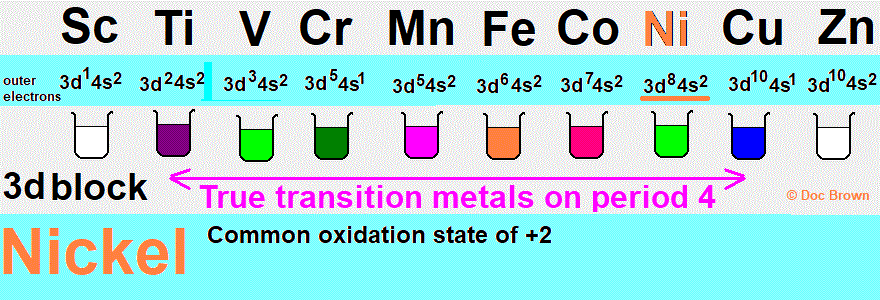
reaction, the nickel(II) complex ion shape changes from
octahedral to tetrahedral, the co-ordination number changes from
6 to 4, but the oxidation state of nickel remains at +2. The
overall electrical charge on the chloro complex is 2- (from
2+/+2 and 4x-1).
In this ligand exchange
reaction, the nickel(II) complex ion shape changes from
octahedral to tetrahedral, the co-ordination number changes from
6 to 4, but the oxidation state of nickel remains at +2. The
overall electrical charge on the chloro complex is 2- (from
2+/+2 and 4x-1). [Ni(H2O)6]2+(aq) +
4CN–(aq)
[Ni(H2O)6]2+(aq) +
4CN–(aq)
