|
Interpreting
and explaining the
1H proton NMR spectrum of phenol C6H5OH
[Author
©
Dr Phil Brown GRIC, PhD:
Doc Brown's advanced level organic chemistry exam revision notes
suitable for students of UK A level chemistry courses & US K12 grade
11, grade 12 and AP honors chemistry courses: Molecular
spectroscopy - analysing the 1H NMR spectra of
phenol
[spectra
page updated
RE-EDIT]
email doc
brown
Re-edit
the 1H NMR spectrum of C6H5OH
H-1
proton NMR spectroscopy - spectra index
Links associated with phenol
* [privacy policy, cookies
and disclaimer]
This is a BIG chemistry website, PLEASE take time to explore it
Practise
exam questions on the 1H NMR spectrum of
phenol
with answers!
Introductory note on the 1H NMR spectra of phenol
Students and teachers please note my explanation of the
proton NMR spectrum of phenol is designed for advanced, but
pre-university, chemistry courses.
The chemical shift
δ splitting pattern effects for
phenol are
confined to a proton spin-spin
coupling effects analysed using the n+1 rule for adjacent
non-equivalent proton fields (n is the number of neighbouring
protons in a non-equivalent different chemical environment for the
phenol molecule).
It is assumed that the integrated intensities of the
δ
chemical shifts give the ratio of the protons in the different
non-equivalent chemical environments of the phenol molecule.
The most common solvent used for investigating the 1H NMR
spectrum of compounds like phenol, is CDCl3 and other
deuterated solvents to avoid confusion with a 1H NMR
signal, 2D (2H) has a different chemical
shift.
TMS is the acronym for tetramethylsilane, formula Si(CH3)4,
whose protons are arbitrarily given a chemical shift of 0.0 ppm.
This is the 'standard' in 1H NMR spectroscopy and all
other proton resonances, called chemical shifts, are measured
with respect to the TMS, and depend on the
individual (electronic) chemical environment of the hydrogen atoms
in an organic molecule - phenol here.
The chemical shifts quoted in ppm on the diagram of
the H-1 NMR spectrum of phenol represent the peaks of the intensity of
the chemical shifts of (which are often groups of split lines at
high resolution) AND the relative integrated areas under the peaks
gives you the ratio of protons in the different chemical
environments of the phenol molecule.
Phenol,
C6H6O,
C6H5OH,
 ,
,

The
molecular structure
and naming of aromatic compounds
Interpreting the
H-1 NMR spectrum of
phenol
In terms of spin-spin coupling from the possible proton magnetic orientations,
for phenol I
have only considered the interactions of
non-equivalent protons on adjacent carbon atoms
e.g. R-CH-CH-X protons
etc. but no splitting of or by the hydroxyl OH proton.
You need high
resolution H-1 NMR spectrum of phenol to detect the
different proton environments.
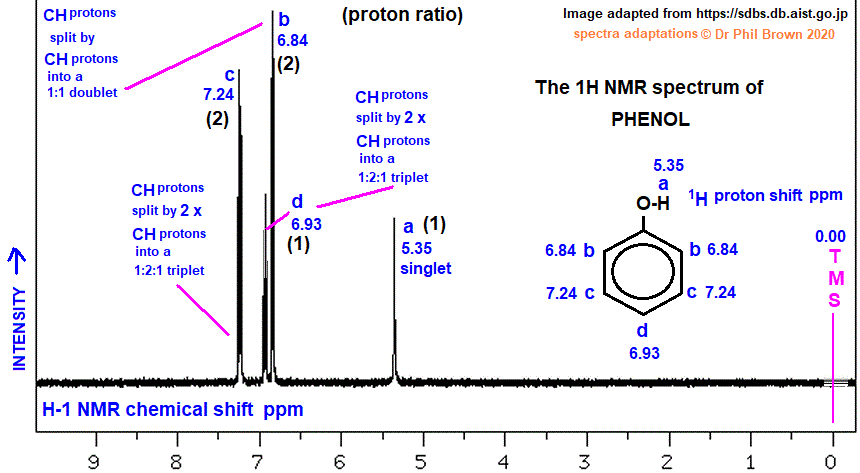
The 6 hydrogen atoms (protons) of phenol occupy
4
different chemical environments so that the high resolution NMR
spectra should show 4 principal
1H peaks of different H-1 NMR chemical shifts (diagram above for
phenol).
Chemical shifts
(a) to (d) on the H-1 NMR
spectrum diagram above for phenol.
Although there are 6 hydrogen atoms in the molecule,
there are only 4 possible different chemical
environments for the hydrogen atoms in phenol molecule.
The integrated signal proton ratio of
1:2:2:1 observed
in the high resolution H-1 NMR spectrum, corresponds with
the structural formula of phenol.
The high resolution 1H NMR
spectrum of phenol
The high resolution spectra of phenol
shows 4 groups of proton resonances and in the
1:2:2:1
ratio expected from the
structural
formula of phenol.
The ppm quoted on the diagram represent the peak
of resonance intensity for a particular proton group in the
molecule of phenol - since the peak' is at the apex of a band of
H-1 NMR resonances due to spin - spin coupling field splitting effects - see high resolution
notes on phenol below.
So, using the chemical shifts and applying the
n+1 rule to
phenol
and make some predictions using some colour coding! (In problem
solving you work the other way round!)
C6H5OH
Resonance
(a) 1H
Chemical shift for OH proton, 5.35 ppm.
This is observed as a singlet, there are
no adjacent protons on the C1 carbon atom of the
benzene ring, so no splitting observed via the n+1 rule.
See
extra note
on proton mobility and effect of adding D2O to the phenol
sample.

Reference diagram for the benzene ring protons of phenol
Ring positions in monosubstituted benzene compounds.
Note that
C2 = C6 and C3 = C5 for 1H
nmr shifts i.e. they occupy the same chemical environment, this is an important point of symmetry for the 1H
chemical shifts for these protons, so only three 1H shifts
for the benzene ring protons.
One of the problems in interpreting NMR spectra
is that the benzene ring CH proton 1H resonances (converted to
chemical shifts) are often quite close together e.g. as in the
1H NMR spectrum of phenol.
Resonance
(b) 1H
Chemical shift for a CH protons on C2/C6, 6.84 ppm.
This 1H NMR resonance applies
to the protons on the equivalent carbon atoms C2 and C6.
This resonance is split into a 1:1
doublet by the adjacent C3 or C5 CH proton (n+1 = 2).
Note there is no proton on carbon
atom C1 that might increase the splitting effect.
Evidence for the presence of a CH group
in the molecule of phenol
Resonance
(c) 1H
Chemical shift for a CH protons on C3/C5, 7.24 ppm.
This 1H NMR resonance applies
to the protons on the equivalent carbon atoms C3 and C5.
This resonance is split into a 1:2:1
triplet by the adjacent CH protons on C4 and C6 on
either side (n+2 = 3).
Resonance
(d) 1H
Chemical shift for a CH proton on C4, 6.93 ppm.
This 1H NMR resonance applies
to the proton on carbon atom C4.
This resonance is split into a 1:2:1
triplet by the adjacent CH protons on C3 and C5 on
either side (n+2 = 3).
EXTRA NOTE on why the OH
proton chemical shift is usually observed as a singlet in phenols
like phenol and how deuterium oxide can be used to identify the peak
caused by the hydroxyl proton
EXAM BOARD NOTE: UK A‑level exam boards do
not
expect OH protons to show spin–spin splitting,
nor do they expect students to predict or interpret
any splitting caused by OH protons. In exam
conditions, OH (alcohols, phenols) and NH
(amines) signals are always treated as singlets,
because rapid proton exchange removes observable
coupling and what you see is a broad singlet.
Although extremely weak acids, there
is constant exchanging of protons between alcohol
molecules (R = alkyl groups of phenol or just the
rest of the molecule).
R-O-H
+ H-O-R
 R-O-H
+ H-O-R
R-O-H
+ H-O-R
The rate of proton transfer is increased by
traces of water.
R-O-H
+ H-O-H
R-O-H
+ H-O-H
This cannot happen with the non-acidic C-H
protons of alkyl groups in phenols like phenol.
This rapid proton transfer interferes with the
field splitting effects of the hydroxyl O-H protons
and carbon C-H protons and the spin-spin
coupling effects disappears
if enough deuterium oxide is present.
This phenomena can be used to identify the O-H
proton resonance in phenols from other C-H proton resonances
in hydroxyl molecules like phenol.
If deuterium oxide (D2O,
where D = 2H) is added to the NMR alcohol sample,
the 1H protons are rapidly replaced by
2H protons in the phenol molecule.
R-O-H
+ D-O-D
 R-O-D
+ H-O-D
R-O-D
+ H-O-D
The 2H chemical shift frequency is
different to the 1H chemical shift
frequency, so the effect of D2O is to
remove (or reduce intensity of) the chemical shift
for the OH proton from the 1H NMR
spectrum of phenol, thereby identifying the original
1H chemical shift as belonging to the
hydroxyl group O-H proton and not a C-H benzene ring proton of
the phenol molecule.
Key
Features of Phenol's ¹H NMR Spectrum
Phenol (C6H5OH) has six protons:
five aromatic hydrogens and one hydroxyl hydrogen.
- Aromatic protons (δ ~6.8–7.4 ppm):
- Multiplet due to coupling between adjacent protons on the
benzene ring.
- Integration: 5 H.
- Characteristic of monosubstituted benzene derivatives.
- Hydroxyl proton (δ ~4.5–7.0 ppm):
- Broad singlet, variable chemical shift depending on hydrogen
bonding and solvent.
- Integration: 1 H.
- Often exchangeable with D2O (disappears upon D2O
shake).
Table of
Chemical Shifts and Proton Assignments
|
δ (ppm) Range |
Proton Type |
Origin |
Integration |
|
6.8–7.4, 6.84-6.93
ppm |
Aromatic H |
Five protons on benzene ring,
but there are three 1H chemical shifts close
together, 2 : 1 : 2 around the ring. |
5 |
|
4.5–7.0, 5.35 ppm |
OH proton |
Hydroxyl group attached to
ring |
1 |
Sources:
NMR
data from NIST Chemistry WebBook
Common
Misconceptions
- Assuming OH always appears at δ ~1–2 ppm (like
alcohols):
In phenol, OH is deshielded by the aromatic ring and hydrogen
bonding, so it shifts downfield (δ ~4.5–7.0 ppm).
- Thinking OH proton always couples:
The OH proton usually appears as a broad singlet due to rapid
exchange, not as a coupled signal.
- Miscounting aromatic protons:
Students sometimes expect 6 aromatic protons; phenol has only 5
because one position is substituted by OH.
- Overlooking D2O exchange test:
The OH signal disappears after D2O addition, confirming
its identity.
Exam
Revision Tips
- Integration check: Always confirm the proton ratio 5:1
(aromatic : OH).
- Coupling pattern: Aromatic protons give a
multiplet, not a simple singlet.
- OH variability: Examiners expect recognition
that OH chemical shift is solvent- and hydrogen bonding-dependent.
- Comparison strategy: Contrast phenol with
benzene (δ ~7.3 ppm, 6 H) and ethanol (OH δ ~2–5 ppm).
- D2O shake test: Mentioning this in
exam answers shows strong understanding of proton exchange.
- Exam technique:
- Identify integration ratios.
- Assign aromatic versus OH signals.
- Comment on chemical shift variability.
- Relate to structure (monosubstituted benzene).
|
QUESTIONS
Advanced A-level chemistry - practise exam questions on
the 1H NMR spectrum of
phenol
A
joint
AI-doc b re-edit experiment!
Jot
down your responses and check out the answers:
ANSWERS
If you think there are
any errors, please email me asap at
chem55555@hotmail.com
I don't mind if students/teachers do a selected printout
of these questions and answers.
Q1.
How many ¹H NMR signals does phenol
normally show?
A.
2 B. 3
C. 4 D. 5
Q2.
Where do the aromatic protons of phenol
typically appear?
A.
0.5–1.5 ppm B. 2–3 ppm
C. 6–8 ppm D. 10–12 ppm
Q3.
Where does the O–H proton of phenol
typically appear?
A.
0.5–1.0 ppm B. 1–5 ppm
C. 6–8 ppm D. 9–12 ppm
Q4.
What splitting pattern is normally observed for the
O–H proton in phenol?
A.
Doublet B. Triplet
C. Broad singlet D. Quartet
Q5.
What splitting pattern is normally observed for phenol's
aromatic protons?
Q6.
What happens to phenol's O–H signal
when D2O is added?
A.
It becomes sharper B. It shifts
upfield C. It disappears
D. It splits into a doublet
Q7.
After adding D2O,
how many ¹H NMR signals remain?
A.
1 B. 2
C. 3 D. 4
Q8.
Which chemical shift region confirms the presence of an
aromatic ring in phenol?
A.
0–2 ppm B. 2–4 ppm
C. 6–8 ppm D. 10–12 ppm
Q9.
Which combination of features confirms phenol rather
than benzene?
A.
Aromatic multiplets + O–H peak at 9–12 ppm
B.
Aromatic multiplets only
C.
Singlet at 1 ppm + multiplet at 7 ppm
D.
Broad peak at 3 ppm + aromatic multiplets
If you think there are
any errors, please email me asap at
chem55555@hotmail.com
I don't mind if students/teachers do a selected printout
of these questions and answers.
Jot
down your responses and check out the answers:
ANSWERS
|
The splitting pattern from proton
spin-spin coupling effects is analysed using the n+1 rule for
adjacent non-equivalent proton fields (n is the number of
neighbouring protons in a non-equivalent different chemical
environment) and applied to the 1H NMR spectrum of
phenol.
|
Number of directly adjacent protons 1H
causing splitting |
Splitting pattern produced from the
n+1 rule on spin-spin coupling and the theoretical ratio of line intensities |
|
0
means no splitting |
|
|
|
|
|
|
1 |
|
|
|
|
|
|
|
1
creates a doublet |
|
|
|
|
|
1 |
|
1 |
|
|
|
|
|
|
2
creates a triplet |
|
|
|
|
1 |
|
2 |
|
1 |
|
|
|
|
|
3
creates a quartet |
|
|
|
1 |
|
3 |
|
3 |
|
1 |
|
|
|
|
4
creates a quintet |
|
|
1 |
|
4 |
|
6 |
|
4 |
|
1 |
|
|
|
5
creates a sextet |
|
1 |
|
5 |
|
10 |
|
10 |
|
5 |
|
1 |
|
|
6
creates a septet |
1 |
|
6 |
|
15 |
|
20 |
|
15 |
|
6 |
|
1 |
Key words & phrases:
C6H6O
C6H5OH Interpreting the proton H-1 NMR spectra of phenol, low resolution & high resolution proton
nmr spectra of phenol, H-1 nmr spectrum of phenol, understanding the
hydrogen-1 nmr spectrum of phenol, explaining the line splitting patterns from
spin-spin coupling in the
high resolution H-1 nmr spectra of phenol, revising the H-1 nmr spectrum of
phenol,
proton nmr of phenol, ppm chemical shifts of the H-1 nmr spectrum of phenol,
explaining and analyzing spin spin line splitting in the H-1 nmr spectrum, how
to construct the diagram of the H-1 nmr spectrum of phenol, how to work out the
number of chemically different protons in the structure of the phenol organic
molecule, how to analyse the chemical shifts in the hydrogen-1 H-1 proton NMR
spectrum of phenol using the n+1 rule to explain the spin - spin coupling ine
splitting in the proton nmr spectrum of phenol deducing the nature of the protons
from the chemical shifts ppm in the H-1 nmr spectrum of phenol
examining the 1H nmr spectrum of phenol analysing the 1-H nmr spectrum of
phenol
how do you sketch and interpret the H-1 NMR spectrum of phenol interpreting
interpretation of the 1H proton spin-spin coupling causing line splitting in the
NMR spectrum of phenol
assignment of chemical shifts in the
proton 1H NMR spectrum of phenol formula explaining spin-spin coupling for line
splitting for phenol aromatic hydroxyl functional group Explanatory diagram of the 1H H-1 proton NMR spectrum of the phenol molecule in terms of its molecular structure. Listing data of all the chemical shift peaks in ppm in the proton NMR spectrum of phenol. How to explain the H-1 NMR spectrum of phenol. The values of the integrated proton ratios in the 1-H NMR spectrum of the phenol molecule. How to work out the molecular structure of the phenol molecule from its proton NMR spectrum. The uses and distinctive features of the proton NMR spectrum of the phenol molecule explained. What does the H-1 proton NMR spectrum tell us about the structure and properties of the phenol molecule?
How do you interpret the H-1 NMR spectrum of
phenol How to interpret
the H-1 NMR spectrum of phenol Explanatory diagram of the chemical
shifts of the 1H H-1 proton NMR spectrum of the phenol
molecule in terms of its molecular structure. Listing data of all the chemical shift peaks in ppm in the
proton NMR spectrum of phenol. How to explain the H-1 NMR spectrum of
phenol. The chemical shifts and integrated values of the proton ratios in the 1-H NMR
spectrum of the phenol molecule. How to work out the molecular
structure of the phenol molecule from its proton NMR spectrum. The uses
and distinctive features of the proton NMR spectrum of the phenol
molecule explained. What does the H-1 proton NMR spectrum chemical
shifts tell us about the
structure and properties of the phenol
molecule? explaining the spin-spin proton coupling effects in the 1H
NMR spectrum of phenol. interpretation
diagram explaining the proton splitting pattern produced from the
n+1 rule and the theoretical ratio of chemical shift
δ and values of
intensities for the proton NMR spectrum lines of phenol
Links associated with phenol
The mass spectrum of
phenol
The
C-13 NMR spectrum of phenol
The infrared spectrum
of phenol
Physical & chemical
properties of phenol and some of its derivatives & uses
The chemistry of AROMATIC COMPOUNDS
revision notes INDEX
H-1 proton NMR spectroscopy index
(Please
read 8 points at the top of the 1H NMR index page)
ALL SPECTROSCOPY INDEXES
All Advanced Organic
Chemistry Notes
Use My Google search site box
Email doc b:
chem55555@hotmail.com
Index of advanced
(pre-university) organic
chemistry revision notes
The chemistry of
alkanes and the petrochemical
industry
The
chemistry of alkenes
The
chemistry of organic halogen compounds
The
chemistry of
alcohols
The chemistry of
aldehydes
and ketones The
chemistry of carboxylic acids and derivatives The chemistry of
organo-nitrogen compounds
The chemistry of
aromatic compounds
Website content © Dr
Phil Brown 2000+. All copyrights reserved on revision notes, images,
quizzes, worksheets etc. Copying of Doc Brown's pre-university
advanced level chemistry website material is NOT
permitted. Exam revision summaries & references to science course specifications
are unofficial. These organic chemistry revision notes on
spectroscopy (1H NMR spectrum of phenol, explanations of the detailed
analysis and how to interpret the spectra notes) are
suitable for use of pre-university students studying AQA advanced level
chemistry, Edexcel advanced level chemistry, OCR advanced level
chemistry, IB advanced level chemistry, WJEC (Eduqas) advanced level
chemistry, CIE advanced level chemistry, CCEA advanced level chemistry, US grade 11-12 AP honors
chemistry courses and they will also prove useful to
1st year undergraduate students of chemistry.
|
ANSWERS
Advanced A-level chemistry - practise exam questions on
the 1H NMR
spectrum of phenol
If you think there are
any errors, please email me asap at
chem55555@hotmail.com
I don't mind if students/teachers do a selected printout
of these questions and answers.
Q1.
How many ¹H NMR signals does
phenol normally show?
A. 2 B. 3
C. 4 D. 5
Correct answer: C
Explanation: Phenol shows
four distinct proton environments:
-
Aromatic protons (four chemically distinct
signals, often overlapping)
-
The O–H proton
At A‑level, these are treated as four
signals: three aromatic regions + one
OH.
Common misconception: Students
often think “all aromatic protons give one
signal,” but they are not equivalent.
Q2.
Where do the aromatic protons
of phenol typically appear?
A. 0.5–1.5 ppm B.
2–3 ppm C. 6–8 ppm
D. 10–12 ppm
Correct answer: C
Explanation: Aromatic protons
appear in the 6–8 ppm region
due to strong deshielding from the benzene ring.
Common misconception: Students
sometimes place aromatic protons at ~4 ppm,
confusing them with protons near electronegative
atoms.
Q3.
Where does the O–H proton of
phenol typically appear?
A. 0.5–1.0 ppm B. 1–5
ppm C. 6–8 ppm
D. 9–12 ppm
Correct answer: D
Explanation: Phenol's O–H
proton is highly deshielded by
the aromatic ring and often appears around
9–12 ppm.
Common misconception: Students
assume all O–H protons appear at 1–5 ppm (like
alcohols), but phenols are much more
downfield.
Q4.
What splitting pattern is normally observed for
the O–H proton in phenol?
A. Doublet B. Triplet
C. Broad singlet D. Quartet
Correct answer: C
Explanation: The O–H proton
exchanges rapidly and appears as a broad
singlet.
Common misconception: Students
expect O–H to split adjacent aromatic protons —
but exchange prevents coupling.
Q5.
What splitting pattern is normally observed for
phenol's aromatic protons?
A. Singlets only B. Complex
multiplets C. Doublets only
D. Triplets only
Correct answer: B
Explanation: Aromatic protons
couple with multiple neighbours, producing
complex multiplets.
Common misconception: Students
often expect simple n+1 patterns, but aromatic
coupling is more complex.
Q6.
What happens to phenol's O–H signal
when D2O is added?
A. It becomes sharper B. It
shifts upfield C. It
disappears D. It splits into a
doublet
Correct answer: C
Explanation: The O–H proton
exchanges with deuterium: C₆H₅OH + D₂O → C₆H₅OD
+ HOD Deuterium does not appear
in ¹H NMR, so the O–H signal vanishes.
Common misconception: Students
think the O–H peak “moves” — it actually
disappears entirely.
Q7.
After adding D2O,
how many ¹H NMR signals remain?
A. 1 B. 2
C. 3 D. 4
Correct answer: C
Explanation: Only the
aromatic protons remain, giving
four distinct aromatic signals (often
overlapping).
Common misconception: Students
sometimes think aromatic protons collapse into
one signal — they do not.
Q8.
Which chemical shift region confirms the
presence of an aromatic ring in
phenol?
A. 0–2 ppm B. 2–4 ppm
C. 6–8 ppm D.
10–12 ppm
Correct answer: C
Explanation: Aromatic protons
appear at 6–8 ppm, a key
diagnostic region.
Common misconception: Students
confuse aromatic protons with aldehyde protons
(9–10 ppm).
Q9.
Which combination of features confirms phenol
rather than benzene?
A. Aromatic multiplets + O–H peak at 9–12 ppm
B. Aromatic multiplets only
C. Singlet at 1 ppm + multiplet at 7 ppm
D. Broad peak at 3 ppm + aromatic multiplets
Correct answer: A
Explanation: Phenol has
aromatic multiplets and a
highly deshielded O–H peak around 9–12
ppm. Benzene lacks the O–H proton.
Common misconception: Students
think benzene and phenol have identical spectra
— but phenol has an O–H signal.
If you think there are
any errors, please email me asap at
chem55555@hotmail.com
I don't mind if students/teachers do a selected printout
of these questions and answers.
|
|
 ENTER
chemistry words e.g. topic, module, exam board, formula, compound, reaction,
structure, concept, equation, any 'phrase', homework question! anything of
chemical interest, like your latest homework question! or anything of
scientific interest! This is a very comprehensive Google
generated search of my website.
ENTER
chemistry words e.g. topic, module, exam board, formula, compound, reaction,
structure, concept, equation, any 'phrase', homework question! anything of
chemical interest, like your latest homework question! or anything of
scientific interest! This is a very comprehensive Google
generated search of my website.