|
Interpreting and
explaining the infrared
spectrum of benzoic acid
C6H5COOH
- including wavenumbers for characteristic bonds
[Author
©
Dr
Phil Brown PhD:
Doc Brown's advanced level organic chemistry exam revision notes
suitable for students of UK A level chemistry courses & US K12 grade
11, grade 12 and AP honors chemistry courses: Molecular
spectroscopy - analysing the infrared spectrum of benzoic acid
[spectra page updated
RE-EDIT]
*
email doc
brown * [privacy policy, cookies
and disclaimer]
Other links
associated with benzoic acid
This is a BIG chemistry website, PLEASE take time to explore it
Introduction
to infrared spectroscopy and IR spectra index
Some practice questions based on the infrared
spectrum of benzoic acid
Introductory note on the infrared spectrum of benzoic acid
Students and teachers please note
my explanation of the infrared
spectrum of benzoic acid is designed
for advanced, but pre-university, chemistry courses.
Based in
the infrared spectrum diagram for benzoic acid, only some of the most
prominent peaks for particular bond vibrations are discussed,
particularly if benzoic acid has a functional group with a particular
characteristic wavenumber peak.
The infrared spectrum of
benzoic acid is
unique and the whole, or selected wavenumbers, can be used to
fingerprint its identity, sometimes analysing a mixture
containing benzoic acid or following its change of concentration in a
reaction.
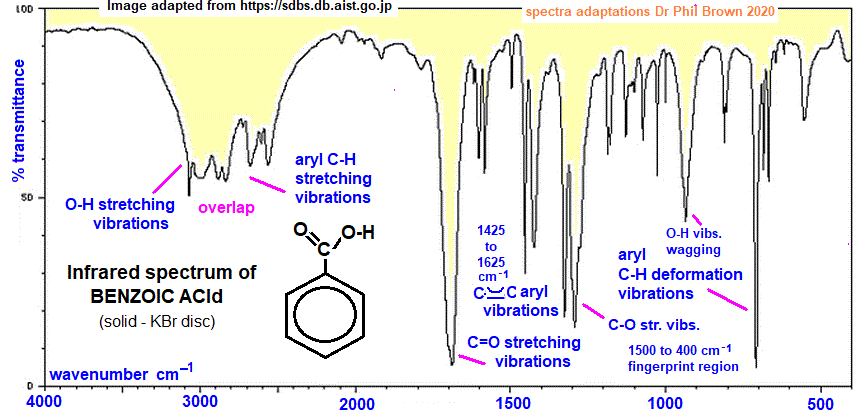
This infrared spectrum was obtained from a liquid film of benzoic acid. The right-hand part of the of the
infrared spectrum of benzoic acid, wavenumbers
~1500 to 400
cm-1 is considered the fingerprint region for the
identification of benzoic acid and most organic compounds. It is due to a unique set
of complex overlapping vibrations of the atoms of the molecule of benzoic
acid.
Benzoic
acid (benenecarboxylic acid),
C7H6O2,
C6H5COOH ,
 , ,
 , ,

The molecular structure and naming of carboxylic
acids and derivatives
The
molecular structure
and naming of aromatic compounds
Interpretation of
the infrared spectrum of benzoic acid
The two most prominent
characteristic infrared absorption bands of benzoic
acid
The first most characteristic absorption band
in the
infrared spectrum of benzoic acid is the broad
O-H
stretching vibration bands at wavenumbers ~3300 to 2500 cm-1,
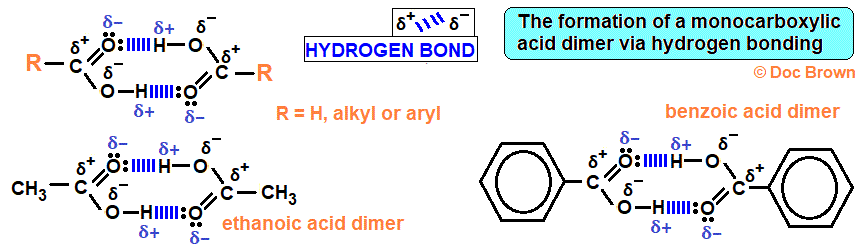
the breadth is caused by interference of intermolecular hydrogen bonding interactions,
including dimer formation (see diagram below), common to
all hydrogen bonded molecules with a hydroxyl group.
The intermolecular
hydrogen bonding: C6H5-C=Oδ--Hδ+ǁǁǁ:Oδ--C6H5
in benzoic acid (an O-H and C=O omitted respectively).
The 'peak' of the O-H stretching vibration is at
~3580 cm-1, but the stretching O-H vibrations overlap the C-H
aryl stretching vibrations at wavenumbers 3080 to 3030 cm-1.
The 2nd most characteristic band in
the
infrared spectrum of benzoic acid is the absorption due to the
carbonyl (C=O) stretching vibrations wavenumbers 1700 to
1680 cm-1 for aryl carboxylic acids like benzoic
acid.
The carbonyl group 'peak' is ~1690 cm-1 on
the diagram above.
Other wave numbers that can be identified in the infrared spectrum of
benzoic acidC6H5COOH
There are
aryl
 in plane
stretching vibration bands at wavenumbers
~1625 to 1465
(for monosubstitution benzene compounds). (Note that
(bond order 1.5)
is NOT the same as C=C (bond order 2) in alkenes)
in plane
stretching vibration bands at wavenumbers
~1625 to 1465
(for monosubstitution benzene compounds). (Note that
(bond order 1.5)
is NOT the same as C=C (bond order 2) in alkenes)
There are
C-O stretching vibration
bands at wavenumbers ~1320 to 1210 cm-1 for the
carboxylic acid group.
There are
aryl C-H (
-H)
stretching vibration bands at wavenumbers ~1100 to 1000 cm-1
(for monosubstitution benzene compounds).
There are
O-H wagging vibration
bands at wavenumbers ~960 to 900 cm-1 for the
carboxylic acid group.
There are quite prominent
aryl C-H deformation vibration
absorptions at wavenumbers 770 to 690 cm-1, you can
see strong absorption at a little over wavenumber 700 cm-1
(typical for monosubstitution benzene compounds like benzoic
acid).
The presence of strong absorption at wavenumbers for
C=O and O-H stretching vibrations are very indicative of a carboxylic
acid group in the benzoic acid molecule, but not proof or exclusive e.g.
you can have a hydroxy-ketone!
The absence of other specific functional group bands
in the
infrared spectrum of benzoic acid will show that a particular functional group is absent from the
benzoic acid
molecular
structure.
Summary of the
infrared
spectrum of benzoic acid and extra comments
The IR spectrum of benzoic acid with
precision and clarity, just the way you like it. Here's a structured
overview tailored for exam prep and misconception-busting:
Some practice questions based on the infrared
spectrum of benzoic acid
Prominent
IR Absorptions of Benzoic Acid
| Functional Group |
Type of Vibration |
~Wavenumber Range (cm-1) |
Notes
on the infrared spectrum of benzoic acid C6H5COOH |
| Carboxylic acid –OH |
Stretch (broad) |
3300-2500 |
Very broad due to hydrogen bonding;
often overlaps with C–H |
| Carboxylic acid C=O |
Stretch |
1700-1680 |
Strong, sharp
absorption peak; diagnostic for
–COOH. Lower than aliphatic acids (typically ~1710–1760 cm⁻¹) because of
conjugation with the benzene ring
stabilising the π system
and
hydrogen‑bonded dimers
further reduce the frequency. A strong peak just below 1700 cm⁻¹ is
characteristic of aryl carboxylic acids. |
| Aromatic C–H |
Stretch |
3100–3000 |
Multiple sharp peaks,
out of plane C-H bending vibrations at 900-690 cm-1, affected
ring substituents. |
| Aromatic C=C |
Stretch |
1600-1400 |
Medium intensity; multiple peaks |
| C–O (acid) |
Stretch |
1320-1210 |
Often overlooked; useful confirmation |
| Fingerprint region |
Complex vibrations |
1500–500 |
Unique to benzoic acid; useful for
compound ID |
Common
Misconceptions about
the infrared spectrum of benzoic acid
(see also below)
- Mistaking the broad –OH stretch
for alcohols: Carboxylic acid
–OH is broader and often extends below 3000 cm⁻¹, unlike the sharper alcohol
–OH.
- Overinterpreting the fingerprint
region: Students often try to
assign every peak. Instead, focus on key functional group regions first.
- Confusing aromatic C=C with alkene
C=C: Aromatic stretches are
typically weaker and split across 1400–1600 cm⁻¹.
- Missing the C–O stretch:
It’s subtle but supports identification of the acid group.
Exam Tips
for questions involving
the infrared spectrum of benzoic acid
(see also above)
- Look for the “hairy beard”:
That broad –OH stretch is a giveaway for carboxylic acids.
- Prioritize “tongues and swords”:
Broad OH = tongue; sharp C=O = sword. These are your fastest identifiers.
- Use molecular formula clues:
If oxygen is present, expect OH or C=O. Calculate degrees of unsaturation to
anticipate aromatic rings.
- Don’t hunt and peck:
Start with the big peaks (OH, C=O), then confirm with aromatic and
fingerprint features.
- Compare spectra:
Practice with similar compounds (e.g. phenol versus benzoic acid) to sharpen
pattern recognition.
|
PRACTICE QUESTIONS based on the
infrared spectrum of benzoic acid
ANSWERS
You may have to sketch out
some molecular structures to work out the answer.
1. Which IR absorption is most characteristic of the carboxylic acid group
in benzoic acid?
- Broad peak around 2500–3300 cm⁻¹
- Sharp peak near 1700 cm⁻¹
- Peak near 1600 cm⁻¹
- Peak near 3000 cm⁻¹
2. What IR peak confirms the presence of a C=O group in benzoic acid?
- 2500–3300 cm⁻¹
- ~1700 cm⁻¹
- ~1600 cm⁻¹
- ~1450 cm⁻¹
3. Which feature distinguishes benzoic acid from phenol in IR spectroscopy?
- Aromatic C–H stretch
- C=C stretch
- C=O stretch ~1700 cm⁻¹
- C–O stretch near 1200 cm⁻¹
4. Which IR region confirms the aromatic ring in benzoic acid?
- 2500–3300 cm⁻¹
- ~1700 cm⁻¹
- 1450–1600 cm⁻¹
- ~1000 cm⁻¹
5. Why is the O–H stretch in benzoic acid unusually broad?
- It overlaps with C–H stretches
- It is due to hydrogen bonding
- It arises from strong intermolecular hydrogen bonding
- It is caused by conjugation with the aromatic ring
6. Which IR feature would be absent in methyl benzoate but present in
benzoic acid?
- Aromatic C=C stretch
- Broad O–H stretch (2500–3300 cm⁻¹)
- C=O stretch
- C–H stretch
7. Which IR absorption confirms the presence of
a carbonyl group in benzoic
acid?
- Sharp peak at 1700 cm⁻¹
- Peak at 1600 cm⁻¹
- Broad band from 2500–3300 cm⁻¹
- Peak at 1200 cm⁻¹
8. Which
combination of peaks confirms benzoic acid versus benzaldehyde?
- C=O and aromatic C=C
- Aromatic C–H and C=O
- Broad O–H and C=O
- C–O and C–H
ANSWERS
to the questions based on the infrared spectrum of benzoic acid |
Key words & phrases:
isomer of C7H6O2
C6H5COOH image and diagram explaining the infrared spectrum
of benzoic acid, complete infrared absorption spectrum of benzoic acid, comparative spectra of
benzoic acid, prominent peaks/troughs for identifying functional groups in the infrared spectrum of
benzoic acid,
important wavenumber values in cm-1 for peaks/troughs in the infrared spectrum
of benzoic acid, revision of infrared spectroscopy of benzoic acid, fingerprint region analysis of
benzoic acid, how to identify benzoic acid from its infrared spectrum, identifying organic
compounds like benzoic acid from their infrared spectrum,
how to analyse the absorption bands in the infrared spectrum of benzoic acid detection of
carboxylic acid functional groups in the benzoic acid molecule example of the infrared spectrum of a
molecule like benzoic acid with a
carboxylic acid
functional group
interpreting interpretation of the infrared spectrum of benzoic acid shows presence
of
carboxylic acid
functional group
aromatic carboxylic acid benzenecarboxylic acid
Explanatory diagram of the infrared spectrum of the benzoic acid molecule in
terms of its molecular structure. Listing data of the prominent main wavenumber
peaks troughs in the infrared spectrum of benzoic acid. How to explain the
infrared spectrum of benzoic acid. Use of the infrared spectrum of benzoic acid,
identification of benzoic acid from its infrared spectrum - fingerprint
wavenumber pattern to identify the benzoic acid molecule. The uses of the
infrared spectrum of the benzoic acid molecule. The distinctive features of the
infrared spectrum of the benzoic acid molecule explained explaining the
peaks-trough of the transmittance of the infrared spectrum of benzoic acid what
does the infrared spectrum tell you about the structure and properties of the
benzoic acid molecule? How do you interpret the infrared absorption spectrum of
benzoic acid How to interpret the infrared spectrum of benzoic acid Explanatory
diagram of the infrared spectrum of the benzoic acid molecule in terms of its
molecular structure. Listing data of the prominent main wavenumber peaks troughs
in the infrared spectrum of benzoic acid. How to explain the infrared spectrum
of benzoic acid. Use of the infrared spectrum of benzoic acid, identification of
benzoic acid from its infrared spectrum - fingerprint wavenumber pattern to
identify the benzoic acid molecule. The uses of the infrared spectrum of the
benzoic acid molecule. The distinctive features of the infrared spectrum of the
benzoic acid molecule explained interpretation diagram explaining the
peaks-trough of the transmittance of the infrared spectrum of benzoic acid what
does the infrared spectrum tell you about the structure and properties of the
benzoic acid molecule? How is infrared spectrum of benzoic acid used to identify
benzoic acid? How do you interpret the infrared absorption spectrum of benzoic
acid How to interpret the infrared spectrum of benzoic acid Explanatory diagram
of the infrared spectrum of the benzoic acid molecule in terms of its molecular
structure. Listing data of the prominent main wavenumber peaks troughs in the
infrared spectrum of benzoic acid. How to explain the infrared spectrum of
benzoic acid. Use of the infrared spectrum of benzoic acid, identification of
benzoic acid from its infrared spectrum - fingerprint wavenumber pattern to
identify the benzoic acid molecule. The uses of the infrared spectrum of the
benzoic acid molecule. The distinctive features of the infrared spectrum of the
benzoic acid molecule explained interpretation diagram explaining the
peaks-trough of the transmittance of the infrared spectrum of benzoic acid what
does the infrared spectrum tell you about the structure and properties of the
benzoic acid molecule? How is infrared spectrum of benzoic acid used to identify benzoic acid?
|
ANSWERS to the questions based on the infrared
spectrum of Benzoic Acid
1. Which IR absorption is most characteristic of the carboxylic acid group
in benzoic acid?
- Broad peak around 2500–3300 cm⁻¹
- Sharp peak near 1700 cm⁻¹
- Peak near 1600 cm⁻¹
- Peak near 3000 cm⁻¹
Answer: A
Explanation: The broad O–H stretch of the carboxylic acid group
appears between 2500–3300 cm⁻¹. While B is the C=O stretch, it is not unique to
acids. C and D are typical of aromatic C=C and C–H stretches respectively, and
not diagnostic for acids.
This answer is given in some textbooks, but there is much overlap with the
broad OH band in alcohols.
2. What IR peak confirms the presence of a C=O group in benzoic acid?
- 2500–3300 cm⁻¹
- ~1700 cm⁻¹
- ~1600 cm⁻¹
- ~1450 cm⁻¹
Answer: B
Explanation: A strong, sharp absorption near 1700 cm⁻¹ is
characteristic of the C=O stretch. A is the broad O–H stretch, C is aromatic
C=C, and D is CH2 bending.
3. Which feature distinguishes benzoic acid from phenol in IR spectroscopy?
- Aromatic C–H stretch
- C=C stretch
- C=O stretch ~1700 cm⁻¹
- C–O stretch near 1200 cm⁻¹
Answer: C
Explanation: Benzoic acid C=O not present in phenol at ~1700 cm⁻¹). A and B are common to both, and D is not diagnostic.
4. Which IR region confirms the aromatic ring in benzoic acid?
- 2500–3300 cm⁻¹
- ~1700 cm⁻¹
- 1450–1600 cm⁻¹
- ~1000 cm⁻¹
Answer: C
Explanation: Aromatic C=C stretches appear in the 1450–1600
cm⁻¹ region. A is the O–H stretch, B is the C=O stretch, and D is part of the
fingerprint region. However, make sure you realise this 'C=C' bond is actually a
'1.5 bond', the aromatic ? has a bond order of 1.5.
5. Why is the O–H stretch in benzoic acid unusually broad?
- It overlaps with C–H stretches
- It is due to hydrogen bonding
- It arises from strong intermolecular hydrogen bonding
- It is caused by conjugation with the aromatic ring
Answer: C
Explanation: Strong intermolecular hydrogen bonding in
carboxylic acids causes the O–H stretch to broaden significantly. A is incorrect
as overlap is minimal, B is too vague, and D affects the C=O stretch more than O–H.
6. Which IR feature would be absent in methyl benzoate but present in
benzoic acid?
- Aromatic C=C stretch
- Broad O–H stretch (2500–3300 cm⁻¹)
- C=O stretch
- C–H stretch
Answer: B
Explanation: Methyl benzoate lacks the acidic O–H group, so the
broad stretch is absent. A, C, and D are present in both compounds.
7. Which IR absorption confirms the presence of
a carbonyl group in benzoic
acid?
- Sharp peak at 1700 cm⁻¹
- Peak at 1600 cm⁻¹
- Broad band from 2500–3300 cm⁻¹
- Peak at 1200 cm⁻¹
Answer:
A
Explanation: A is the C=O stretch, B is aromatic C=C,
C broad O–H stretch is a direct result of
hydrogen bonding and D is C–O stretching,
8. Which
combination of peaks confirms benzoic acid versus benzaldehyde?
- C=O and aromatic C=C
- Aromatic C–H and C=O
- Broad O–H and C=O
- C–O and C–H
Answer: C
Explanation: Benzoic acid has both a broad O–H stretch and a
C=O stretch, whereas benzaldehyde lacks the O–H group. A, B, and D are not
unique to benzoic acid.
ANSWERS
to the questions based on the infrared spectrum of benzoic acid |
Links associated with benzoic acid
The molecular structure and naming of carboxylic
acids and derivatives
The
molecular structure
and naming of aromatic compounds
The mass spectrum of benzoic acid
The H-1 proton NMR spectrum of
benzoic acid
The C-13 carbon-13 NMR
spectrum of benzoic acid
INDEX of all AROMATIC COMPOUND chemistry
revision notes
The
chemistry of CARBOXYLIC ACIDS, ESTERS and other derivatives
The physical and chemical
properties of benzoic acid and selected derivatives
Infrared spectroscopy index
ALL SPECTROSCOPY INDEXES
All Advanced Organic
Chemistry Notes
Use My Google search site box
Email doc b:
chem55555@hotmail.com
Re-edit
of infrared spectrum of
C6H5COOH
Website content © Dr
Phil Brown 2000+. All copyrights reserved on revision notes, images,
quizzes, worksheets etc. Copying of Doc Brown's pre-university
advanced level chemistry website material is NOT
permitted. Exam revision summaries & references to science course specifications
are unofficial. These organic chemistry revision notes on
spectroscopy (on the infrared spectrum of benzoic acid) are
suitable for use of pre-university students studying AQA advanced level
chemistry, Edexcel advanced level chemistry, OCR advanced level
chemistry, IB advanced level chemistry, WJEC (Eduqas) advanced level
chemistry, CIE advanced level chemistry, US grade 11-12 AP honors
chemistry courses and they will also prove useful to
1st year undergraduate students of chemistry. |
