|
Interpreting
and explaining the
mass
spectrum of propylbenzene (1-phenylpropane)
[Author
©
Dr Phil Brown PhD:
Doc Brown's advanced level organic chemistry exam revision notes
suitable for students of UK A level chemistry courses & US K12 grade
11, grade 12 and AP honors chemistry courses:
Molecular
spectroscopy analysis of
propylbenzene
[spectra updated
Mar 28th
2026 *]
email doc
brown
Re-edit mass spectrum of C6H5CH2CH2CH3
Links associated with propylbenzene
This is a BIG chemistry website, PLEASE take time to explore it
Mass spectrometry - spectra index
* [privacy policy, cookies
and disclaimer]
Introductory note on the mass spectrum of propylbenzene
Students and teachers please note
my explanation of the mass spectrum of propylbenzene is designed for
advanced, but pre-university, chemistry courses.
If M represents the
propylbenzene molecule, the initial ionisation to give the molecular ion is:
M(g) +
high KE e- ==> [M•]+(g) + 2e-
and for fragmentation equations assume [M]+ is the start of the
processes and all species are in a gaseous state.
I've not usually shown an unpaired electron on e.g. an ion or a non-ionised
alkyl radical R e.g.
[M•]+ ==> [X]+ + R•,
but you should be aware this is a more accurate depiction of some
processes.
I've used simplified equations to show how some of
the ions that might be formed in the fragmentation pattern for the
mass spectrum of propylbenzene and only the formation of singly charged
positive are considered for the mass spectrum of propylbenzene.
I've included a stick diagram and table of m/z ions for the mass spectrum of
propylbenzene
and doing the mass spectrum analysis under standard conditions,
databases can be compiled based on complex fingerprint patterns, often involving
the relative intensities of many fragment ions, and used to identify compounds including
propylbenzene.
In selected cases, where two
different fragment ions have the same integer m/z value,
I've pointed out that modern mass spectrometers can measure
relative ion mass to four decimal places. So, using
accurate isotopic masses, I've calculated the accurate ion
masses, BUT strictly speaking, 0.0005 should be deducted
for singly charged ions to account for the loss of the
electron in their formation. I have NOT done this for
propylbenzene,
but the mass spectrometer software does!

propylbenzene,
1-phenylpropane, C9H12
,
C6H5CH2CH2CH3 ,
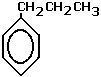 ,
,

An arene aromatic hydrocarbon
The
molecular structure
and naming of aromatic compounds
The molecular structure and
naming of alkanes
Interpreting the fragmentation pattern of the mass spectrum of propylbenzene
[M]+ is the molecular ion peak (M) with an m/z of
120 corresponding to [C9H12]+, the original propylbenzene molecule minus an electron,
[C6H5CH2CH2CH3]+
The small M+1 peak at
m/z 121, corresponds to an ionised
propylbenzene
molecule with one 13C atom in it i.e. an ionised propylbenzene molecule of
formula [13C12C8H12]
(see also m/z 92 ion)
Carbon-13 only accounts for ~1% of all carbon atoms
(12C ~99%), but the more carbon atoms in the molecule,
the greater the probability of observing this 13C M+1
peak.
Propylbenzene has 9
carbon atoms, so on average, ~1 in 11 molecules will contain a 13C atom.
The most abundant ion of the molecule under mass
spectrometry investigation (propylbenzene) is usually given an arbitrary abundance value of
100, called the base ion peak, and all other abundances
('intensities') are measured against it.
The base ion peak for the mass spectrum of propanal
is the m/z 91 ion
[C7H7]+
Identifying the species giving the most prominent peaks
(apart from M) in the fragmentation pattern of propylbenzene.
The parent molecular
ion for propanal is the m/z 120 ion
[C6H5CH2CH2CH3]+
or [C9H12]+
|
m/z value of
[fragment]+ |
105 |
92 |
92 |
91 |
78 |
77 |
65 |
51 |
39 |
|
[molecular fragment]+ |
[C8H9]+ |
[13C12C6H7]+ |
[C7H8]+ |
[C7H7]+ |
[C6H6]+ |
[C6H5]+ |
[C5H5]+ |
[C4H3]+ |
[C3H3]+ |
Analysing and explaining the principal ions in the
fragmentation pattern of the mass spectrum of propylbenzene
PLEASE NOTE
I have found it difficult to find 'authentic' equations to explain mass
spectra fragmentation patterns and it is complex chemistry! I've identified
the formulae of the ionised fragments on the mass spectrum diagram, but the
equations are from the internet or my conjecture as to how the ions might be
formed - please take care in using the information, especially for
assignments at university or pre-university level.
Atomic masses: H = 1; C = 12 (13 for ~1
in 100)
Bond enthalpies = kJ/mol:
 = 518 (benzene ring);
C-C = 348;
C-H = 412
= 518 (benzene ring);
C-C = 348;
C-H = 412
Possible
suggested equations to explain the most abundant ion peaks of
the propylbenzene mass spectrum
There are
many fragments and lots of possible fragmentation process, some are more
favoured than others, but this becomes university level analysis!
Formation of m/z 105 ion
[C6H5CH2CH2CH3]+ ===> [C8H9]+
+ CH3
C-C bond fission in
the parent molecular ion and loss of methyl group from the end of
the alkyl side-chain.
The m/z 105 ion is the base peak ion, the most
abundant and 'stable' ion fragment, formed by the loss of a methyl
group from the parent molecular ion.
Mass change 120 - 15 = 105
(M=15 ion peak)
F ormation
of the m/z 91 ion
[C6H5CH2CH2CH3]+
===> [C6H5CH2]+
+
CH2CH3
or more simply (since
structures might not be quite the same as in the original molecule)
[C9H12]+
===> [C7H7]+
+
C2H5
C-C bond fission in
the parent molecular ion and loss of ethyl group from the end of the
alkyl side-chain.
mass change 120 - 29 = 91 (M-29 ion peak)
The m/z 92 ion theoretically is the
[C7H8]+
ion, but I think it is more likely to be the
[13C12C6H7]+
ion, formed by the process described above since around 1 in 11
molecules or fragment ions has a crabon-13 atom in it.
Note that an accurate mass
spectrometer can sort out ions with the same integer m/z value
because they can measure relative fragment ion
masses to four decimal places
e.g. using accurate relative isotopic masses:
1H
= 1.0078 12C
= 12.0000 13C = 13.0034, from which you can calculate (predict)
that the accurate relative ion masses are:
For m/z 92:
[C7H8]+ =
92.0264
or [13C12C6H7]+
= 92.0580, a relative ion mass difference of 0.0316.
Formation of the m/z 77 ion
[C6H5CH2CH2CH3]+ ===> [C6H5]+
+
CH2CH2CH3
C-C bond fission with
loss of the alkyl side chain.
Mass change 120 - 43 =
77 (M-43 ion peak)
This is a phenyl cation and very characteristic in
the mass spectrum of aromatic benzene compounds like
propylbenzene.
It could also be
formed from the m/z 91 ion by C-C bond scission and loss of CH2
[C7H7]+
===> [C6H5]+
+
CH2
mass change 91 - 14 = 77
The m/z 78 ion can be formed involving proton
rearrangement in larger fragment - apparently a characteristic ion
in the mass spectra of aromatic benzene compounds like
propylbenzene.
Formation of m/z ion 65 ?
[C7H7]+
===> [C5H5]+
+ C2H2
Elimination of ethyne
from the m/z 91 ion
mass change 91 - 26 =
65
Formation of m/z 51 ion
Loss of CH2
from the m/z 65 ion?
[C5H5]+
===> [C4H3]+
+ CH2
mass change 65 - 14 = 51
Formation of m/z 39 ion
[C5H5]+
===> [C3H3]+
+ C2H2
Elimination of ethyne
from the m/z 65 ion
mass change 65 - 26 = 39
but other possibilities too.
Key words & phrases:
1-phenlypropane
C9H12 C6H5CH2CH2CH3 image diagram on how to interpret and explain the mass spectrum of
propylbenzene m/z m/e base peaks, image and diagram of the mass spectrum of
propylbenzene, details of the mass spectroscopy of propylbenzene, low and high resolution mass
spectrum of propylbenzene, prominent m/z peaks in the mass spectrum of
propylbenzene, comparative
mass spectra of propylbenzene, the molecular ion peak in the mass spectrum of
propylbenzene,
analysing and understanding the fragmentation pattern of the mass spectrum
of propylbenzene, characteristic pattern of peaks in the mass spectrum of
propylbenzene, relative
abundance of mass ion peaks in the mass spectrum of propylbenzene, revising the mass
spectrum of propylbenzene, revision of mass spectroscopy of propylbenzene, most abundant ions in the
mass spectrum of propylbenzene, how to construct the mass spectrum diagram for abundance
of fragmentation ions in the mass spectrum of propylbenzene, how to analyse the mass
spectrum of propylbenzene, how to describe explain the formation of fragmented ions in the
mass spectra of propylbenzene equations for explaining the formation of the positive ions
in the fragmentation of the ionised molecule of propylbenzene recognising the
base ion peak of propylbenzene interpreting
interpretation the mass spectrum of propylbenzene
1-phenylpropane n-propylbenzene C6H5C3H7
How do you interpret the mass spectrum of
propylbenzene How to interpret
the mass spectrum of propylbenzene Explanatory diagram of the mass spectrum of the
propylbenzene molecule in
terms of its molecular structure.
Table listing data of the m/z ion prominent main peaks in the mass spectrum of
propylbenzene. How to explain the mass spectrum of propylbenzene. The m/z value of the
molecular ion peak in the mass spectrum of propylbenzene. Identifying
propylbenzene from
its mass spectrum pattern. The m/z m/e peak analysis interpretation
diagram of the mass
spectrum of the propylbenzene molecule. The uses of the mass spectrum of the
propylbenzene molecule. The distinctive features of the mass spectrum of
the propylbenzene molecule explained. explaining the fragmentation pattern of the mass spectrum of
propylbenzene equations showing the
formation of the ionised fragments in the mass spectrum of
propylbenzene
what does the mass spectrum tell you about the structure and
properties of the propylbenzene molecule? Data table of ionised fragments in
the mass spectrum of propylbenzene and equations for their formation in the
fragmentation of the ionised propylbenzene molecule.1-phenlypropane
Links associated
with
propylbenzene
The infrared spectrum of
propylbenzene
The
H-1 NMR spectrum of Propylbenzene
TheC-13 NMR spectrum
of Propylbenzene
The chemistry of AROMATIC COMPOUNDS
revision notes INDEX
Mass spectrometry index
ALL SPECTROSCOPY INDEXES
All Advanced Organic
Chemistry Notes
Use My Google search site box
Email doc b:
chem55555@hotmail.com
Website content © Dr
Phil Brown 2000+. All copyrights reserved on revision notes, images,
quizzes, worksheets etc. Copying of Doc Brown's pre-university
advanced level chemistry website material is NOT
permitted. Exam revision summaries & references to science course specifications
are unofficial. These organic chemistry revision notes on
spectroscopy (on the infrared spectrum of propylbenzene,
1-phenylpropane) are
suitable for use of pre-university students studying AQA advanced level
chemistry, Edexcel advanced level chemistry, OCR advanced level
chemistry, IB advanced level chemistry, WJEC (Eduqas) advanced level
chemistry, CIE advanced level chemistry, CCEA advanced level chemistry, US grade 11-12 AP honors
chemistry courses and they will also prove useful to
1st year undergraduate students of chemistry. |
