Advanced Organic Chemistry: Mass spectrum of 2-methylbutane (CH3)2CHCH2CH3
|
Interpreting and explaining the mass spectrum of 2-methylbutane [Author © Dr Phil Brown GRIC, PhD: Doc Brown's advanced level organic chemistry exam revision notes suitable for students of UK A level chemistry courses & US K12 grade 11, grade 12 and AP honors chemistry courses: Molecular spectrometry - analysing the mass spectrum of 2-methylbutane [spectra page updated RE-EDIT* email doc brown * [privacy, cookies & disclaimer policies] * Re-edit mass spectrum of CH3CH2CH(CH3)2 Links associated with 2-methylbutane This is a BIG chemistry website, please take time to explore it Mass spectrometry - introduction and spectra index See also comparing the infrared, mass, 1H NMR and 13C NMR spectra of the 3 alkane isomers of C5H12 Isomers of molecular formula C5H12 (Mr = 72) Database of accurate m/z values and possible identity of ions formed in mass spectrometry Introductory note on the mass spectrum of 2-methylbutane
2-methylbutane C5H12
For more see The molecular structure and naming of alkanes
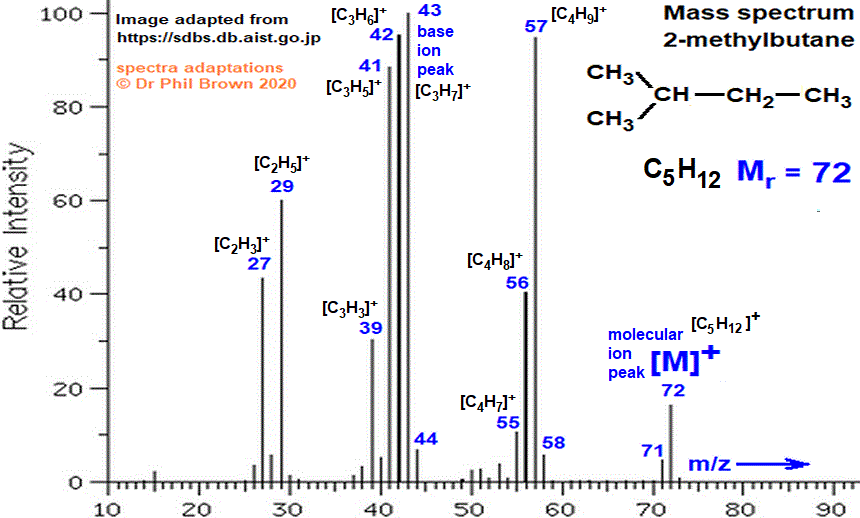
[M]+ is the molecular ion peak (M) with an m/z of 72 corresponding to [C5H12]+, the original 2-methylbutane molecule minus an electron, [(CH3)2CHCH2CH3]+ Unless otherwise stated, C means a 12C atom, if not, the isotopic carbon atom 13C will be indicated. The very tiny M+1 peak at m/z 73, corresponds to an ionised 2-methylbutane molecule with one 13C atom in it i.e. an ionised 2-methylbutane molecule of formula [13C12C4H12]+
Identifying the species giving the most prominent peaks (apart from M) in the fragmentation pattern of 2-methylbutane. The most abundant ion of the molecule under mass spectrometry investigation (2-methylbuane) is usually given an arbitrary abundance value of 100, called the base ion peak, and all other abundances ('intensities') are measured against it.
The parent molecular ion is m/z of 72 corresponding to [C5H12]+ or [(CH3)2CHCH2CH3]+
|
|||||||||||||||||||||||||||||||||||||||||||||||||||||||||||||||||||||||||||||||||||||||||||||||||||||||||||
 ,
,

| m/z | Ion Formula | Fragment Origin | Notes |
|---|---|---|---|
| 72 | C5H12⁺ | Molecular ion (M⁺) | Often weak due to instability |
| 57 | C4H9⁺ | Loss of CH3 (methyl group) | Common in branched alkanes |
| 43 | C3H7⁺ | Loss of C2H5 (ethyl group) or rearrangement | Base peak — very stable ion |
| 41 | C3H5⁺ | Further fragmentation of C3H7⁺ | Less intense, m/z ions 39 and 42 quite prominent |
| 29 | C2H5⁺ | Ethyl cation from deeper fragmentation | Often present |
| 15 | CH3⁺ | Methyl cation | Small peak |
Sources: NIST Mass Spectrometry Database, AQA/Edexcel/OCR specimen papers
Common Misconceptions in Mass Spectrometry
- Confusing base peak with molecular ion: The base peak is the tallest, not necessarily the molecular ion.
- Assuming M⁺ is always strong: In alkanes, M⁺ is often weak or absent due to fragmentation.
- Ignoring rearrangements: Branched alkanes like 2-methylbutane can undergo rearrangement before fragmentation.
- Thinking all fragments are neutral: Only positive ions are detected — neutral fragments are invisible.
Exam Revision Tips for Mass Spectra
What to Focus On
- Identify M⁺ peak: Look for the peak at the molecular mass (C₅H₁₂ = 72).
- Spot the base peak: Usually m/z = 43 for 2-methylbutane.
- Understand fragmentation logic: Break C–C bonds to form stable carbocations.
- Use peak differences: Subtract m/z values to deduce lost groups (e.g., 72 → 57 = loss of CH₃).
Memory Aids
- “Base peak = most stable ion” — not the biggest fragment.
- “M⁺ is the full molecule” — helps anchor your analysis.
- “Alkanes fragment easily” — expect weak M⁺ and strong alkyl ions.
Exam questions strategy
- Annotate spectra with m/z values and fragment origins.
- Use molecular formula to calculate expected M⁺.
- Practice with isomers: Compare spectra of pentane versus 2-methylbutane.
- Link to structure: Use skeletal formula to predict fragmentation routes.
 Practice
questions based on the mass spectrum of 2-methylbutane
Practice
questions based on the mass spectrum of 2-methylbutane
Three varied, technically accurate multiple-choice questions on the mass spectrum of 2-methylbutane (C5H12), suitable for AQA, Edexcel, OCR, WJEC, CCEA, CIE, IB, and US AP/Honors chemistry exams.
These questions explore fragmentation logic, ion stability, and isomer comparison, with model answers and distractor analysis.
Question 1: Base Peak Identification and Fragment Stability based on the mass spectrum of 2-methylbutane
In the EI mass spectrum of 2-methylbutane, the base peak appears at m/z 57.
What is the most likely identity and origin of this fragment?
- C4H9⁺ formed by loss of a methyl radical from the molecular ion
- C3H3⁺ formed by loss of an ethyl radical
- C5H12⁺ molecular ion with no fragmentation
- C2H5⁺ formed by cleavage of the central carbon
Correct Answer: A
Model Answer:
The molecular ion of 2-methylbutane (M⁺ = 72) fragments by losing a methyl
radical (•CH3),
forming a C4H9⁺
ion (m/z 57). This ion is a secondary carbocation, which is
relatively stable and thus appears as the base peak.
Distractor Analysis:
| Option | Why It’s Incorrect |
|---|---|
| B | C3H3⁺ (m/z 43) is a possible fragment but less stable and less intense than C4H3⁺. |
| C | The molecular ion (m/z 72) is often weak or absent in alkanes due to rapid fragmentation. |
| D | C₂H₅⁺ (m/z 29) is too small and not the dominant fragment in this molecule. |
Question 2: Isomer Comparison by Fragmentation Pattern based on the mass spectrum of 2-methylbutane
Which of the following best explains why the mass spectrum of 2-methylbutane differs from that of pentane, even though both have the same molecular formula (C5H12)?
- 2-methylbutane produces a more stable secondary carbocation at m/z 57, while pentane favours m/z 43
- Pentane contains a double bond, which alters its fragmentation pattern
- 2-methylbutane has a higher molecular ion peak due to branching
- Pentane contains chlorine, which introduces isotope peaks
Correct Answer: A
Model Answer:
Both molecules have M⁺ = 72, but
2-methylbutane fragments to form a stable secondary carbocation (C4H9⁺,
m/z 57), while
pentane more commonly fragments to form C3H7⁺
(m/z 43). The difference in
fragment stability and branching leads to distinct base peaks.
Distractor Analysis:
| Option | Why It’s Incorrect |
|---|---|
| B | Neither molecule contains a double bond; both are saturated alkanes. |
| C | Branching affects fragmentation, not the molecular ion mass. |
| D | No halogens are present in either molecule. |
Question 3: Fragmentation Mechanism and Ion Formation based on the mass spectrum of 2-methylbutane
Which of the following best describes the fragmentation mechanism that leads to the m/z 57 peak in the mass spectrum of 2-methylbutane?
- Homolytic cleavage of a C–C bond adjacent to the branched carbon, forming a secondary carbocation
- Loss of a hydrogen radical from the central carbon, forming a tertiary carbocation
- Rearrangement to form a cyclic ion with m/z 57
- Loss of a chlorine atom from the molecular ion
Correct Answer: A
Model Answer:
The m/z 57 fragment arises from homolytic cleavage of a
C–C bond, typically adjacent to the branched carbon. This produces a
secondary carbocation (C4H9⁺),
which is stabilized by hyperconjugation and appears as the base peak.
Distractor Analysis:
| Option | Why It’s Incorrect |
|---|---|
| B | Loss of hydrogen would give m/z 71, but this tertiary carbocation is not favoured in this case. |
| C | Cyclic rearrangements are rare in simple alkanes under EI conditions. |
| D | No chlorine is present in 2-methylbutane. |
|
Comparing the infrared, mass, 1H NMR and 13C NMR
spectra of the 3 alkane isomers of C5H12 NOTE: The images are linked to their original detailed spectral analysis pages AND can be doubled in size with touch screens to increase the definition to the original pentane, 2-methylbutane and 2,2-dimethylpropane image sizes. |
|
 |
 |
 |
Comparing the
infrared
spectra of pentane, 2-methylbutane and 2,2-dimethylpropane Pentane, 2-methylbutane and 2,2-dimethylpropane are structural isomers of molecular formula C5H12 Pentane, 2-methylbutane and 2,2-dimethylpropane exemplify infrared spectra of the alkane homologous series CnH2n+2 hydrocarbon molecules, where n = 5 |
|
INFRARED SPECTRA (above): There are, as expected, differences in the fingerprint region at wavenumbers 1500 to 400 cm-1, but there is no specific infrared absorption band for a functional group. The infrared spectra of pentane and 2-methylbutane seem very similar, but that of 2,2-dimethylpropane seems much simpler. |
|
 |
 |
 |
Comparing the
mass
spectra of pentane, 2-methylbutane and 2,2-dimethylpropane Pentane, 2-methylbutane and 2,2-dimethylpropane are structural isomers of molecular formula C5H12 Pentane, 2-methylbutane and 2,2-dimethylpropane exemplify the mass spectra of the alkane series CnH2n+2 hydrocarbon molecules, where n = 5 |
|
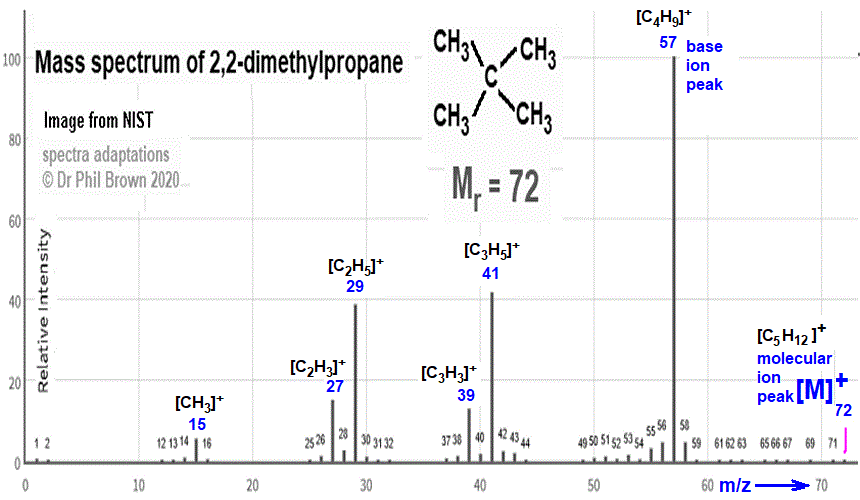
MASS SPECTRA (above): All three hydrocarbons show some similarities in their mass spectra e.g. m/z ions 27 to 29 for [C2Hx]+ (x = 2 and 4). The molecular ion peaks will be the same for all three isomers (m/z 72), but it is very tiny for 2,2-dimethypropane. The pattern ratios for m/z 39 to 43 are similar for pentane and 2-methylbutane, but m/z 42 and 43 ions are almost absent from the 2,2-dimethylpropane spectrum. The base peak ion for pentane is m/z 43, but for 2-methylbutane and 2,2-dimethylpropane it is m/z 57. |
|
 |
 |
 |
Comparing the
1H proton NMR
spectra of pentane, 2-methylbutane and 2,2-dimethylpropane Pentane, 2-methylbutane and 2,2-dimethylpropane are structural isomers of molecular formula C5H12 Pentane, 2-methylbutane and 2,2-dimethylpropane exemplify the 1H proton NMR spectra of the alkane homologous series CnH2n+2 hydrocarbon molecules where, n = 5 |
|
1H NMR SPECTRA (above): The 1H NMR spectra of all three molecules give different proton ratios for the different 1H chemical environments i.e. pentane's proton ratio is 3:2:1 (from 6:4:2 H's in the molecule). 2-methylbutane's proton ratio is 6:1:2:3 and 2,2-dimethylpropane's doesn't have a proton ratio, all hydrogen atoms are equivalent. This means all three isomeric C5H12 hydrocarbons can be distinguished from their 1H NMR spectra. |
|
 |
 |
 |
Comparing the
carbon-13 NMR
spectra of pentane, 2-methylbutane and 2,2-dimethylpropane Pentane, 2-methylbutane and 2,2-dimethylpropane are structural isomers of molecular formula C5H12 Pentane, 2-methylbutane and 2,2-dimethylpropane exemplify the carbon-13 NMR spectra of members of the alkane homologous series CnH2n+2 hydrocarbon molecules, where n = 5 |
|
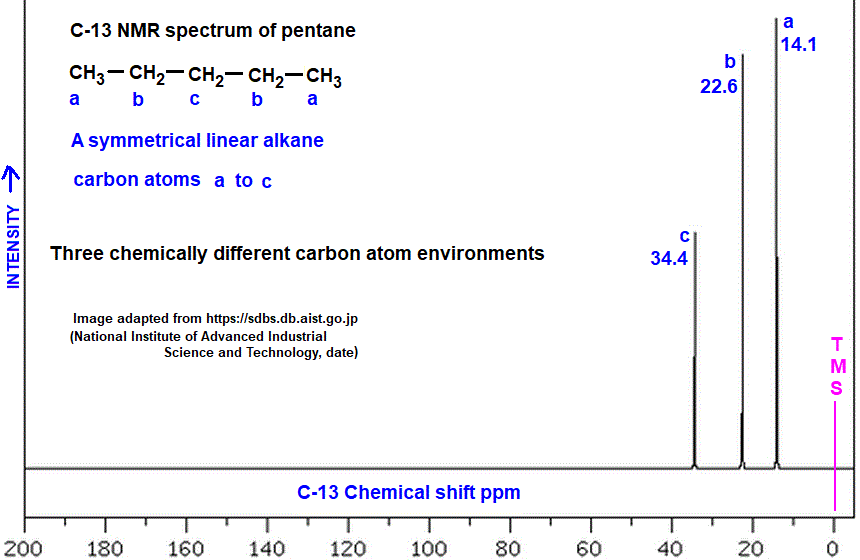
13C NMR SPECTRA (above): The 13C NMR spectra of the three molecules show different numbers of carbon-13 chemical environments i.e different numbers of 13C NMR resonance lines. So, pentane gives three 13C chemical shifts, 2-methylbutane four and 2,2-dimethylpropane two. This means all three isomeric C5H12 hydrocarbons can be distinguished from their 13C NMR spectra. |
|
Key words & phrases: isopentane methylbutane image diagram on how to interpret and explain the mass spectrum of 2-methylbutane m/z m/e base peaks, image and diagram of the mass spectrum of 2-methylbutane, details of the mass spectroscopy of 2-methylbutane, low and high resolution mass spectrum of 2-methylbutane, prominent m/z peaks in the mass spectrum of 2-methylbutane, comparative mass spectra of 2-methylbutane, the molecular ion peak in the mass spectrum of 2-methylbutane, analysing and understanding the fragmentation pattern of the mass spectrum of 2-methylbutane, characteristic pattern of peaks in the mass spectrum of 2-methylbutane, relative abundance of mass ion peaks in the mass spectrum of 2-methylbutane, revising the mass spectrum of 2-methylbutane, revision of mass spectroscopy of 2-methylbutane, most abundant ions in the mass spectrum of 2-methylbutane, how to construct the mass spectrum diagram for abundance of fragmentation ions in the mass spectrum of 2-methylbutane, how to analyse the mass spectrum of 2-methylbutane, how to describe explain the formation of fragmented ions in the mass spectra of 2-methylbutane equations for explaining the formation of the positive ions in the fragmentation of the ionised molecule of 2-methylbutane recognising the base ion peak of 2-methylbutane isopentane methylbutane Stick diagram of the relative abundance of ionised fragments in the fingerprint pattern of the mass spectrum of 2-methylbutane. Table of the m/e m/z values and formula of the ionised fragments in the mass spectrum of 2-methylbutane. The m/e m/z value of the molecular ion peak in the mass spectrum of 2-methylbutane. The m/e m/z value of the base ion peak in the mass spectrum of 2-methylbutane. Possible examples of equations showing the formation of the ionised fragments in 2-methylbutane. Revision notes on the mass spectrum of 2-methylbutane. Matching and deducing the structure of the 2-methylbutane molecule from its mass spectrum. Mass spectroscopy of aliphatic alkanes, mass spectra of 2-methylbutane, an isomer of molecular formula C5H12
How do you interpret the mass spectrum of 2-methylbutane How to interpret the mass spectrum of 2-methylbutane Explanatory diagram of the mass spectrum of the 2-methylbutane molecule in terms of its molecular structure. Listing data of the prominent main peaks in the mass spectrum of 2-methylbutane. How to explain the mass spectrum of 2-methylbutane. The m/z value of the molecular ion peak in the mass spectrum of 2-methylbutane. Identifying 2-methylbutane from its mass spectrum pattern. The m/z m/e peak analysis of the mass spectrum of the 2-methylbutane molecule. The uses of the mass spectrum of the 2-methylbutane molecule. The distinctive features of the mass spectrum of the 2-methylbutane molecule explained. explaining the fragmentation pattern of the mass spectrum of 2-methylbutane equations showing the formation of the ionised fragments in the mass spectrum of 2-methylbutane what does the mass spectrum tell you about the structure and properties of the 2-methylbutane molecule? Data table of ionised fragments in the mass spectrum of 2-methylbutane and equations for their formation in the fragmentation of 2-methylbutane moleculesLinks associated with 2-methylbutane
The infrared spectrum for 2-methylbutane
The H-1 NMR spectrum for 2-methylbutane
The C-13 NMR spectrum for 2-methylbutane
Mass spectrometry - introduction and spectra index
All Advanced Organic Chemistry Notes
Email doc b: chem55555@hotmail.com
Index of my advanced
(pre-college/university) organic
chemistry revision notes
The chemistry of
alkanes and the petrochemical
industry
The chemistry of
aldehydes
and ketones The chemistry of
organo-nitrogen compounds The chemistry of
aromatic compounds
Website content © Dr Phil Brown 2000+. All
copyrights reserved on revision notes, images, quizzes, worksheets etc. Copying
of website material is NOT permitted. Exam revision summaries & references to
A level chemistry course specifications are unofficial.
Website content © Dr Phil Brown 2000+. All
copyrights reserved on these organic chemistry exam revision
notes on mass spectrum of 2-methylbutane, these A level chemistry revision notes are suitable for use of pre-university students studying AQA advanced level
organic chemistry revision notes on mass spectrum of 2-methylbutane, Edexcel advanced level
organic chemistry revision notes on mass spectrum of 2-methylbutane, OCR advanced level
organic chemistry revision notes on mass spectrum of 2-methylbutane, IB advanced level
organic chemistry revision notes on mass spectrum of 2-methylbutane, WJEC (Eduqas) advanced level
organic chemistry revision notes on mass spectrum of 2-methylbutane, CIE Cambridge advanced level
organic chemistry revision notes on mass spectrum of 2-methylbutane, CCEA advanced level
organic chemistry revision notes on mass spectrum of 2-methylbutane,
and useful for US grade 11 grade 12 AP honors organic chemistry courses
involving mass spectrum of 2-methylbutane
Explaining the importance of mass spectrum of
2-methylbutane
in organic chemistry, What you need to know about mass spectrum of
2-methylbutane for organic
chemistry,
Explaining the use of mass spectrum of 2-methylbutane knowledge in organic chemistry, Examples of
mass spectrum of 2-methylbutane explained
when studying organic chemistry, What is
the significance of mass spectrum of 2-methylbutane in organic chemistry, What is the use of
mass spectrum of 2-methylbutane
in organic chemistry Describing and
explaining the theory of mass spectrum of 2-methylbutane when studying organic chemistry, exam revision
notes for mass spectrum of 2-methylbutane in exams, online help for mass
spectrum of 2-methylbutane, revision notes for mass spectrum of 2-methylbutane,
what do I need to learn for mass spectrum of 2-methylbutane in exams? revision summary for
mass spectrum of 2-methylbutane, help in
teaching mass spectrum of 2-methylbutane, learning notes for mass
spectrum of 2-methylbutane, help to pass the mass spectrum of 2-methylbutane exam, how to
prepare for examination questions on mass spectrum of 2-methylbutane?
Website content © Dr
Phil Brown 2000+. All copyrights reserved on revision notes, images,
quizzes, worksheets etc. Copying of Doc Brown's pre-university
advanced level chemistry website material is NOT
permitted. Exam revision summaries & references to science course specifications
are unofficial. These organic chemistry revision notes on
spectroscopy
on the mass spectrum of 2-methylbutane, diagnostic features, data
analysed, useful infrared spectra exam revision comment notes
suitable for use of pre-university students studying AQA advanced level
chemistry, Edexcel advanced level chemistry, OCR advanced level
chemistry, IB advanced level chemistry, WJEC (Eduqas) advanced level
chemistry, CIE advanced level chemistry, US grade 11-12 AP honors
chemistry courses and they will also prove useful to
1st year undergraduate students of chemistry.
