|
Part 6.
The Chemistry of Carboxylic Acids and their Derivatives
Part 6.5
Selective reductions of
carboxylic acids, use of products in organic synthesis routes
and a unique
carboxylic acid oxidation!
[Author
© Dr
Phil Brown PhD: Doc
Brown's exam revision notes suitable
for A level chemistry students of advanced pre-university/college advanced level organic chemistry courses:
carboxylic acid
& derivatives
chemistry revision notes on miscellaneous reactions involving reduction and
oxidation
[updated April 15th 2026 *]
email doc
brown - comments - query?
*
[privacy, cookies and disclaimer]
All my revision notes on the
chemistry of carboxylic acids and derivatives
All my advanced A level organic
chemistry revision notes
Index of GCSE level oil and basic organic chemistry notes
Part 6.5
Selective reduction of
carboxylic acids and use of the products in organic synthesis routes
and a unique
carboxylic acid oxidation!
6.5.1 Reduction of a carboxylic acid to a
primary aliphatic alcohol
Sodium
tetrahydridoborate(III) NaBH4, (sodium borohydride), is not a powerful enough reducing agent to reduce
carboxylic acids.
Lithium
tetrahydridoaluminate(III), LiAlH4, (lithium aluminium tetrahydride), is a
much more
powerful reducing agent than NaBH4, and in ether solvent, readily
reduces carboxylic acids to primary alcohols.
The LiAlH4 effectively
releases a hydride ion,
:H-, a
powerful nucleophile - electron pair donor, which can attacks the
δ+ carbon of polarised carbonyl bond
δ+C=Oδ-.
(electronegativity of O > C).
The reaction must be carried with a
dry solvent such as ethoxyethane ('ether') because LiAlH4 reacts rapidly with water
(and ethanol too).
The reaction is complex and goes
through various stages and can be summarised
as:
RCOOH + 4[H]
===> RCH2OH + H2O (R = H, alkyl or aryl)
The initial product must then be
hydrolysed with water to release the primary alcohol.
e.g. propanoic acid to
propan–1–ol:
CH3CH2COOH + 4[H] ==> CH3CH2CH2OH
+ H2O
or benzoic acid to
phenylmethanol:
C6H5COOH + 4[H] ==> C6H5CH2OH
+ H2O
 + 4[H] ===>
 + H2O
+ H2O
So, LiAlH4 (not
NaBH4) readily reduces the
carbonyl group (>C=O) in carboxylic acids and derivatives to the
primary alcohol functional group.
As far as I know,
metal/acid reducing agents like Zn(s)/HCl(aq) is not powerful enough to reduce carboxylic acids.
H2(g)/Ni(s) will NOT reduce
carboxylic acids, but there are other specialised catalysts that can effect
this reduction using hydrogen gas in the chemical industry.
RCOOH + 2H2
===> RCH2OH + H2O (R = H, alkyl or aryl)
A simple example
to illustrate what is, and is not, reduced in terms of the functional
groups.
e.g. propenoic acid H2C=CH-COOH
('acrylic acid'),
which has two functional groups -
alkene and carboxylic acid
(i) H2C=CH-COOH
+ [H] == NaBH4 ==> No reaction,
no reduction
(ii)
H2C=CH-COOH +
4[H] == LiAlH4 ==> H2C=CH-CH2OH
+ H2O
The alkene is NOT
reduced, but the carbonyl group is, giving prop-2-en-1-ol.
via the negative hydride ion nucleophile attacking the polarised
carbonyl bond.
Nucleophilic attack:
-H:
==> δ+C=Oδ-
This product is an unsaturated primary alcohol,
still with two functional groups.
The >C=C< alkene group is NOT reduced by
LiAlH4 because the attacking nucleophile is
essentially a negative hydride ion (:H-)
which would be repelled by the high electron density of the pi electron cloud of the
non-polar C=C double bond.
(iii)
H2C=CH-COOH
+ H2 == Ni ==> H3C-CH2-COOH
Only the alkene group is
reduced with a nickel catalyst, giving propanoic acid with only one
functional group.
This means you
can selectively reduce either functional groups or you need two
reductions to form propan-1-ol.
The molecule
now has the chemistry of primary alcohols
6.5.2
A unique oxidation
Carboxylic acids are usually quite stable
against oxidation.
Think of the end product of oxidising
alcohols and aldehydes with acidified potassium
dichromate(VI) - carboxylic acids.
However, in terms of lower members of the
simple aliphatic carboxylic acids, there is one clear
exception.
Apart from a carboxylic acid with an aldehyde group as or in
a side chain, the first in this homologous series of aliphatic carboxylic
acids, methanoic acid (HCOOH) is the only carboxylic acid that is
the only one easily
oxidised, acting as a reducing agent, it gives the following results with the following reagents:
(i) It gives a silver mirror with ammoniacal silver
nitrate (Tollen's reagent).
(ii) It gives a red-brown copper(I) oxide (Cu2O)
with blue Fehling's solution.
(iii) However, it does not give a yellow-orange precipitate with
2,4-dinitrophenylhydrazine - carboxylic acids themselves do not usually undergo
nucleophilic addition - elimination reactions like aldehydes do.
Explanation
In tests (i) and (ii) methanoic acid is oxidised to
carbon dioxide and water.
HCOOH + [O] ===> CO2 + H2O
So methanoic acid acts as a
reducing agent and readily oxidised to carbon
dioxide and water by these two reagents.
When you write the formula of methanoic acid, HCOOH, the
'usual' abbreviated structural formula, the explanation isn't as obvious
until you write it another way ...
 i.e. HOCHO is now a formula of a
hydroxy-aldehyde, hence its ease of oxidation, giving positive results
for two the simple tests for aldehydes !!! i.e. HOCHO is now a formula of a
hydroxy-aldehyde, hence its ease of oxidation, giving positive results
for two the simple tests for aldehydes !!!
So methanoic acid
behaves like an aldehyde, the left of this particular
carboxylic acid molecule has a
H-C=O
grouping, identical to an aldehyde group.
Methanoic acid esters have the same
'end' grouping e.g. ethyl methanoate,
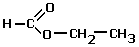 so I assume they can also give a positive 'aldehyde'
result?
so I assume they can also give a positive 'aldehyde'
result?
 Ethanoic acid CH3COOH etc., cannot behave in this
way, the left H of methanoic acid is replaced by an alkyl group, so there
is no equivalent of an aldehyde group present in the
molecule.
Ethanoic acid CH3COOH etc., cannot behave in this
way, the left H of methanoic acid is replaced by an alkyl group, so there
is no equivalent of an aldehyde group present in the
molecule.
You can't 'rearrange' any of the other carboxylic
acids to be both aldehyde and carboxylic acid.
|
Website content © Dr
Phil Brown 2000+. All copyrights reserved on
Doc Brown's Chemistry revision notes carboxylic acids and
derivatives. Copying of website material is NOT
permitted.
Website content © Dr Phil Brown 2000+. All
copyrights reserved on revision notes, images, quizzes, worksheets etc. Copying
of website material is NOT permitted. Exam revision summaries & references to
science course specifications are unofficial.
Website content © Dr Phil Brown 2000+. All
copyrights reserved on these organic chemistry exam revision
notes on reduction of carboxylic acids to alcohols, these A level chemistry revision notes are suitable for use of pre-university students studying AQA advanced level
organic chemistry revision notes on reduction of carboxylic acids to
alcohols, Edexcel advanced level
organic chemistry revision notes on reduction of carboxylic acids to
alcohols, OCR advanced level
organic chemistry revision notes on reduction of carboxylic acids to
alcohols, IB advanced level
organic chemistry revision notes on reduction of carboxylic acids to
alcohols, WJEC (Eduqas) advanced level
organic chemistry revision notes on reduction of carboxylic acids to
alcohols, CIE Cambridge advanced level
organic chemistry revision notes on reduction of carboxylic acids to
alcohols, CCEA advanced level
organic chemistry revision notes on reduction of carboxylic acids to
alcohols, and useful for US grade 11 grade 12 AP honors
organic chemistry courses involving reduction of carboxylic
acids to alcohols, Explaining the importance of
methods reagents for reducing carboxylic acids
in organic chemistry, What you need to know about methods reagents for
reducing carboxylic acids for organic
chemistry,
Explaining the use of methods reagents for reducing carboxylic acids knowledge in organic chemistry, Examples of
methods reagents for reducing carboxylic acids explained
when studying organic chemistry, What is
the significance of methods reagents for reducing carboxylic acids in organic chemistry, What is the use of
methods reagents for reducing carboxylic acids
in organic chemistry Describing and
explaining the theory of methods reagents for reducing carboxylic acids when studying organic chemistry, exam revision
notes for methods reagents for reducing carboxylic acids in exams, online help for
methods reagents for reducing carboxylic acids, revision notes for
methods reagents for reducing carboxylic acids,
what do I need to learn for methods reagents for reducing carboxylic
acids in exams? revision summary for methods reagents for
reducing carboxylic acids, help in
teaching methods reagents for reducing carboxylic acids, learning notes for
methods reagents for reducing carboxylic acids, help to pass the
methods reagents for reducing carboxylic acids exam, how to
prepare for examination questions on methods reagents for reducing
carboxylic acids?
[SEARCH
BOX]
advanced pre-university/college chemistry links
My advanced level carboxylic acid
notes index
All my advanced level organic
chemistry notes
All my advanced level
inorganic chemistry notes
All my advanced level
theoretical chemistry notes |
|
