|
Doc Brown's
Advanced Chemistry: Part 14.7
The
constitutional-structural isomers of molecular formula
C5H10X2
(X = halogen)
[Author
©
Dr
WP Brown PhD: Doc
Brown's advanced level organic chemistry exam revision notes suitable
for students of UK advanced level chemistry courses, IB advanced
chemistry & US K12 grades 11-12 and AP honors chemistry courses: Molecular
spectroscopy and analysing the isomers of C5H10X2
[page updated Feb 26th 206 *]
Associated organic chemistry page links
Index of sets of isomers for a given
molecular formula
This is a big chemistry website, please allow time
to explore it
email doc
brown - comments - query?
*
[privacy policy, cookies
and disclaimer]
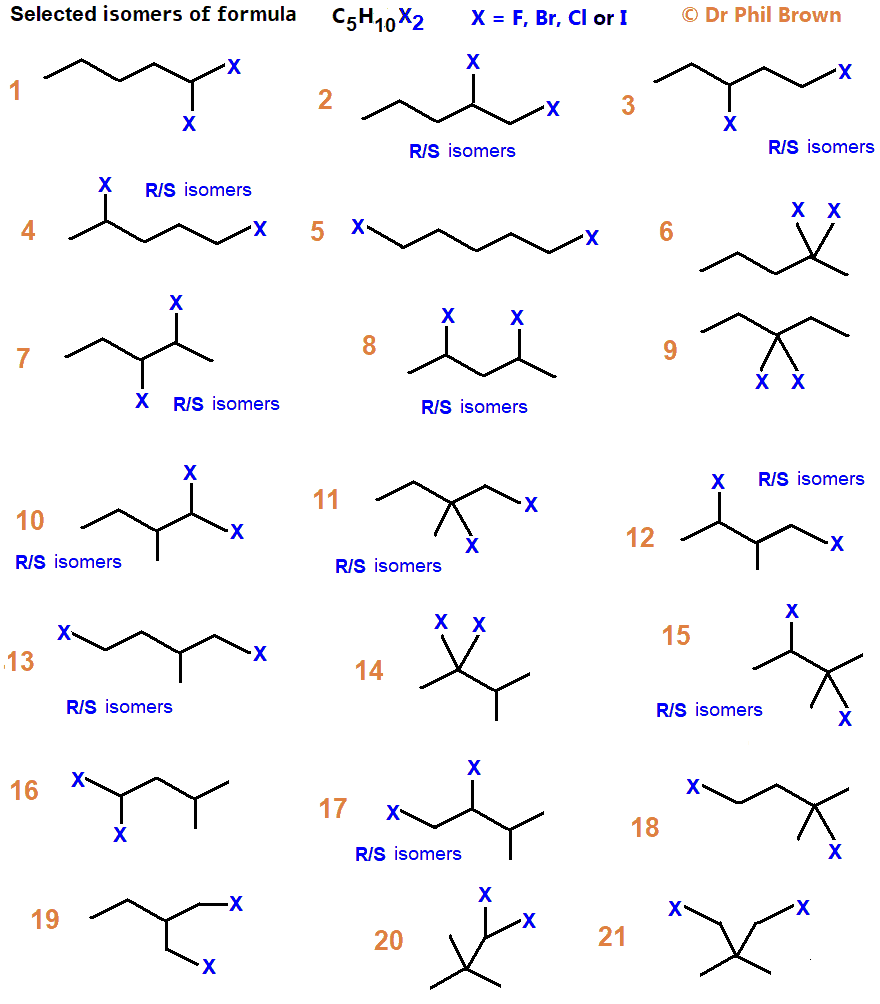
The 21 constitutional-structural isomers of molecular formula C5H10X2
(X = halogen)
Introduction to isomerism in molecules of formulae
C5H10X2
(X = halogen)
Relative molecular mass and
percent composition of
C5H10F2,
C5H10Cl2, C5H10Br2
and C5H10I2
based on atomic masses:
C 12.01,
H 1.01, F 19.00, Cl 35.45,
Br 79.90, I 126.90
|
Formula of compound |
Relative molecular
mass |
%
carbon |
%
hydrogen |
%
halogen |
|
C5H10F2 |
108.15 |
55.52 |
9.34 |
35.14 |
|
C5H10Cl2 |
141.05 |
42.57 |
7.16 |
50.27 |
|
C5H10Br2 |
229.95 |
26.12 |
4.39 |
69.49 |
|
C5H10I2 |
323.95 |
18.54 |
3.11 |
78.35 |
Empirical formula
= molecular formula
=
C5H10X2
(where X = a single halogen atom)
If applicable
(see isomerism
summary at the end of the page)
Structural isomerism
- isomers of the same specific molecular formula, based on different connectivity's of the constituent atoms
(the constitutional isomers), so
they cannot be spatially identical (but sometimes can be defined as having the same shape).
This includes (a)
carbon chain variation (usually need a minimum of 4 atoms),
(b) change in position of a substituent or functional group and
(c) functional group isomerism where the atoms have a different
connectivity configuration, usually with significant differences in
chemical and physical properties e.g.
(a) carbon chain isomerism - halogen disubstituted
carbon skeletons of pentane, 2-methylbutane and 2,2-dimethypropane.
(b) halogen atom substituent positional
isomerism for all three carbon skeletons
Stereoisomerism is
where molecules have the same basic constitutional structural formula, but
isomers differ in the 2D/3D arrangement of the atoms. Applicable here,
but only R/S isomerism.
Stereoisomerism - isomers
based on the same connectivity of the atoms (same constitutional
formula), but in some way, they are 2D or 3D spatially different
non-superimposable images (e.g. E/Z
'geometrical' isomers or mirror image R/S 'optical' isomers)
E/Z stereoisomerism
was called 'geometrical isomerism' e.g.
cis (= Z) and
trans (= E) isomers of alkenes
or disubstituted cyclic alkanes where there are 2D/3D spatial variations
that are not mirror images and not super imposable.
This is not possible for these open chain
saturated aliphatic compounds.
R/S stereoisomerism
was called 'optical isomerism', the pairs of isomers are called
enantiomers, which are 3D non-superimposable mirror image forms of the
molecule (enantiomers).
The molecule must have a chiral centre
(a stereocentre), that is an asymmetric carbon atom with four different
atoms/groups attached to it.
Although there are no E/Z isomers, but there are
several R/S optical
isomers.
NOTE
All of the isomers are halogen substituted saturated
open chain aliphatic compounds.
Some of the isomers described may be highly reactive
and very thermodynamically unstable e.g. due to weak highly
strained bonds and some may not even exist at all (except
theoretically of course!).
I've identified 21
constitutional-structural isomers of molecular formula
C5H10X2 (X =
F, Cl, Br and I),
irrespective of any E/Z or R/S isomerism that may be possible.
To avoid errors I put a set of 21 names through the
internet and they all checked out and as far as I can tell, I haven't
missed out any isomers.
Many of them exhibit R/S optical isomerism, and I've indicated
where a pair of enantiomers exist (non-superimposable mirror image forms).
All the structural isomerism is based on three carbon chain
formations and different substituent positions of the halogen atoms plus R/S
optical isomers exhibited by 11 of the 21.
They are all open chain aliphatic
compounds derived from halogen mono-substitution products of alkane hydrocarbons
with the formula C5H12
9 isomers are based on a disubstituted pentane, a C-C-C-C-C
chain.
10 isomers are based on a disubstituted methylbutane, a
C-C-C(-C)2 chain
2 isomers are based on a disubstituted dimethylpropane, a
C(-C)4 chain
Details of the 21
constitutional structural isomers
of
C5H10F2
C5H10Cl2
C5H10Br2
and
C5H10I2
and any resulting
stereoisomers, all of which are R/S 'optical' isomers, though not all are
optically active!
How to work them out:
(1) to (9) are nine isomers based on the linear pentane backbone
(1)
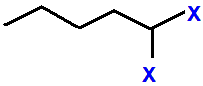 a double primary haloalkane?
1,1-difluoropentane, 1,1-dichloropentane,
1,1-dibromopentane,
1,1-diiodoropentane
Number of low resolution
NMR chemical shift
δ
signal peaks: 5 1H
and 5 13C
(email
if disagree?)
1H NMR ratio of integrated peak areas: 3 : 2 : 2 : 2 : 1 (for equivalent protons)
(2)
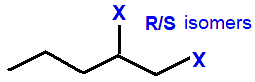 a primary and secondary haloalkane
1,2-difluoropentane, 1,2-dichloropentane, 1,2-dibromopentane,
1,2-diiodoropentane
Can form R/S optical isomers, carbon atom 2 is asymmetric (chiral).
CIP assignment priority rule for R/S isomers:
ZX >
6CZX > 6C6C > 1H (X = halogen, Z = 9, 17, 35, 53)
Number of low resolution
NMR chemical shift
δ
signal peaks: 5 1H
and 5 13C
(email
if disagree?)
1H NMR ratio of integrated peak areas: 3 : 2 : 2 :
1 : 2 (for equivalent protons)
(3)
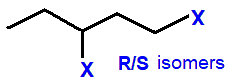 a primary and secondary haloalkane
1,3-difluoropentane, 1,3-dichloropentane,
1,3-dibromopentane,
1,3-diiodopentane
Can form R/S optical isomers, carbon atom 3 is asymmetric (chiral).
CIP assignment priority rule for R/S isomers:
ZX >
6C6CZX >
6C6C1H
> 1H (X = halogen, Z = 9, 17, 35, 53)
Number of low resolution
NMR chemical shift
δ
signal peaks: 5 1H
and 5 13C
(email
if disagree?)
1H NMR ratio of integrated peak areas: 3 : 2 : 1 : 2 :
2 (for equivalent protons)
(4)
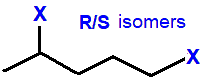 a primary and secondary haloalkane
1,4-difluoropentane, 1,4-dichloropentane,
1,4-dibromopentane,
1,4-diiodoropentane
Can form R/S optical isomers, carbon atom 4 is asymmetric (chiral).
CIP assignment priority rule for R/S isomers:
ZX >
6C6C
> 6C1H > 1H (X = halogen, Z = 9, 17, 35, 53)
Number of low resolution
NMR chemical shift
δ
signal peaks: 5 1H
and 5 13C
(email
if disagree?)
1H NMR ratio of integrated peak areas: 3 : 1 : 2 : 2 :
2 (for equivalent protons)
(5)
 a double primary haloalkane
1,4-difluoropentane, 1,5-dichloropentane,
1,4-dibromopentane, 1,4-diodopentane
Symmetrical molecule, reduction in chemical shifts.
Number of low resolution
NMR chemical shift
δ
signal peaks: 3 1H
and 3 13C
(email
if disagree?)
1H NMR ratio of integrated peak areas: 4
(2+2) : 4 (2+2) : 2 (for equivalent protons)
(6)
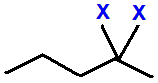 a double secondary haloalkane
2,2-difluoropentane, 2,2-dichloropentane,
2,2-dibromopentane, 2,2-diiodopentane
Number of low resolution
NMR chemical shift
δ
signal peaks: 4 1H
and 5 13C
(email
if disagree?)
1H NMR ratio of integrated peak areas: 3 : 2 : 2 :
3 (for equivalent protons)
(7)
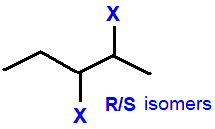 a double secondary haloalkane
2,3-difluoropentane, 2,3-dichloropentane,
2,3-dibromopentane, 2,3-diiodopentane
Can form R/S optical isomers, carbon atoms 2 and 3 are asymmetric (chiral)
and not equivalent.
CIP assignment priority rule for R/S isomers:
ZX > 6CZX >
6C6CZX >
6C6C1H > 6C1H >
1H (X = halogen, Z = 9, 17, 35, 53)
There will four possibilities of optically active
stereoisomers because there of the two chiral centres: RR', RS', SR' and SS', but this is university level analysis.
Number of low resolution
NMR chemical shift
δ
signal peaks: 5 1H
and 5 13C
(email
if disagree?)
1H NMR ratio of integrated peak areas: 3 : 2 : 1 :
1 : 3 (for equivalent protons)
(8)
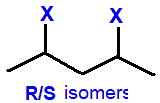 a double secondary haloalkane
2,4-difluoropentane, 2,4-dichloropentane,
2,4-dibromopentane, 2,4-diiodopentane
Can form R/S optical isomers, carbon atoms 2 and 4 are asymmetric (chiral),
but two equivalent chiral centres.
There are two identical chiral carbons, so there will be a pair of
enantiomers and a third stereoisomer (meso form) that is optically inactive
having a plane of symmetry.
Symmetrical molecule, reduces the number of chemical shifts.
Number of low resolution
NMR chemical shift
δ
signal peaks: 3 1H
and 3 13C
(email
if disagree?)
1H NMR ratio of integrated peak areas: 6
(3+3) : 2 (1+1) : 2 (for equivalent protons)
(9)
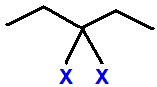 a double secondary haloalkane?
3,3-difluoropentane, 3,3-dichloropentane,
3,3-dibromopentane, 3,3-diiodopentane
Number of low resolution
NMR chemical shift
δ
signal peaks: 2 1H
and 3 13C
(email
if disagree?)
1H NMR ratio of integrated peak areas: 6
(3+3) : 4 (2+2) (for equivalent protons)
How to work them out:
(10) to (19) are ten isomers based on the branched 2-methylbutane backbone
(10)
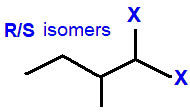 a double primary haloalkane?
1,1-difluoro-2-methylbutane,
1,1-dichloro-2-methylbutane, 1,1-dibromo-2-methylbutane,
1,1-diiodo-2-methylbutane
Can form R/S optical isomers, carbon atom 2 is asymmetric (chiral).
CIP assignment priority rule for R/S isomers:
6C6CZX >
6C6C
> 6C1H > 1H (X = halogen, Z = 9, 17, 35, 53)
Number of low resolution
NMR chemical shift
δ
signal peaks: 5 1H
and 5 13C
(email
if disagree?)
1H NMR ratio of integrated peak areas: 3 : 2 : 1 :
3 : 1 (for equivalent protons)
(11)
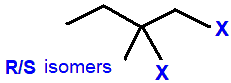 a primary and tertiary haloalkane
1,2-difluoro-2-methylbutane,
1,2-dichloro-2-methylbutane, 1,2-dibromo-2-methylbutane,
1,2-diiodo-2-methylbutane
Can form R/S optical isomers, carbon atom 2 is asymmetric (chiral).
CIP assignment priority rule for R/S isomers:
ZX
> 6CZX > 6C6C > 6C1H >
1H (X = halogen, Z = 9, 17, 35, 53)
Number of low resolution
NMR chemical shift
δ
signal peaks: 4 1H
and 5 13C
(email
if disagree?)
1H NMR ratio of integrated peak areas: 3 : 2 : 3 : 2 (for equivalent protons)
(12)
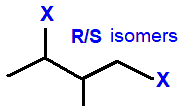 a double secondary haloalkane
1,3-difluooro-2-methylbutane,
1,3-dichloro-2-methylbutane, 1,3-dibromo-2-methylbutane,
1,3-diiodo-2-methylbutane
Can form R/S optical isomers, carbon atoms 2 and 3 are both asymmetric
(chiral), but not identical stereocentres - not equivalent. There will four possibilities of
optically active stereoisomers: RR', RS', SR' and SS', but this is
university level analysis.
CIP assignment priority rule for R/S isomers
(tricky!):
ZX
> 6CZX >
6C6CZX >
6C6C1H
> 6C6C > 6C1H >
1H (X = halogen, Z = 9, 17, 35, 53)
Number of low resolution
NMR chemical shift
δ
signal peaks: 5 1H
and 5 13C
(email
if disagree?)
1H NMR ratio of integrated peak areas: 3 : 1 : 1 :
3 : 2 (for equivalent protons)
(13)
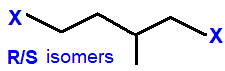 a double primary haloalkane
1,4-difluoro-2-methylbutane,
1,4-dichloro-2-methylbutane, 1,4-dibromo-2-methylbutane,
1,4-diiodo-2-methylbutane
Can form R/S optical isomers, carbon atom 2 is asymmetric (chiral).
CIP assignment priority rule for R/S isomers:
6CZX
> 6C6C > 6C1H >
1H (X = halogen, Z = 9, 17, 35, 53)
Number of low resolution
NMR chemical shift
δ
signal peaks: 5 1H
and 5 13C
(email
if disagree?)
1H NMR ratio of integrated peak areas: 2 : 2 : 1 :
3 : 2 (for equivalent protons)
(14)
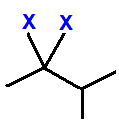 a double secondary haloalkane?
2,2-difluoro-3-methylbutane,
2,2-dichloro-3-methylbutane, 2,2-dibromo-3-methylbutane,
2,2-diiodo-3-methylbutane
Number of low resolution
NMR chemical shift
δ
signal peaks: 3 1H
and 4 13C
(email
if disagree?)
1H NMR ratio of integrated peak areas: 3 : 1 : 6
(3+3) (for equivalent protons)
(15)
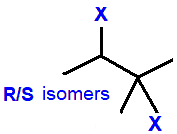 a secondary and tertiary haloalkane
2,3-difluoro-2-methylbutane,
2,3-dichloro-2-methylbutane, 2,3-dibromo-2-methylbutane,
2,3-diiodo-2-methylbutane
Can form R/S optical isomers, carbon atom 3 is asymmetric (chiral).
CIP assignment priority rule for R/S isomers:
ZX
>
6C6C > 6C1H >
1H (X = halogen, Z = 9, 17, 35, 53)
Number of low resolution
NMR chemical shift
δ
signal peaks: 3 1H
and 4 13C
(email
if disagree?)
1H NMR ratio of integrated peak areas: 3 : 1 : 6
(3+3) (for equivalent protons)
(16)
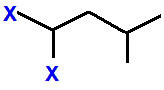 a double primary haloalkane?
1,1-difluoro-3-methylbutane,
1,1-dichloro-3-methylbutane, 1,1-dibromo-3-methylbutane,
1,1-diiodo-3-methylbutane
Number of low resolution
NMR chemical shift
δ
signal peaks: 4 1H
and 4 13C
(email
if disagree?)
1H NMR ratio of integrated peak areas: 1 : 2 : 1 :
6 (3+3) (for equivalent protons)
(17)
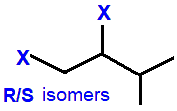 a primary and secondary haloalkane
1,2-difluoro-3-methylbutane,
1,2-dichloro-3-methylbutane, 1,2-dibromo-3-methylbutane,
1,2-diiodo-3-methylbutane
Can form R/S optical isomers, carbon atom 2 is asymmetric (chiral).
CIP assignment priority rule for R/S isomers:
ZX
> 6CZX
> 6C6C >
1H (X = halogen, Z = 9, 17, 35, 53)
Number of low resolution
NMR chemical shift
δ
signal peaks: 4 1H
and 4 13C
(email
if disagree?)
1H NMR ratio of integrated peak areas: 2 : 1 : 1 :
6 (3+3) (for equivalent protons)
(18)
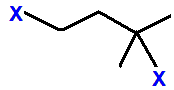 a primary and tertiary haloalkane
1,3-difluoro-3-methylbutane,
1,3-dichloro-3-methylbutane, 1,3-dibromo-3-methylbutane,
1,3-diiodo-3-methylbutane
Number of low resolution
NMR chemical shift
δ
signal peaks: 4 1H
and 4 13C
(email
if disagree?)
1H NMR ratio of integrated peak areas: 2 : 2 : 6
(3+3) (for equivalent protons)
(19)
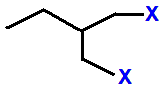 a double primary haloalkane
1-fluoro-2-(fluoromethyl)butane,
1-chloro-2-(chloromethyl)butane, 1-bromo-2-(bromomethyl)butane,
1-iodo-2-(iodomethyl)butane
Number of low resolution
NMR chemical shift
δ
signal peaks: 4 1H
and 4 13C
(email
if disagree?)
1H NMR ratio of integrated peak areas: 3 : 2 : 1 :
4 (2+2) (for equivalent protons)
How to work them out:
(20-21) are two isomers based on the branched 2,2-dmethylpropane backbone
(20)
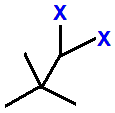 a double primary haloalkane?
1,1-fluoro-2,2-dimethylpropane,
1,1-dichloro-2,2-dimethylpropane, 1,1-dibromo-2,2-dimethylpropane,
1,1-diiodo-2,2-dimethylpropane
Number of low resolution
NMR chemical shift
δ
signal peaks: 2 1H
and 3 13C
(email
if disagree?)
1H NMR ratio of integrated peak areas: 9
(3x3) : 1 (for equivalent protons)
(21)
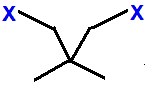 a double primary haloalkane?
1,3-difluoro-2,2-dimethylpropane,
1,3-dichloro-2,2-dimethylpropane, 1,3-dibromo-2,2-dimethylpropane,
1,3-diiodo-2,2-dimethylpropane
Number of low resolution
NMR chemical shift
δ
signal peaks: 2 1H
and 3 13C
(email
if disagree?)
1H NMR ratio of integrated peak areas: 4
(2+2) : 6
(3+3) (for equivalent protons)
Note that spectra can be used to distinguish which halogen
compound and which isomer
EXTRA
NOTES
An overview of
the constituent isomers of C5H10X2
Constitutional isomers with formulas
C5H10F2, C5H10Cl2,
C5H10Br2 and C5H10I2 are families of dihalogenated pentanes that differ in the carbon
skeleton and the positions of the two halogen substituents; these variations
produce chain isomers, positional isomers and, where appropriate, stereoisomers.
Types of constitutional isomerism
students should recognise
for C5H10F2, C5H10Cl2,
C5H10Br2 and C5H10I2
-
Chain isomers: different carbon backbones (straight chain
versus methyl‑branched C5 skeletons).
-
Positional isomers: same carbon skeleton with halogens at
different carbon atoms (e.g. 1,2‑ ; 1,3‑ ; 1,4‑ ; 1,1‑).
-
Geminal versus vicinal: geminal dihalide =
both halogens on same carbon (1,1‑); vicinal = halogens on
adjacent carbons (1,2‑).
-
Stereoisomers: some 1,2‑disubstituted cases can create
chiral centres or E/Z‑type configurations in constrained systems; simple
open‑chain dihalopentanes mainly show chiral centres when a carbon bearing a
halogen also has four different substituents.
General structural and property
trends across halogens (not about isomerism)
-
Size and polarizability increase down the group (F <
Cl < Br < I), so physical properties change: boiling point and
London dispersion increase from F→I for comparable isomers; bond strengths
decrease from C–F (strong) to C–I (weak) affecting chemical reactivity.
-
Electronegativity and dipole effects are
strongest with fluorine (large dipoles), less with chlorine, and
progressively weaker for bromine and iodine; these influence polarity,
solubility and spectroscopic signatures.
-
Leaving group ability improves down the
group (I– > Br– > Cl– > F–), so reactivity in substitution and elimination
differs markedly between families.
Representative isomer classes for
each formula and what to expect
C5H10F2 (difluoropentanes)
-
Common constitutional types: 1,1‑difluoropentane (geminal),
1,2‑difluoropentane (vicinal), 1,3‑, 1,4‑difluoropentane, and isomers on
branched C5 skeletons (e.g. 2‑methylbutane backbone with two F
substituents).
-
Structural consequences: strong C–F bonds produce chemically
stable compounds with large C–F dipoles; physical properties depend strongly
on positional dipole cancellation or reinforcement.
C5H10Cl2 (dichloropentanes)
-
Common constitutional types: the same positional and chain
varieties as above (1,1; 1,2; 1,3; 1,4; branched).
-
Structural consequences: larger Cl atoms increase
polarizability and intermolecular attractions relative to F analogues;
vicinal dichlorides are common substrates for elimination to alkenes, and
some positional isomers can be chiral.
C5H10Br2 (dibromopentanes)
-
Common constitutional types: 1,2‑, 1,3‑, 1,4‑ and geminal
dibromides on straight and branched carbon skeletons.
-
Structural consequences: greater polarizability than Cl
analogues, higher boiling points and better leaving group ability, making
many dibromides useful intermediates in substitution and coupling reactions.
C5H10I2 (diiodopentanes)
-
Common constitutional types: 1,2‑, 1,3‑, 1,4‑ and 1,1‑diiodo isomers on
various C5 backbones.
-
Structural consequences: weakest C–I bonds and excellent leaving group
ability produce the highest chemical reactivity toward nucleophilic
substitution and elimination; physical properties dominated by very strong
dispersion forces.
Practical notes and
identification clues
-
Position isomers often show small but diagnostic shifts in
IR and 13C NMR for carbons bearing halogen substitution; vicinal versus geminal
substitution affects coupling patterns in 1H NMR and carbon chemical shifts.
-
Geminal (1,1) dihalides lack vicinal coupling between
halogen‑bearing protons, vicinal (1,2) dihalides often show characteristic
vicinal proton coupling patterns and possible diastereotopic proton signals
on neighbouring carbons.
-
Reactivity differences are most pronounced between halogen
families: expect C–I compounds to be most reactive in
substitution/elimination and C–F compounds to be least reactive
chemically but strongly polar in physical behaviour.
How to enumerate and draw isomers
efficiently
-
Start from the straight‑chain pentane and place two halogens
in all non‑equivalent positions (consider symmetry to avoid duplicates).
-
Repeat on methyl‑branched backbones (2‑methylbutane and
2,2‑dimethylpropane variants where applicable) and check for unique
connectivity.
-
Mark geminal, vicinal and remote (1,3/1,4) placements and
test for chirality at substituted carbons.
-
This is how I arrived at identifying 21 constitutional
isomers for each of the dihaloalkane formulae
C5H10F2, C5H10Cl2,
C5H10Br2 and C5H10I2
Examples of the uses and
applications of dihalo compounds of formula C5H10X2
Families
C5H10F2, C5H10Cl2,
C5H10Br2 and C5H10I2
are sets of
constitutional dihalopentane isomers (straight and branched backbones;
geminal, vicinal and more remote substitution patterns). Uses follow
predictable structure–property relationships: halogen identity (size,
polarizability, bond strength, leaving‑group ability) and substitution
pattern (position, geminal/vicinal, branching, presence of stereocentres)
determine physical properties and suitability for applications.
General structure → use
principles
-
Polarity and dipole moment: vicinal and
separated polar C–X bonds give greater molecular dipoles than symmetrically
placed halogens; higher polarity aids solvency for polar solutes.
-
Boiling point and volatility: larger, more
polarizable halogens (Br, I) increase boiling points and reduce volatility;
branching lowers boiling point.
-
Chemical reactivity: C–I << C–Br < C–Cl <<
C–F in bond strength; leaving‑group ability increases I > Br > Cl > F, so
iodides and bromides are much more useful as synthetic electrophiles.
-
Stability and persistence: C–F bonds are
very strong and give chemically and thermally stable compounds used where
inertness is required; C–I compounds are comparatively reactive and less
stable.
C5H10F2 (difluoropentanes) —
typical uses and why
-
Uses: specialty solvents and processing
aids in fluorinated formulation chemistry, intermediates in
medicinal‑chemistry/ agrochemical synthesis where introduction of C–F motifs
modifies biological activity or metabolic stability, and components in
specialty lubricants or heat‑transfer fluids at small scale.
-
Structure–use link: strong C–F bonds and
high electronegativity produce large, localized dipoles and chemical
inertness, so difluorides are chosen where thermal/chemical stability and
altered lipophilicity are required; fluorine substitution can strongly
influence bioactivity and metabolic resistance in pharma leads.
C5H10Cl2 (dichloropentanes) —
typical uses and why
-
Uses: industrial intermediates for further
functional group transformation (nucleophilic substitution, elimination to
give alkenes), solvents/degreasers in specialized formulations, feedstocks
for making more complex chlorinated or oxygenated products, and rare uses in
polymer chemistry or additive manufacture.
-
Structure–use link: C–Cl is a moderate
leaving group and chlorine gives moderate polarizability and intermolecular
attraction; positional isomers (vicinal versus geminal) influence reactivity
toward elimination (vicinal → alkenes) and toward substitution. Chlorides
balance reactivity and stability for many synthetic sequences.
C5H10Br2 (dibromopentanes) —
typical uses and why
-
Uses: versatile organic synthesis
intermediates (bromides are excellent electrophiles for nucleophilic
substitution, radical and organometallic coupling reactions), precursors to
di‑functionalised molecules for cross‑coupling, and in laboratory scale
preparations where a good leaving group is required.
-
Structure–use link: greater polarizability
and much better leaving‑group ability (Br−) than Cl or F make dibromides
preferred when converting a carbon centre to other functionalities (e.g.,
formation of organocuprates, Grignard‑type manipulations after halogen‑metal
exchange, or elimination to alkenes).
C5H10I2 (diiodopentanes) —
typical uses and why
-
Uses: reactive synthetic intermediates for
rapid nucleophilic substitution and for introducing heavy‑atom handles
(e.g., for subsequent metal‑mediated coupling, iodination–metal exchange to
form organometallic reagents), specialised radiochemistry precursors
(radioiodination where appropriate isotopes are used), and small‑scale
laboratory transformations where maximal reactivity is required.
-
Structure–use link: very weak C–I bonds and
excellent leaving‑group ability (I−) make diiodides the most reactive of
these families; positional isomers guide selectivity (vicinal diiodides
eliminate easily to alkenes; geminal diiodides behave differently in
substitution/hydrolysis).
How substitution pattern
(position/branching) changes specific applications
-
Geminal (1,1) dihalides: often used where a
single carbon needs to be converted to another functionality; they undergo
different reaction pathways (e.g., dehalogenation, carbenoid formation) than
vicinal isomers.
-
Vicinal (1,2) dihalides: convenient
precursors to alkenes (elimination) or to 1,2‑difunctionalised products; can
give diastereomeric outcomes if stereocentres are present.
-
Remote (1,3 / 1,4) dihalides: used for
building longer chains with two functional handles separated by spacer
carbons—useful in tethering, cross‑linking or difunctional ligand synthesis.
-
Branched versus linear backbone: branching
lowers volatility and can improve solubility in nonpolar media; branching
also affects steric accessibility for substitution, often slowing reactions
at hindered centres.
Practical/laboratory
considerations
-
Choose iodides or bromides when fast,
high‑yielding substitutions or metal–halogen exchanges are needed.
-
Choose chlorides for balanced stability and
moderate reactivity when storage or transport is required.
-
Use fluorinated isomers when stability,
altered lipophilicity or metabolic robustness are design goals in materials
or drug discovery.
-
Safety and environmental impact increase with persistence
and bioaccumulation potential for some halogenated organics; selection often
balances performance with regulatory and toxicological constraints.
Learning objectives - questions to be answered?
Be able to deduce the isomers of
organic halogen molecules with the formula C5H10Cl2 C5H10Br2 C5H10F2 C5H10I2.
Be able to draw and name the
substituted halogen compounds
isomers of molecular formula C5H10Cl2 C5H10Br2 C5H10F2 C5H10I2.
Be able to deduce if the isomers of
C5H10Cl2 C5H10Br2 C5H10F2 C5H10I2 organic halogen compounds can exhibit R/S optical isomerism.
Be able to deduce if the isomers of
C5H10Cl2 C5H10Br2 C5H10F2 C5H10I2 can exhibit E/Z geometrical isomerism (do C5H10Cl2 C5H10Br2 C5H10F2 C5H10I2 have cis/trans geometric
isomers?).
How do you draw the structural formula
and skeletal formula of the isomers of molecular formula C5H10Cl2 C5H10Br2 C5H10F2 C5H10I2?
How many aliphatic structural isomers
are there of halogen compounds with molecular formula C5H10Cl2 C5H10Br2 C5H10F2 C5H10I2?
How many aliphatic carbon chain isomers
are there of halogen compounds with molecular formula C5H10Cl2 C5H10Br2 C5H10F2 C5H10I2?
How many positional isomers are there
of organic halogen molecules with molecular formula C5H10Cl2 C5H10Br2 C5H10F2 C5H10I2?
How many E/Z (geometrical) isomers are
there of molecular formula C5H10Cl2 C5H10Br2 C5H10F2 C5H10I2?
How many R/S (optical) isomers
(enantiomers) of molecular formula C5H10Cl2 C5H10Br2 C5H10F2 C5H10I2?
Are there any cyclic haloalkene isomers
of formula C5H10Cl2 C5H10Br2 C5H10F2 C5H10I2?
Are there any cyclo haloalkane isomers
of formula C5H10Cl2 C5H10Br2 C5H10F2 C5H10I2?
Are there any functional group isomers
with a molecular formula C5H10Cl2 C5H10Br2 C5H10F2 C5H10I2?
Do C5H10Cl2 C5H10Br2 C5H10F2 C5H10I2 organic halogen
molecules have any stereoisomers?
Are there any E/Z (geometrical) isomers
with a molecular formula C5H10Cl2 C5H10Br2 C5H10F2 C5H10I2?
Are there any R/S (optical) isomers
(enantiomers) with a molecular formula C5H10Cl2 C5H10Br2 C5H10F2 C5H10I2?
Be able to deduce the isomers of
organic halogen molecules with the formula C5H10Cl2 C5H10Br2 C5H10F2 C5H10I2.
Be able to draw and name the
substituted halogen compounds
isomers of molecular formula C5H10Cl2 C5H10Br2 C5H10F2 C5H10I2.
Be able to deduce if the isomers of
C5H10Cl2 C5H10Br2 C5H10F2 C5H10I2 organic halogen compounds can exhibit R/S optical isomerism.
Be able to deduce if the isomers of
C5H10Cl2 C5H10Br2 C5H10F2 C5H10I2 can exhibit E/Z geometrical isomerism (do C5H10Cl2 C5H10Br2 C5H10F2 C5H10I2 have cis/trans geometric
isomers).
This page
will answer these questions for molecular formula
C5H10Cl2 C5H10Br2 C5H10F2 C5H10I2
Associated organic chemistry links
Index of sets of isomers for a given
molecular formula
The molecular structure and naming of
HALOALKANES (how
to name and draw alkane structures)
The molecular structure and
naming of ALKANES (how
to name and draw alkane structures)
Advanced Level pre-university
organic chemistry notes
IR, mass and H-1 and C-13 NMR
spectra of organic compounds
For isomerism in organic chemistry, see also the
notes
Isomerism: introduction, structural isomerism - chain,
positional, functional group, tautomerism
Stereoisomerism:
introduction, definition,
priority rules, E/Z isomerism (cis/trans isomerism)
Stereoisomerism - R/S isomerism (optical
isomerism) -
definition - examples explained
This is a big chemistry website, please allow time
to explore it
A summary chart of isomerism

|
Website content © Dr Phil Brown 2000+. All copyrights reserved on revision
notes, images, quizzes, worksheets etc. Copying of Doc Brown's pre-university
advanced level chemistry website material is NOT permitted. Exam revision
summaries & references to science course specifications are unofficial. These
organic chemistry revision notes on isomerism are suitable for use of
pre-university students studying AQA advanced level chemistry, Edexcel advanced
level chemistry, OCR advanced level chemistry, IB advanced level chemistry, WJEC
(Eduqas) advanced level chemistry, CIE advanced level chemistry, US grade 11-12
AP honors chemistry courses and they will also prove useful to 1st year
undergraduate students of chemistry. |
Keywords or phrases:
isomers of halogenoalkanes, how many isomers are
there of halogen compounds of molecular formula C5H10Cl2 C5H10Br2 C5H10F2 C5H10I2? what is the
structure of the halogen compound isomers of molecular formula how do you name the isomers of
molecular formula C5H10Cl2 C5H10Br2 C5H10F2 C5H10I2? what is the molecular structure of the
isomers of C5H10Cl2 C5H10Br2 C5H10F2 C5H10I2, what type of isomerism is exhibited by molecules
of formula C5H10Cl2 C5H10Br2 C5H10F2 C5H10I2, how do you work out the isomers of haloalkanes
formula C5H10Cl2 C5H10Br2 C5H10F2 C5H10I2, what are the structural isomers of C5H10Cl2 C5H10Br2 C5H10F2 C5H10I2, the carbon chain
isomers of C5H10Cl2 C5H10Br2 C5H10F2 C5H10I2 in the homologous series of alkanes, comparing
the many structural isomers does C5H10Cl2 C5H10Br2 C5H10F2 C5H10I2 have?
what are the possible isomers of C5H10Cl2 C5H10Br2 C5H10F2 C5H10I2? revision notes on
isomerism of C5H10Cl2 C5H10Br2 C5H10F2 C5H10I2 molecules, the molecular structure of
the isomers of C5H10Cl2 C5H10Br2 C5H10F2 C5H10I2 how to draw the
structural formula of isomers of C5H10Cl2 C5H10Br2 C5H10F2 C5H10I2, how to draw the displayed
formula of isomers of C5H10Cl2 C5H10Br2 C5H10F2 C5H10I2, how to draw the skeletal formula of
halogenoalkane compound isomers of formula C5H10Cl2 C5H10Br2 C5H10F2 C5H10I2, how to name the isomers of molecular formula C5H10Cl2 C5H10Br2 C5H10F2 C5H10I2, R/S optical isomers
enantiomers of C5H10Cl2 C5H10Br2 C5H10F2 C5H10I2 isomeric with molecular formula C5H10Cl2 C5H10Br2 C5H10F2 C5H10I2, structural isomers of molecular
formula C5H10Cl2 C5H10Br2 C5H10F2 C5H10I2, optical isomers R/S enantiomers isomeric with molecular
formula C5H10Cl2 C5H10Br2 C5H10F2 C5H10I2, positional isomers isomeric with halocycloalkenes,
haloalkanes, haloalkynes, haloalkenes of molecular formula C5H10Cl2 C5H10Br2 C5H10F2 C5H10I2,
which types of isomerism are exhibited by molecules of formula
C5H10Cl2 C5H10Br2 C5H10F2 C5H10I2 alkyl positional isomers of C5H10Cl2 C5H10Br2 C5H10F2 C5H10I2 branched carbon chain
isomers of C5H10Cl2 C5H10Br2 C5H10F2 C5H10I2,
stereoisomers of molecular formula C5H10Cl2 C5H10Br2 C5H10F2 C5H10I2,
optical isomers R/S enantiomers isomeric with molecular
formula C5H10Cl2 C5H10Br2 C5H10F2 C5H10I2, positional isomers isomeric with molecular formula C5H10Cl2 C5H10Br2 C5H10F2 C5H10I2,
which types of isomerism are exhibited by C5H10Cl2 C5H10Br2 C5H10F2 C5H10I2 halogen atom positional isomers of C5H10Cl2 C5H10Br2 C5H10F2 C5H10I2,
how to work out the halogen compound names of isomers of C5H10Cl2 C5H10Br2 C5H10F2 C5H10I2,
haloalkene C5H10Cl2 C5H10Br2 C5H10F2 C5H10I2 isomers, cycloalkane isomers of C5H10Cl2 C5H10Br2 C5H10F2 C5H10I2, cycloalkene
isomers of C5H10Cl2 C5H10Br2 C5H10F2 C5H10I2
How to deduce the isomers of
organic halogen molecules with the formula C5H10Cl2 C5H10Br2 C5H10F2 C5H10I2, How to write, draw and name the
substituted halogen compounds
isomers of molecular formula C5H10Cl2 C5H10Br2 C5H10F2 C5H10I2,
How to deduce if the isomers of
C5H10Cl2 C5H10Br2 C5H10F2 C5H10I2 organic halogen compounds can exhibit R/S optical isomerism, How to deduce if the isomers of
C5H10Cl2 C5H10Br2 C5H10F2 C5H10I2 can exhibit E/Z geometrical isomerism (do C5H10Cl2 C5H10Br2 C5H10F2 C5H10I2 have cis/trans geometric
isomers?), number of structural isomers of C5H10Cl2 C5H10Br2 C5H10F2 C5H10I2, number of
stereoisomers of C5H10Cl2 C5H10Br2 C5H10F2 C5H10I2
|
