|
Doc Brown's
Advanced Chemistry: Part 14.7:
Isomers
and extra notes on their properties and uses
The 9
constitutional structural isomers of molecular formula
C4H8X2
(X = halogen) & associated stereoisomers
[Author
©
Dr WP Brown PhD:
Doc Brown's advanced level organic chemistry exam revision notes
suitable for students of UK advanced level chemistry courses, IB
chemistry & US K12 grade
11, grade 12 and AP honors chemistry courses: Molecular
spectroscopy and analysing the isomers of C4H8X2
[updated
Feb 22nd 2026 *]
Associated organic chemistry page links
Index of sets of isomers for a given
molecular formula
This is a big chemistry website, please allow time
to explore it
email doc
brown - comments - query?
*
[privacy policy, cookies
and disclaimer]
The 9 constitutional-structural isomers of molecular formula C4H8X2
(X = halogen atom)
Relative molecular mass and
percent composition of
C4H8X2
based on atomic masses:
C 12.01,
H 1.01, F 19.00, Cl 35.45,
Br 79.90, I 126.90
|
Formula of compound |
Relative molecular
mass |
%
carbon |
%
hydrogen |
%
halogen |
|
C4H8F2 |
94.12 |
51.04 |
8.58 |
40.38 |
|
C4H8Cl2 |
127.02 |
37.82 |
6.36 |
55.82 |
|
C4H8Br2 |
215.92 |
22.25 |
3.74 |
74.01 |
|
C4H8I2 |
309.92 |
15.50 |
2.61 |
81.89 |
Empirical formula
C2H4X
for the molecular formula
C4H8X2
(where X = halogen atom)
Introduction to isomerism in molecules of formulae
C4H8X2
(X = halogen atom)
If applicable
(see isomerism
summary at the end of the page)
Structural isomerism
- isomers based on different connectivity's of the constituent atoms, so cannot
be spatially identical (but can be defined as having the same shape).
This includes (a)
carbon chain variation (usually need a minimum of 4 atoms),
(b) change in position of a substituent or functional group and
(c) functional group
isomerism where the atoms have a different connectivity configuration, usually with
significant differences in chemical and physical properties.
Examples of (a) chain isomerism, but all are
(b) halogen substituent positional isomers.
Stereoisomerism - isomers
based on the same connectivity of the atoms (same constitutional formula), but
in some way, they are 2D or 3D spatially different non-superimposable images (e.g. E/Z
'geometrical' isomers or mirror image R/S 'optical' isomers)
E/Z
stereoisomerism was called 'geometrical isomerism' e.g. cis
and trans isomers of alkenes or disubstituted cyclic alkanes
where there are 3D spatial variations that are not mirror images and not
super imposable.
Not applicable here.
R/S
stereoisomerism was called 'optical isomerism', the pairs of
isomers are called enantiomers which are 3D non-superimposable
mirror image forms of the molecule. The molecule must have a chiral centre
(a stereocentre), that is an asymmetric carbon atom with four
different atoms/groups attached to it.
There are several examples of R/S optical isomerism.
NOTE
For each of the molecular
formulae
C4H8F2, C4H8Cl2, C4H8Br2
and C4H8I2:
The are 9
constitutional-structural isomers of molecular formula
C4H8X2 (X =
F, Cl, Br and I),
irrespective of any E/Z or R/S isomerism that may be possible.
There are 7 stereoisomers based on three of the
constituent isomers.
Therefore there are 13 unique distinct isomers of molecular
formula C4H8X2.
They are all open chain aliphatic
compounds derived from halogen di-substitution products of the alkane hydrocarbons
butane or 2-methylpropane
with the molecular formula C4H10
Details of the
constitutional structural isomers
C4H8X2 (X =
F, Cl, Br and I)
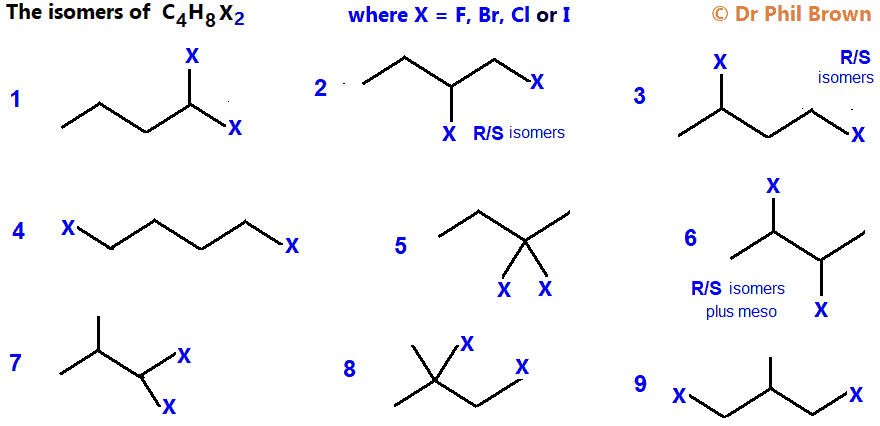
The 9 constitutional
Isomers, and 7 stereoisomers, making a total of 13 distinct isomers for each of
the following molecular formulae:
C4H8F2,
C4H8Cl2,
C4H8Br2
and C4H8I2
(1)
 CH3CH2CH2CX2
a double primary haloalkane
CH3CH2CH2CX2
a double primary haloalkane
1,1-difluorobutane, 1,1-dichlorobutane,
1,1-dibromobutane, 1,1-diiodobutane
Constitutional isomers (1) to (6) have a linear carbon chain,
(7) to (9)have a branched carbon chain.
Number of low resolution
NMR chemical shift
δ
signal peaks: 4 1H
and 4 13C
(email
if disagree?)
1H NMR ratio of peaks: 3 : 2 : 1 (for equivalent protons)
Index of
1H NMR spectra organic
compounds and
Index of
13C NMR spectra organic
compounds
(2)
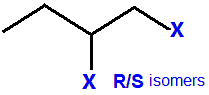 CH3CH2CHXCH2X
a primary and secondary haloalkane
CH3CH2CHXCH2X
a primary and secondary haloalkane
1,2-difluorobutane, 1,2-dichlorobutane,
1,2-dibromobutane, 1,2-diiodobutane
These molecules exhibit R/S (optical isomers), a pair of
enantiomers based on the C2 chiral centre.
From the CIP priority rule for R/S optical isomer assignment
(for the pair of enantiomers):
ZX > ZX6C > 6C6C
> 1H (where X = halogen, and Z = 9, 17, 35 or 53)
Number of low resolution
NMR chemical shift
δ
signal peaks: 4 1H
and 4 13C
(email
if disagree?)
1H NMR ratio of peaks: 3 : 2 : 1 : 2 (for equivalent protons)
(3)
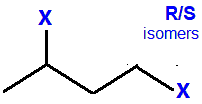 CH3CHXCH2CH2X
a primary and secondary haloalkane
CH3CHXCH2CH2X
a primary and secondary haloalkane
1,3-difluorobutane, 1,3-dichlorobutane,
1,3-dibromobutane, 1,3-diiodobutane
These molecules exhibit R/S (optical isomers), a pair of
enantiomers based on the C3 chiral centre.
From the CIP priority rule for R/S optical isomer assignment
(for the pair of enantiomers):
ZX > 6C6C > 1H6C
> 1H (where X = halogen, and Z = 9, 17, 35 or 53)
Number of low resolution
NMR chemical shift
δ
signal peaks: 4 1H
and 4 13C
(email
if disagree?)
1H NMR ratio of peaks: 3 : 1 : 2 : 2 (for equivalent protons)
(4)
 XH2CCH2CH2CH2X
a double primary haloalkane
XH2CCH2CH2CH2X
a double primary haloalkane
1,4-difluorobutane, 1,4-dichlorobutane,
1,4-dibromobutane, 1,4-diiodobutane
Symmetrical molecules, number of NMR shifts decreased.
Number of low resolution
NMR chemical shift
δ
signal peaks: 2 1H
and 2 13C
(email
if disagree?)
1H NMR ratio of peaks: 4
(2+2) : 4 (2+2) = 1 : 1 (for equivalent protons)
(5)
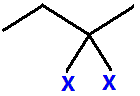 CH3CH2CX2CH3
a double secondary haloalkane?
CH3CH2CX2CH3
a double secondary haloalkane?
2,2-difluorobutane, 2,2-dichlorobutane,
2,2-dibromobutane, 2,2-diiodobutane (2+2)
Number of low resolution
NMR chemical shift
δ
signal peaks: 3 1H
and 4 13C
(email
if disagree?)
1H NMR ratio of peaks: 3 : 2 : 3 (for equivalent protons)
(6)
 CH3CHXCHXCH3
a double secondary haloalkane
CH3CHXCHXCH3
a double secondary haloalkane
2,3-difluorobutane, 2,3-dichlorobutane,
2,3-dibromobutane, 2,3-diiodobutane
These molecules exhibit R/S (optical isomers), pair of
enantiomers based on two equivalent chiral carbon atoms (C2 and C3)
With two equivalent chiral centres, you can have a
configuration with plane of symmetry, so the optical rotations cancel
each other out producing an optically inactive meso isomer.
The configurations of the three isomers are the
optically active (2R, 3R) and (2S, 3S) and the optically inactive
achiral meso forms (2R, 3S) or (2S,3R)
From CIP priority rule for R/S isomer assignment:
ZX > > 6C6C > 6C
> 1H (where X = halogen, and Z = 9, 17, 35 or 53)
Number of low resolution
NMR chemical shift
δ
signal peaks: 2 1H
and 2 13C
(email
if disagree?)
1H NMR ratio of peaks: 6
(3+3) : 2 = 3 : 1 (for equivalent protons)
Constitutional isomers (1) to (6) have a linear carbon chain,
(7) to (9) have a branched carbon chain.
(7)
 (CH3)2CHCHX2
a double primary alkane?
(CH3)2CHCHX2
a double primary alkane?
1,1-difluoro-2-methylpropane,
1,1-dichloro-2-methylpropane, 1,1-dibromo-2-methylpropane,
1,1-diiodo-2-methylpropane.
Number of low resolution
NMR chemical shift
δ
signal peaks: 3 1H
and 3 13C
(email
if disagree?)
1H NMR ratio of peaks: 6
(3+3) : 1 : 1 (for equivalent protons)
(8)
 (CH3)2CXCH2X
a primary and tertiary haloalkane
(CH3)2CXCH2X
a primary and tertiary haloalkane
1,2-difluoro-2-methylpropane,
1,2-dichloro-2-methylpropane, 1,2-dibromo-2-methylpropane,
1,2-diiodo-2-methylpropane
Number of low resolution
NMR chemical shift
δ
signal peaks: 2 1H
and 3 13C
(email
if disagree?)
1H NMR ratio of peaks: 6
(3+3) : 2 = 3 : 1 (for equivalent protons)
(9)
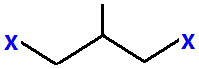 XH2CCH(CH3)CH2X
a double primary haloalkane
XH2CCH(CH3)CH2X
a double primary haloalkane
1,3-difluoro-2-methylpropane,
1,3-dichloro-2-methylpropane, 1,3-dibromo-2-methylpropane,
1,3-diiodo-2-methylpropane
Number of low resolution
NMR chemical shift
δ
signal peaks: 3 1H
and 3 13C
(email
if disagree?)
1H NMR ratio of peaks: 4
(2+2) : 1 : 3 (for equivalent protons)
Note how spectra can be used to distinguish which halogen
compound and which isomer
Summary of the
isomerism for molecular formulae
C4H8F2,
C4H8Cl2,
C4H8Br2
and C4H8I2
These dihalogenated butanes offer examples of
structural and stereoisomeric isomerism.
Since the halogens (Cl, Br, F, I) are all monovalent and
replace hydrogen atoms, the carbon chain backbone remains, both linear and
branched.
Overview of Isomerism Types for molecular formulae
C4H8F2,
C4H8Cl2,
C4H8Br2
and C4H8I2
|
Type
of Isomerism |
Description |
Applies to C4H8X2? |
|
Chain
isomerism |
Variation in
carbon chain branching |
Yes |
|
Positional
isomerism |
Variation in
position of halogen atoms on the chain |
Yes |
|
Geometrical isomerism |
Cis–trans
isomerism around double bonds or restricted rotation |
Not applicable
here |
|
Stereoisomerism (optical) |
Chiral centres
leading to enantiomers |
Yes (in some
cases) |
|
Functional
group isomerism |
Different
functional groups (e.g. alcohol versus ether) |
Not applicable
here |
|
Ring–chain
isomerism |
Open-chain versus
cyclic structures |
Not applicable here |
Structural Isomers (Chain & Positional) for
C4H8F2,
C4H8Cl2,
C4H8Br2
and C4H8I2
These arise from different carbon skeletons and halogen
placements:
1.
Straight-chain versus branched-chain
-
Straight-chain: e.g. 1,2-dichlorobutane,
1,3-dibromobutane
-
Branched-chain: e.g.
1,2-dichloro-2-methylpropane
2.
Positional isomers of halogens
-
Halogens can be on:
-
Adjacent carbons (vicinal): e.g. 1,2-diiodobutane
-
Terminal carbons (geminal): e.g. 1,1-difluorobutane
-
Internal positions: e.g. 2,3-dibromobutane
Stereoisomers (Optical Isomerism)
for
C4H8F2,
C4H8Cl2,
C4H8Br2
and C4H8I2
Chirality arises when a carbon is bonded to four different
groups. Some isomers of C₄H₈X₂ can be chiral:
Example:
2,3-dihalobutane
-
If X = Cl, Br, F, or I, and both halogens are on C2 and C3:
Summary Table of Isomer Types by Example
for
C4H8F2,
C4H8Cl2,
C4H8Br2
and C4H8I2
|
Isomer
Type |
Example (C4H8Cl2) |
Notes |
|
Chain isomerism |
1,2-dichlorobutane
versus 1,2-dichloro-2-methylpropane |
Different carbon
skeletons |
|
Positional
isomerism |
1,2-dichlorobutane
versus 1,3-dichlorobutane |
Same chain,
different halogen positions |
|
Optical isomerism |
(2R,3R)-2,3-dichlorobutane |
Chiral centres →
enantiomers and meso forms |
Selected Uses and Applications of Specific C4H8X2
Isomers
C4H8F2
(Difluorobutanes)
-
1,4-Difluorobutane
• Component in specialist refrigerant blends, valued for low toxicity and
thermal stability.
• Precursor for fluoropolymer side-chains and surface-treatment agents.
-
1,2-Difluorobutane
• Internal standard in ^19F NMR spectroscopy due to well-resolved C–F
signals.
• Building block in medicinal chemistry to enhance metabolic stability and
membrane permeability.
C4H8Cl2
(Dichlorobutanes)
-
1,2-Dichlorobutane
• Industrial intermediate in the manufacture of butadiene rubber and other
chlorinated polymers.
• Solvent for non-polar organic reactions and separation processes.
-
2,3-Dichlorobutane
• Textbook example in stereochemistry courses (meso vs. enantiomeric pairs).
• Chiral building block for synthesis of optically active compounds.
C4H8Br2
(Dibromobutanes)
-
1,2-Dibromobutane
• Widely used reagent in organic synthesis, enabling introduction of bromine
moieties and subsequent functional-group transformations.
• Solvent and intermediate in the production of pharmaceuticals and
agrochemicals.
-
2,3-Dibromobutane
• Classic substrate for teaching optical isomerism and meso-compound
formation.
• Precursor for stereoselective coupling reactions in fine-chemical
synthesis.
C4H8I2
(Diiodobutanes)
-
1,4-Diiodobutane
• Bifunctional linker in macrocyclization and polymer-crosslinking
reactions.
• Intermediate in the synthesis of organoiodine compounds used for specialty
dyes.
-
1,2-Diiodobutane
• Highly reactive diiodide for rapid nucleophilic substitution under mild
conditions.
• Foundation for radiolabeling precursors when using iodine-125 or
iodine-131 isotopes.
Learning objectives - questions to be answered?
How do you draw the structural formula
and skeletal formula of the isomers of molecular formula C4H8Cl2 C4H8Br2 C4H8F2 C4H8I2?
How many aliphatic structural isomers
are there of halogen compounds with molecular formula C4H8Cl2 C4H8Br2 C4H8F2 C4H8I2?
How many aliphatic carbon chain isomers
are there of halogen compounds with molecular formula C4H8Cl2 C4H8Br2 C4H8F2 C4H8I2?
How many positional isomers are there
of organic halogen molecules with molecular formula C4H8Cl2 C4H8Br2 C4H8F2 C4H8I2?
How many E/Z (geometrical) isomers are
there of molecular formula C4H8Cl2 C4H8Br2 C4H8F2 C4H8I2?
How many R/S (optical) isomers
(enantiomers) of molecular formula C4H8Cl2 C4H8Br2 C4H8F2 C4H8I2?
Are there any cyclic haloalkene isomers
of formula C4H8Cl2 C4H8Br2 C4H8F2 C4H8I2?
Are there any cyclo haloalkane isomers
of formula C4H8Cl2 C4H8Br2 C4H8F2 C4H8I2?
Are there any halodiene isomers of
molecular formula C4H8Cl2 C4H8Br2 C4H8F2 C4H8I2?
Are there any haloalkyne isomers of
molecular formula C4H8Cl2 C4H8Br2 C4H8F2 C4H8I2?
Are there any functional group isomers
with a molecular formula C4H8Cl2 C4H8Br2 C4H8F2 C4H8I2?
Do C4H8Cl2 C4H8Br2 C4H8F2 C4H8I2 organic halogen
molecules have any stereoisomers?
Are there any E/Z (geometrical) isomers
with a molecular formula C4H8Cl2 C4H8Br2 C4H8F2 C4H8I2?
Are there any R/S (optical) isomers
(enantiomers) with a molecular formula C4H8Cl2 C4H8Br2 C4H8F2 C4H8I2?
Be able to deduce the isomers of
organic halogen molecules with the formula C4H8Cl2 C4H8Br2 C4H8F2 C4H8I2.
Be able to draw and name the
substituted halogen compounds
isomers of molecular formula C4H8Cl2 C4H8Br2 C4H8F2 C4H8I2.
Be able to deduce if the isomers of
C4H8Cl2 C4H8Br2 C4H8F2 C4H8I2 organic halogen compounds can exhibit R/S optical isomerism.
Be able to deduce if the isomers of
C4H8Cl2 C4H8Br2 C4H8F2 C4H8I2 can exhibit E/Z geometrical isomerism (do C4H8Cl2 C4H8Br2 C4H8F2 C4H8I2 have cis/trans geometric
isomers).
This page
will answer these questions for molecular formula
C4H8F2, C4H8Cl2, C4H8Br2
or C4H8I2
Associated organic chemistry links
Index of sets of isomers for a given
molecular formula
The molecular structure and naming of
HALOALKANES (how
to name and draw alkane structures)
Index of revision notes on the chemistry
HALOALKANES
including reactions
Advanced Level pre-university
organic chemistry notes
IR, mass and H-1 and C-13 NMR
spectra of organic compounds
For isomerism in organic chemistry, see also the
notes
Isomerism: introduction, structural isomerism - chain,
positional, functional group, tautomerism
Stereoisomerism:
introduction, definition,
priority rules, E/Z isomerism (cis/trans isomerism)
Stereoisomerism - R/S isomerism (optical
isomerism) -
definition - examples explained
This is a big chemistry website, please allow time
to explore it
A summary chart of isomerism

|
Website content © Dr
Phil Brown 2000+. All copyrights reserved on revision notes, images,
quizzes, worksheets etc. Copying of Doc Brown's pre-university
advanced level chemistry website material is NOT
permitted. Exam revision summaries & references to science course specifications
are unofficial. These organic chemistry revision notes on
isomerism are
suitable for use of pre-university students studying AQA advanced level
chemistry constitutional isomers of C4H8F2, C4H8Cl2, C4H8Br2 and
C4H8I2:, Edexcel advanced level chemistry constitutional isomers of
C4H8F2, C4H8Cl2, C4H8Br2 and C4H8I2:, OCR advanced level chemistry
constitutional isomers of C4H8F2, C4H8Cl2, C4H8Br2 and C4H8I2:, IB
advanced level chemistry constitutional isomers of C4H8F2, C4H8Cl2,
C4H8Br2 and C4H8I2:, WJEC (Eduqas) advanced level chemistry
constitutional isomers of C4H8F2, C4H8Cl2, C4H8Br2 and C4H8I2:, CIE
Cambridge advanced level chemistry constitutional isomers of C4H8F2,
C4H8Cl2, C4H8Br2 and C4H8I2:, US grade 11-12 AP honors
chemistry courses constitutional isomers of C4H8F2, C4H8Cl2,
C4H8Br2 and C4H8I2: and they will also prove useful to
1st year undergraduate students of chemistry including
constitutional isomers of C4H8F2, C4H8Cl2, C4H8Br2 and C4H8I2:. |
Keywords or phrases:
isomers of halogenoalkanes, how many isomers are
there of halogen compounds of molecular formula C4H8Cl2 C4H8Br2 C4H8F2 C4H8I2? what is the
structure of the halogen compound isomers of molecular formula how do you name the isomers of
molecular formula C4H8Cl2 C4H8Br2 C4H8F2 C4H8I2? what is the molecular structure of the
isomers of C4H8Cl2 C4H8Br2 C4H8F2 C4H8I2, what type of isomerism is exhibited by molecules
of formula C4H8Cl2 C4H8Br2 C4H8F2 C4H8I2, how do you work out the isomers of haloalkanes
formula C4H8Cl2 C4H8Br2 C4H8F2 C4H8I2, what are the structural isomers of C4H8Cl2 C4H8Br2 C4H8F2 C4H8I2, the carbon chain
isomers of C4H8Cl2 C4H8Br2 C4H8F2 C4H8I2 in the homologous series of alkanes, comparing
the many structural isomers does C4H8Cl2 C4H8Br2 C4H8F2 C4H8I2 have?
what are the possible isomers of C4H8Cl2 C4H8Br2 C4H8F2 C4H8I2? revision notes on
isomerism of C4H8Cl2 C4H8Br2 C4H8F2 C4H8I2 molecules, the molecular structure of
the isomers of C4H8Cl2 C4H8Br2 C4H8F2 C4H8I2 how to draw the
structural formula of isomers of C4H8Cl2 C4H8Br2 C4H8F2 C4H8I2, how to draw the displayed
formula of isomers of C4H8Cl2 C4H8Br2 C4H8F2 C4H8I2, how to draw the skeletal formula of
halogenoalkane compound isomers of formula C4H8Cl2 C4H8Br2 C4H8F2 C4H8I2, how to name the isomers of molecular formula C4H8Cl2 C4H8Br2 C4H8F2 C4H8I2, R/S optical isomers
enantiomers of C4H8Cl2 C4H8Br2 C4H8F2 C4H8I2 isomeric with molecular formula C4H8Cl2 C4H8Br2 C4H8F2 C4H8I2, structural isomers of molecular
formula C4H8Cl2 C4H8Br2 C4H8F2 C4H8I2, optical isomers R/S enantiomers isomeric with molecular
formula C4H8Cl2 C4H8Br2 C4H8F2 C4H8I2, positional isomers isomeric with halocycloalkenes,
haloalkanes, haloalkynes, haloalkenes of molecular formula C4H8Cl2 C4H8Br2 C4H8F2 C4H8I2,
which types of isomerism are exhibited by molecules of formula
C4H8Cl2 C4H8Br2 C4H8F2 C4H8I2 alkyl positional isomers of C4H8Cl2 C4H8Br2 C4H8F2 C4H8I2 branched carbon chain
isomers of C4H8Cl2 C4H8Br2 C4H8F2 C4H8I2,
stereoisomers of molecular formula C4H8Cl2 C4H8Br2 C4H8F2 C4H8I2,
optical isomers R/S enantiomers isomeric with molecular
formula C4H8Cl2 C4H8Br2 C4H8F2 C4H8I2, positional isomers isomeric with molecular formula C4H8Cl2 C4H8Br2 C4H8F2 C4H8I2,
which types of isomerism are exhibited by C4H8Cl2 C4H8Br2 C4H8F2 C4H8I2 halogen atom positional isomers of C4H8Cl2 C4H8Br2 C4H8F2 C4H8I2,
how to work out the halogen compound names of isomers of C4H8Cl2 C4H8Br2 C4H8F2 C4H8I2,
haloalkene C4H8Cl2 C4H8Br2 C4H8F2 C4H8I2 isomers, cycloalkane isomers of C4H8Cl2 C4H8Br2 C4H8F2 C4H8I2, cycloalkene
isomers of C4H8Cl2 C4H8Br2 C4H8F2 C4H8I2
How to deduce the isomers of
organic halogen molecules with the formula C4H8Cl2 C4H8Br2 C4H8F2 C4H8I2, How to write, draw and name the
substituted halogen compounds
isomers of molecular formula C4H8Cl2 C4H8Br2 C4H8F2 C4H8I2,
How to deduce if the isomers of
C4H8Cl2 C4H8Br2 C4H8F2 C4H8I2 organic halogen compounds can exhibit R/S optical isomerism, How to deduce if the isomers of
C4H8Cl2 C4H8Br2 C4H8F2 C4H8I2 can exhibit E/Z geometrical isomerism (do C4H8Cl2 C4H8Br2 C4H8F2 C4H8I2 have cis/trans geometric
isomers?), number of structural isomers of C4H8Cl2 C4H8Br2 C4H8F2 C4H8I2, number of
stereoisomers of C4H8Cl2 C4H8Br2 C4H8F2 C4H8I2
|
