|
Doc Brown's
Advanced Chemistry: Part 14.7:
Isomers and extra notes on their properties and uses
The
3 constitutional-structural
chain and functional group isomers of molecular formula C3H8O
[Author
©
Dr
Phil Brown GRIC, PhD:
Doc Brown's advanced level organic chemistry exam revision notes
suitable for students of UK A level chemistry courses, IB advanced
chemistry and US K12 grade
11, grade 12 and AP honors chemistry courses: Molecular
spectroscopy and analysing the isomers of C3H8O
[updated
RE-EDIT]
Sub-index for
this page on the isomers of C3H8O
(a)
Introduction to the isomers of molecular formula C3H8O
(b)
Details of the 3 constitutional structural
isomers of molecular formula C3H8O
(c)
Extra comments on the
isomers of C3H8O including uses and IR spectroscopy
comments
(d)
Practice exam questions based on
the isomers of C3H8O
email doc
brown - comments - query?
*
[privacy policy, cookies and
disclaimer]
Associated organic chemistry page links
Index of sets of isomers for a given
molecular formula
This is a big chemistry website, please allow time
to explore it
(a)
Introduction to the 3 aliphatic
non-cyclic alcohols and ether constitutional structural isomers of molecular formula C3H8O
(see also summary
diagram)
Percent mass composition of
C3H8O based on
the relative atomic masses
C= 12.01 H =
1.01 O = 16.00 and Mr(C3H8O) =
60.11
Element composition by mass: 59.94% carbon *
13.44%
hydrogen * 26.62% oxygen
Empirical formula =
molecular formula =
C3H8O
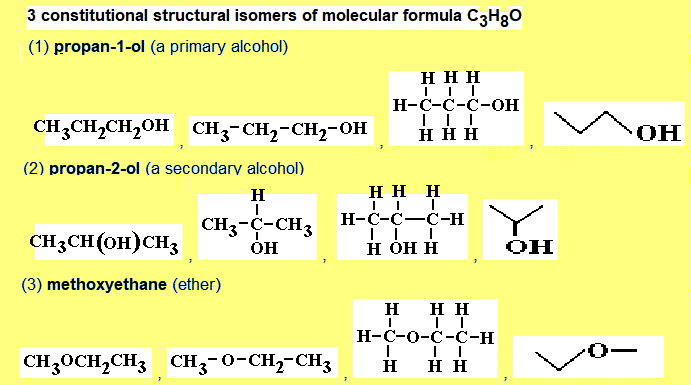
Structural isomerism
- isomers based on different connectivity's of the constituent atoms, so cannot
be spatially identical (but can be defined as having the same shape).
This includes (a) carbon chain variation (usually need a minimum of
4 atoms),
(b) change in position of a substituent or functional group and (c) functional group
isomerism where the atoms have a different connectivity configuration, usually with
significant differences in chemical and physical properties.
(a) applies in the sense of isomeric chains e.g. C-C-C-O
or C-C-O-C
(b) positional structural isomerism applies here for different positions of the OH
group,
(c) functional group isomerism applies here for alcohols versus an ether.
Stereoisomerism - isomers
based on the same connectivity of the atoms, but 2D or 3D spatially different,
non-superimposable images (e.g. E/Z isomers or mirror image R/S optical isomers)
This is
where molecules have the same basic constitutional structural formula, but
isomers differ in the 2D/3D arrangement of the atoms. NOT possible for
molecules of molecular formula
C3H8O
Note
This is an example of functional group
isomerism (alcohol C-O-H linkage, ether C-O-C linkage)
There are two isomeric alcohols and one isomeric
ether.
So there are only 3
constitutional isomers and so only 3 distinct isomers of molecular
formula
C3H8O
since there are no stereoisomers - stereoisomerism is not possible for isomers
of
C3H8O.
(b)
Details of the 3 constitutional structural
isomers of molecular formula C3H8O
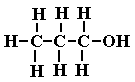
(1) Propan-1-ol (a primary alcohol)
 ,
,
 ,
,
 ,
,

Number of low resolution
NMR chemical shift
δ
signal peaks: 4 1H
and 3 13C
(email
if disagree?)
1H NMR ratio of peaks: 3 : 2 : 2 : 1 (for equivalent protons)
Comparison of prominent wavenumber absorptions in
the infrared spectra of C3H8O isomers.
The infrared spectrum of Propan-1-ol (1-propanol,
n-propyl alcohol)
The mass spectrum of Propan-1-ol (1-propanol,
n-propyl alcohol)
The H-1 NMR spectrum of Propan-1-ol (1-propanol,
n-propyl alcohol)
The C-13 NMR spectrum
of Propan-2-ol (2-propanol,
isopropyl alcohol)
(2)
Propan-2-ol (a secondary alcohol)
 ,
,
 ,
,
 , ,

Number of low resolution
NMR chemical shift
δ
signal peaks: 3 1H
and 2 13C
(email
if disagree?)
1H NMR ratio of peaks: 6 : 1 : 1 (for equivalent protons),
symmetry leads to fewer peaks.
Comparison of prominent wavenumber absorptions in the infrared spectra of C3H8O
isomers.
The infrared spectrum of Propan-2-ol (2-propanol,
isopropyl alcohol)
The mass spectrum of Propan-2-ol (2-propanol,
isopropyl alcohol)
The H-1 NMR spectrum of Propan-2-ol (2-propanol,
isopropyl alcohol)
The C-13 NMR spectrum
of Propan-2-ol (2-propanol,
isopropyl alcohol)
(3)
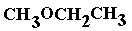
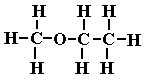
methoxyethane
(an ether)
 ,
,
 ,
,
 , ,

Number of low resolution
NMR chemical shift
δ
signal peaks: 3 1H
and 3 13C
(email
if disagree?)
1H NMR ratio of peaks: 3 : 2 : 3 (for equivalent protons)
Comparison of prominent wavenumber absorptions in the infrared spectra of C3H8O
isomers.
The
infrared spectrum of methoxyethane
The mass
spectrum of methoxyethane
The H-1
NMR spectrum of methoxyethane
The
C-13 NMR spectrum of methoxyethane
(c) Extra comments on the
isomers of C3H8O
Examples of the
difference in physical and chemical properties of the isomers of C3H8O and
their applications and uses - the latter greatly influenced by the different
isomeric molecular structures
A rich topic with excellent scope for comparative tables,
misconception-busting, and exam-relevant insights. The molecular formula
C3H8O corresponds to several organic isomers, each
exhibiting different types of isomerism, physical
properties, chemical reactivity, and
applications. Here's a structured breakdown:
Types of Isomerism in C3H8O
|
Isomer
Name |
Structure |
Type
of Isomerism |
Functional Group |
|
Propan-1-ol |
CH3CH2CH2OH |
Position isomerism
(OH on C1) |
Alcohol |
|
Propan-2-ol |
CH3CHOHCH3 |
Position isomerism
(OH on C2) |
Alcohol |
|
Methoxyethane |
CH3CH2OCH3 |
Functional group
isomerism (ether versus alcohol) |
Ether |
Isomerism Types Explained
-
Functional Group Isomerism: Alcohols versus
ethers — same molecular formula, different functional groups.
-
Position Isomerism: Same functional group
(OH), but different position on the carbon chain.
Physical Properties
Comparison for the isomers of C3H8O
|
Isomer |
Boiling Point |
Solubility in Water |
Volatility |
Reasoning |
|
Propan-1-ol |
97°C |
High |
Low |
Strong H-bonding,
OH at end |
|
Propan-2-ol |
82°C |
High |
Moderate |
Slightly less
H-bonding due to branching |
|
Methoxyethane |
7°C |
Low |
High |
No OH group, weak
dipole interactions |
Exam Tip: Alcohols have higher boiling
points than ethers due to hydrogen bonding. Don't confuse dipole-dipole
interactions with H-bonding strength.
Chemical Reactivity Comparison
for the isomers of C3H8O
|
Isomer |
Reactivity |
Typical Reactions |
Notes |
|
Propan-1-ol |
Higher |
Oxidation →
propanal
→
propanoic acid |
Primary alcohol |
|
Propan-2-ol |
Moderate |
Oxidation →
propanone
→ difficult, C-C cleavage |
Secondary alcohol |
|
Methoxyethane |
Lower |
Generally inert,
can undergo cleavage with HI |
Ether, lacks OH
group |
Misconception Alert: Students often
assume all C3H8O isomers undergo oxidation to acids or ketones. Ethers
do not oxidize easily and lack the OH group.
Uses and Applications
of
the isomers of C3H8O
|
Isomer |
Uses |
Why? |
|
Propan-1-ol |
Solvent,
antiseptic, intermediate in synthesis, propyl esters |
Polar, miscible
with water |
|
Propan-2-ol |
Rubbing alcohol,
disinfectant, lab solvent, isopropyl esters |
Volatile,
effective antiseptic |
|
Methoxyethane |
Solvent in organic
synthesis |
Non-polar, low
boiling point |
Revision Tip: Link structure to use —
e.g., propan-2-ol is preferred in antiseptics due to
volatility and moderate polarity.
Common Misconceptions
about
the isomers of C3H8O
|
Misconception |
Clarification |
|
All C3H8O isomers
are alcohols |
Methoxyethane is
an ether |
|
Boiling point
depends only on molecular mass |
H-bonding plays a
dominant role |
|
All alcohols
oxidize to acids |
Only
primary alcohols do; secondary → ketones |
|
Ethers are always
inert |
They can react
with strong acids like HI |
Exam Revision Tips
for questions that may involve
the isomers of C3H8O
-
Draw and label all isomers clearly, showing
functional groups.
-
Compare boiling points using H-bonding
versus
dipole interactions.
-
Practice oxidation reactions: distinguish
primary versus secondary alcohols.
-
Use mnemonics: e.g., “1-ol → acid, 2-ol →
ketone, ether → inert”.
-
Include IR/NMR clues: OH stretch in IR
(~3300 cm⁻¹), not present in ethers
Comparative infrared spectra wavenumbers for C3H8O
Isomers
|
Isomer |
Key IR
Absorptions (cm⁻¹) |
Functional
Group Clues |
Fingerprint
Region (1500–500 cm⁻¹) |
|
Propan-1-ol |
- Broad O–H
stretch: ~3500–3200 (due to H-bonding)
- C–H stretch: ~2950
- C–O stretch: ~1050–1150 |
Primary alcohol — strong
H-bonding broad OH peak |
Unique overlapping
vibrations |
|
Propan-2-ol |
- Broad O–H
stretch: ~3400
- C–H stretch: ~2950
- C–O stretch: ~1050–1150 |
Secondary alcohol —
similar OH peak, slightly shifted |
Distinct from propan-1-ol |
|
Methoxyethane |
- No O–H stretch
- C–H stretch: ~2950
- C–O–C stretch: ~1100–1000 |
Ether — absence of OH peak
is diagnostic |
Unique ether fingerprint |
Key Differences and Diagnostic
Features for the infrared spectra of
the isomers of C3H8O
Presence or Absence of O–H Stretch
C–O Stretching
Fingerprint Region
Exam Tips
for questions that may involve the infrared spectra of
the isomers of C3H8O
-
Always check for the O–H stretch: its
presence, shape, and breadth are key to identifying alcohols.
-
Fingerprint region is often overlooked —
but it’s essential for distinguishing positional isomers.
-
Don't confuse C–O stretches in alcohols
and ethers — context matters.
-
Use IR alongside mass/NMR for full
structural confirmation in exam questions (links
details for each isomer).
|
(d) Practise exam questions
based on isomers of molecular formula C3H8O
Jot
down your responses and check out the answers
ANSWERS
to the questions based on the isomers of
C3H8O
If you think there are
any errors, please email me asap at
chem55555@hotmail.com
I don't mind if students/teachers do a selected printout
of these questions and answers.
Given the structural formulae of the three aliphatic
isomers of molecular formula
A CH3CH2CH2OH,
B CH3CH(OH)CH3,
C CH3OCH2CH3
Q1 Name them
with a correct IUPAC name and classify their functional
group.
Q2 Do any of
the isomers of C3H8O exhibit stereoisomerism?
Q3 (a) Which
can be readily oxidised to a ketone, but not a carboxylic
acid?
(b) Which
cannot form esters on reaction with a carboxylic acid?
(c) Which can
be readily oxidised to an aldehyde and carboxylic acid?
Q4 (a) Which
isomer will give four principal 1H NMR signals?
(b) Which
isomer will give only two principal 13C NMR
signals?
Q5 (a) Suggest
some functional groups in isomers of molecular formula C3H6O
which do NOT occur in isomers of C3H8O
(b) Which
functional groups can be common to both sets of isomers?
Q6
You are given
the infrared spectrum, mass spectrum, 1H NMR spectrum and
13C NMR
spectrum for an unknown molecule and one additional clue to deduce the identity
and molecular structure of the molecule. (These spectra
questions are on
two separate pages)
6a
Spectra question 02 Four spectra of molecule 02, empirical
formula C3H8O *
ANSWER
6b
Spectra question 06 Four spectra of molecule 06, empirical
formula C3H8O *
ANSWER
ANSWERS
to the questions based on the isomers of
C3H8O
If you think there are
any errors, please email me asap at
chem55555@hotmail.com
I don't mind if students/teachers do a selected printout
of these questions and answers.
|
Associated organic chemistry links
See also
Examples of the effects of isomerism on the similarity or difference
in the physical and chemical properties of structural isomers
Advanced Level pre-university
organic chemistry notes
IR, mass and H-1 & C-13 NMR
spectra of organic compounds
Comparison of the ir,
mass, 1H and 13C NMR spectra of the isomers of C4H10O
(via a 1H NMR
spectrum page)
Index of sets of isomers for a given
molecular formula
The molecular structure and naming of aliphatic ALCOHOLS including isomeric ethers
INDEX of ALL revision notes on the chemistry of ALCOHOLS (and mention of ethers)
Isomerism: introduction, structural isomerism - chain,
positional, functional group, tautomerism
Stereoisomerism:
introduction, definition,
priority rules, E/Z isomerism (cis/trans isomerism)
Stereoisomerism - R/S isomerism (optical
isomerism) -
definition - examples explained
This is a big chemistry website, please allow time
to explore it
Index of my advanced
(pre-college/university) organic
chemistry revision notes
Index
of all my spectroscopy pages
Index
of all my isomerism pages
The chemistry of
alkanes and the petrochemical
industry
The
chemistry of alkenes
The
chemistry of haloalkanes
The
chemistry of
alcohols
The chemistry of aldehydes
and ketones
The
chemistry of carboxylic acids and derivatives
The chemistry of organo-nitrogen compounds
The chemistry of
aromatic compounds
A summary diagram of isomerism

|
Website
content © Dr Phil Brown 2000+. All copyrights reserved on Doc
Brown's Chemistry revision notes, images, quizzes, worksheets etc.
Copying of website material is NOT permitted. Advanced
level pre-university/college organic chemistry
revision notes
The isomerism of molecular formula C3H8O.
All
suitable for
chemistry students taking the WJEC advanced A level chemistry, CCEA
advanced A level chemistry, Cambridge CIE advanced A level chemistry, AQA
advanced A level chemistry, Edexcel advanced A level chemistry, OCR
advanced A level chemistry, Salters advanced A level chemistry, IB
advanced level chemistry, US grade 11-12 K12 AP Honors chemistry courses |
Keywords or phrases: how many isomers are
there of molecular formula C3H8O? how do you name the isomers of
molecular formula C3H8O? what is the molecular structure of the
isomers of C3H8O, what type of isomerism is exhibited by molecules
of formula C3H8O, how do you work out the isomers of molecular
formula C3H8O, what are the structural isomers of C3H8O, the carbon chain
isomers of C3H8O in the homologous series of alkanes, comparing
the spectra of isomers of molecular formula C3H8O how many structural isomers of
C3H8O can you draw? how many structural isomers does C3H8O have?
what are the possible isomers of C3H8O? revision notes on
isomerism of C3H8O molecules, isomerism in
aliphatic alcohols, isomerism in aliphatic ethers, alcohol
isomers of C3H8O, ether isomers of C3H8O the molecular structure
of the isomers of C3H8O,
isomers of C3H8O of molecular mass 60
|
ANSWERS
Practise exam questions
based on isomers of molecular formula C3H8O
If you think there are
any errors, please email me asap at
chem55555@hotmail.com
I don't mind if students/teachers do a selected printout
of these questions and answers.
Given the structural formulae of the three aliphatic
isomers of molecular formula
A CH3CH2CH2OH,
B CH3CH(OH)CH3,
C CH3OCH2CH3
Q1 Name them
with a correct IUPAC name and classify their functional
group.
ANSWERS
A
propan-1-ol, primary alcohol,
B
propan-2-ol, secondary alcohol,
C
methoxyethane, ether
Q2 Do any of
the isomers of C3H8O exhibit stereoisomerism?
ANSWER:
NO,
no >C=C< bond, so no possibility of E/Z 'optical' isomerism
and no chiral 'asymmetric' carbon atom attached to four
different atoms/groups, so no R/S 'optical' isomerism
possible.
Q3 (a) Which
can be readily oxidised to a ketone, but not a carboxylic
acid?
(b) Which
cannot form esters on reaction with a carboxylic acid?
(c) Which can
be readily oxidised to an aldehyde and carboxylic acid?
ANSWERS
(a) B
CH3CH(OH)CH3 +
[O] ===>
CH3COCH3 + H2O
secondary alcohols readily oxidise to ketones, propanone
in this case
(b) C
is an ether with no hydroxyl group, unlike alcohols cannot
be esterified.
(c) A
CH3CH2CH2OH
+ [O] ===>
CH3CH2CHO + H2O
primary alcohols readily oxidise to aldehydes and onto
carboxylic acids
CH3CH2CHO
+ 2[O] ===>
CH3CH2COOH + H2O
and aldehydes readily oxidise to carboxylic acids.
Q4 (a) Which
isomer will give four principal 1H NMR signals?
(b) Which
isomer will give only two principal 13C NMR
signals?
ANSWERS
(a)
A
CH3CH2CH2OH,
B and C give three principal 1H NMR signals
(b)
B,
CH3CH(OH)CH3,
the less symmetrical A and C both give three principal
1H NMR signals
Q5 (a) Suggest
some functional groups in isomers of molecular formula C3H6O
which do NOT occur in isomers of C3H8O
(b) Which
functional groups can be common to both sets of isomers?
ANSWERS
(a) >C=C<
and >C=O
e.g. for C3H6O, H2C=CHCH2OH
(2 others too), CH3CH2CHO (and
propanone), unsaturated compounds not allowed with C3H8O.
Also, C3H6O isomers can have cyclic
structures including cyclopropanol and epoxypropane.
(b) hydroxy -OH in saturated alcohols and unsaturated
alcohols (e.g. above), ether C-O-C in saturated ethers
(methoxyethane) and unsaturated ethers e.g. H2C=CHOCH3
(methoxyethene)
For more details see
Isomers of molecular formula
C3H6O
(Mr = 58)
|
|
