|
Doc Brown's
Advanced Chemistry: Part 14.7:
Isomers and extra notes on their properties and uses
The
constitutional-structural isomers of molecular formula C2H6O
[Author
©
Dr
Phil Brown GRIC, PhD:
Doc Brown's advanced level organic chemistry exam revision notes
suitable for students of UK A level chemistry courses,
IB advanced chemistry & US K12 grade
11, grade 12 and AP honors chemistry courses: Molecular
spectroscopy and analysing the isomers of C2H6O
[isomerism page updated
RE-EDIT]
Sub-index
for this page on the isomers of molecular formula C2H6O
(1)
Introduction to the isomers of C2H6O
(2)
Details of the isomers of C2H6O
(3)
Key points and extra information about the isomers of
C2H6O
(4)
Learning objectives related to the isomers of C2H6O
(5)
Practise exam questions based on the isomers of
C2H6O
email doc
brown - comments - query?
[privacy policy,
cookies and disclaimer]
Associated organic chemistry page links
Index of sets of isomers for a given
molecular formula
This is a big chemistry website, please allow time
to explore it
(1)
Introduction and details of the 2 constitutional isomers of C2H6O
The 2
aliphatic
non-cyclic alcohol and ether structural isomers of molecular formula
C2H6O
(Mr = 46)
Percent composition by mass based on atomic masses C = 12.01 H =
1.01 O = 16.00, Mr(C2H6O) = 46.08
Element composition (to two dp): carbon = 52.13%
hydrogen = 13.15% oxygen = 34.72%
Empirical
formula = molecular formula = C2H6O
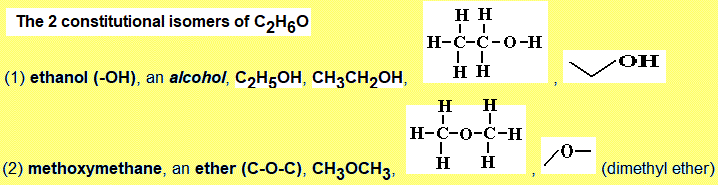
Structural isomerism
- isomers based on different connectivity's of the constituent atoms, so cannot
be spatially identical (but can be defined as having the same shape).
This includes (a) carbon chain variation (usually need a minimum of 4 C atoms),
(b) change in position of a substituent or functional group and (c) functional group
isomerism where the atoms have a different connectivity configuration, usually with
significant differences in chemical and physical properties.
In terms of isomers of
C2H6O
there are
(a) chain variations based on the C and O atoms, which
leads to
(c) functional group isomers of an alcohol and an ether.
Stereoisomerism - isomers
based on the same connectivity of the atoms, but 2D or 3D spatially different,
non-superimposable images (e.g. E/Z isomers or mirror image R/S optical isomers)
This is
where molecules have the same basic constitutional structural formula, but
isomers differ in the 2D/3D arrangement of the atoms. NOT possible for
C2H6O
(2)
Details of the 2 constitutional isomers of
C2H6O
There are only two
constitutional structural isomers of molecular formula C2H6O.
This is an example of functional group
isomerism (alcohol C-O-H linkage, ether C-O-C linkage).
There is one isomeric alcohol
(C-OH
group) and one isomeric
ether (C-O-C link) and no other isomerism is possible for
C2H6O i.e.
no E/Z
or R/S stereoisomerism is possible.
(1) ethanol
(-OH), an
alcohol,
C2H5OH,
CH3CH2OH,
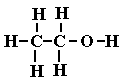 , ,

Abbreviated structural
formulae, displayed formula and skeletal formula, old name ethyl alcohol
Functional group primary
alcohol
C-OH (hydroxyl group).
Functional group isomer
(alcohol versus ether).
Number of low resolution
NMR
chemical shift
δ
signal peaks: 3
1H and
2 13C
(email
if disagree?)
1H NMR integrated proton ratio of the
principal signal peaks: 3 : 2 : 1 (for equivalent protons)
See also
Comparing the infrared spectra of ethanol and
methoxymethane (dimethyl ether)
The maximum possible 1H or 13C NMR chemical shift peaks
for this isomer, due to the minimum molecular symmetry of ethanol, all
the protons and carbon atoms exist in chemical environments.
Adding D2O will not change the 13C NMR
spectrum but the O-H proton shift will be removed (for more details see
1H NMR ethanol link below).
The infrared spectrum of Ethanol (ethyl alcohol)
The mass spectrum of Ethanol (ethyl alcohol)
The H-1 NMR spectrum of
Ethanol (ethyl alcohol)
The C-13 NMR spectrum Ethanol (ethyl alcohol)
(2) methoxymethane, an
ether (C-O-C), CH3OCH3,
 , ,
 (dimethyl ether)
Functional group
ether C-O-C.
Functional group
isomer (alcohol versus ether).
Abbreviated
structural formula, displayed formula and skeletal formula.
Number of low resolution
NMR
chemical shift
δ
signal peaks: 1
1H and
1 13C
Only one 1H or 13C NMR chemical shift possible for this
isomer, due to the maximum molecular symmetry of methoxymethane, only
one chemical environment possible for the protons or carbon atoms.
Adding D2O will not change either spectrum.
See also
Comparing the infrared spectra of ethanol and
methoxymethane (dimethyl ether)
The
infrared spectrum of methoxyethane
The mass
spectrum of methoxyethane
The H-1
NMR spectrum of methoxyethane
The
C-13 NMR spectrum of methoxyethane
No other forms of isomerism are possible and
this is quite a simple case of functional group isomerism by simply altering the
order of the carbon and oxygen atoms.
(3)
Summary of key points and extra notes on the isomers of molecular
formula
C2H6O
The molecular formula C2H6O lends
itself beautifully to exploring several types of isomerism, perfect for
highlighting how even the smallest changes in atomic arrangement can lead to
substantial differences in properties and function.
Comparing the
infrared spectra of ethanol and methoxymethane (dimethyl
ether)
Ethanol and dimethyl ether (methoxymethane) are structural
isomers with the same molecular formula (C2H6O), but
their infrared (IR) spectra differ significantly due to their distinct
functional groups: ethanol is an alcohol, while dimethyl ether is an ether.
Here's a comparative breakdown of their infrared spectra:
Functional Group Differences between ethanol and methoxymethane
|
Feature |
Ethanol
(CH3CH2OH) |
Methoxymethane (Dimethyl Ether) (CH3OCH3) |
|
Functional
group |
Hydroxyl (-OH) |
Ether (-O-) |
|
Hydrogen
bonding |
Present
(intermolecular) |
Absent |
|
Molecular
polarity |
Higher |
Lower |
Key IR
Absorption Bands for ethanol and methoxymethane
|
Vibrational Mode |
Ethanol
(Alcohol) |
Methoxymethane (Dimethyl
Ether) |
|
O–H Stretch |
Broad band at
~3300–3500 cm⁻¹ (strong) |
Absent |
|
C–H Stretch
(alkyl) |
~2850–2970
cm⁻¹ (medium) |
~2850–2970
cm⁻¹ (medium) |
|
C–O Stretch |
~1050–1150
cm⁻¹ (strong) |
~1000–1100
cm⁻¹ (strong) |
|
O–H Bend |
~1400–1440
cm⁻¹ (medium) |
Absent |
|
CH₃
Rocking/Bending |
~1350–1470
cm⁻¹ |
~1350–1470
cm⁻¹ |
|
Fingerprint
Region |
Complex, with
broad O–H contributions |
Simpler,
sharper ether bands |
Sources:
NIST WebBook for Dimethyl Ether,
Infrared Intensities of Alcohols and Ethers – Rogers, 1980
Interpretation Highlights of the infrared spectra ethanol and methoxymethane
-
Ethanol’s broad O–H stretch is a hallmark
of hydrogen bonding and is absent in dimethyl ether.
-
Dimethyl ether’s spectrum lacks the broad
hydrogen-bonding features and shows sharper C–O stretches due to its
symmetrical ether structure.
-
The C–O stretching region overlaps in both
but differs in intensity and exact position due to the bonding environment.
Types
of Isomerism for molecular formula C2H6O
|
Isomer Type |
Isomers |
Structural
Difference |
Description |
|
Functional group
constitutional
(structural) functional group isomers |
Ethanol versus Dimethyl
ether |
Alcohol (C-OH) versus
Ether (C-O-C) |
Different functional
groups entirely |
|
Same as above |
Connectivity of atoms
differs |
All functional group
isomers are structural isomers |
|
Stereoisomerism |
Not applicable here |
No chiral centres or
double bonds |
Stereoisomerism requires
additional complexity |
Differences in Physical Properties
of the isomers of molecular formula
C2H6O
|
Property |
Ethanol
(CH3CH2OH) |
Methoxymethane
(dimethyl ether)
(CH3OCH3) |
Reason |
|
Boiling point |
78 °C |
-24 °C |
London + polar + hydrogen bonding versus
weaker Van der Waals forces only |
|
Solubility in
water |
Very soluble |
Moderately soluble |
Ethanol forms hydrogen
bonds with water |
|
State at room temp |
Liquid |
Gas |
Due to differences in intermolecular
bonding forces |
|
Smell |
Characteristic alcoholic
scent |
Ether-like, slightly sweet |
Functional group dependent |
Differences in Chemical Properties
of the isomers of molecular formula
C2H6O
|
Reaction Type |
Ethanol |
Methoxymethane (dimethyl
ether) |
|
Combustion |
Combusts to
CO2 + H2O |
Same general
combustion |
|
Oxidation |
Oxidizes to
ethanal → ethanoic acid |
Not readily
oxidized under same conditions |
|
Reaction with Na |
Produces H2
(typical of alcohols) |
No reaction |
|
Acid/base behaviour |
Weak acid (can
donate H⁺ from OH) |
No protic
hydrogen; behaves neutral |
|
Reaction with carboxylic
acids |
Forms ethyl esters with acid
catalyst |
No reaction |
Uses
and Applications
of the isomers of molecular formula
C2H6O
|
Compound |
Uses |
|
Ethanol |
Antiseptic,
solvent, fuel, alcoholic beverages, intermediate in organic
synthesis |
|
Dimethyl ether |
Propellant in
aerosols, refrigerant, potential clean fuel alternative |
Common
Misconceptions
about the isomers of molecular formula
C2H6O
-
“Same formula means same properties”:
Molecular formula alone doesn't dictate behavior—structure is everything!
-
“Only one kind of isomerism possible”:
Students often overlook conformational isomerism and think only functional
group isomerism matters.
-
“Both are alcohols”: Dimethyl ether is not
an alcohol despite having an oxygen; it lacks the hydroxyl (-OH) group.
Exam
Tips for questions involving
the isomers of molecular formula
C2H6O
-
Always draw structures when asked about isomerism—words
alone might lose marks.
-
Clearly differentiate between structural and functional
group isomerism; they often overlap but are assessed separately.
-
Link differences in boiling point and solubility to
intermolecular forces (Hydrogen bonding versus Dipole-induced dipole).
-
Quote examples of reactions (e.g., ethanol + sodium) to
demonstrate chemical differences.
-
Check if the question hints at "physical
and
chemical properties”—both must be addressed!
(4)
Learning objectives - questions to be answered?
Can you IUPAC name these isomers
of molecular formula
C2H6O?
Can you deduce the number of principal 1H chemical
shifts and proton ratio you would expect to see in the NMR spectrum of
these
C2H6O isomers?
Can you deduce the number of principal 13C chemical
shifts you would expect to see in the NMR spectrum of these
C2H6O
isomers?
How do you work out the structure
of the isomers of molecular formula C2H6O?
How do you draw the structural
formula and skeletal formula of the isomers of molecular formula
C2H6O?
How do you name the isomers of molecular formula
C2H6O?
How many aliphatic structural
isomers are there of molecular formula C2H6O?
How many aliphatic carbon chain
isomers are there of molecular formula C2H6O?
How many positional isomers are
there of molecular formula C2H6O?
How many E/Z (geometrical) isomers
are there of molecular formula C2H6O?
How many R/S (optical) isomers
(enantiomers) of molecular formula C2H6O?
Are there any functional group
isomers with a molecular formula C2H6O?
Does C2H6O have any stereoisomers?
Are there any E/Z (geometrical)
isomers with a molecular formula C2H6O?
Are there any R/S (optical) isomers
(enantiomers) with a molecular formula C2H6O?
This page will answer these questions for molecular formula C2H6O
QUESTIONS
|
Practise exam questions
based on isomers of molecular formula
the isomers of C2H6O
Jot
down your responses
with explanations!
ANSWERS
to the questions based on the isomers of
C2H6O
If you think there are
any errors, please email me asap at
chem55555@hotmail.com
I don't mind if students/teachers do a selected printout
of these questions and answers.
Q1 How many isomers have a molecular formula of
C2H6O? and can you name them and
draw their skeletal formula?
Q2 Do the isomers of
C2H6O have
similar boiling points?
Q3
Can some of the structural isomers of
C2H6O exhibit R/S optical
stereoisomerism
Q4
Is the empirical formula for all isomers of
C2H6O
the same as the molecular formula?
Q5 How many 1H and
13C NMR chemical shifts would you expect for the isomers of
C2H6O?
Q6
Which, if any, isomers can yield an ester on reaction with a
carboxylic acid?
Q7
What would you expect to see the biggest difference in the
infrared spectra of the isomers of
C2H6O?
If you think there are
any errors, please email me asap at
chem55555@hotmail.com
ANSWERS
to the questions based on the isomers of
C2H6O
|
Associated organic chemistry links
Advanced Level pre-university
organic chemistry notes
IR, mass and H-1 & C-13 NMR
spectra of organic compounds
Index of sets of isomers for a given
molecular formula
M olecular structure and naming of aliphatic ALCOHOLS including isomeric ethers
Examples of effects of isomerism on similarity or difference in the
physical & chemical properties of structural isomers
Comparison of the ir,
mass, 1H and 13C NMR spectra of the isomers of C2H6O
(via a 1H NMR
spectrum page)
INDEX of ALL revision notes on the chemistry of ALCOHOLS (and mention of ethers)
Isomerism: introduction, structural isomerism - chain,
positional, functional group, tautomerism
Stereoisomerism:
introduction, definition,
priority rules, E/Z isomerism (cis/trans isomerism)
Stereoisomerism - R/S isomerism (optical
isomerism) -
definition - examples explained This is a big chemistry website, please allow time
to explore it
email doc
brown - comments - query?
Index of my advanced
(pre-college/university) organic
chemistry revision notes
Index
of all my spectroscopy pages
Index
of all my isomerism pages
The chemistry of
alkanes and the petrochemical
industry
The
chemistry of alkenes
The
chemistry of haloalkanes
The
chemistry of
alcohols
The chemistry of
aldehydes
and ketones The
chemistry of carboxylic acids and derivatives The chemistry of
organo-nitrogen compounds
The chemistry of
aromatic compounds

Keywords or phrases: how many isomers are
there of molecular formula C2H6O? how do you name the isomers of
molecular formula C2H6O? what is the molecular structure of the
isomers of C2H6O, what type of isomerism is exhibited by molecules
of formula C2H6O, how do you work out the isomers of molecular
formula C2H6O, what are the structural isomers of C2H6O, the carbon chain
isomers of C2H6O in the homologous series of alkanes, comparing
the spectra of isomers of molecular formula C2H6O how many structural isomers of
C2H6O can you draw? how many structural isomers does C2H6O have?
what are the possible isomers of C2H6O? revision notes on
isomerism of C2H6O molecules, isomerism in
aliphatic alcohols, isomerism in aliphatic ethers, alcohol
isomers of C2H6O, ether isomers of C2H6O the molecular structure
of the isomers of C2H6O,
isomers of C2H6O of molecular mass 46 ethers alcohols molecules
isomeric with molecular formula C2H6O, structural isomers of
molecular formula C2H6O, optical isomers R/S enantiomers
isomeric with molecular formula C2H6O, positional isomers
isomeric with molecular formula C2H6O, which types of isomerism
are exhibited by molecules isomeric with molecular formula C2H6O
alkyl positional isomers of C2H6O branched carbon chain ethers
alcohols isomers of C2H6O
|
Website content © Dr
Phil Brown 2000+. All copyrights reserved on revision notes, images,
quizzes, worksheets etc. Copying of Doc Brown's pre-university
advanced level chemistry website material is NOT
permitted. Exam revision summaries & references to science course specifications
are unofficial. These organic chemistry revision notes on
isomerism are
suitable for use of pre-university students studying AQA advanced level
chemistry constitutional isomers of C2H6O, Edexcel advanced level
chemistry constitutional isomers of C2H6O, OCR advanced level
chemistry constitutional isomers of C2H6O, IB advanced level
chemistry constitutional isomers of C2H6O, WJEC (Eduqas) advanced
level chemistry constitutional isomers of C2H6O, CIE Cambridge advanced level chemistry
constitutional isomers of C2H6O, US grade 11-12 AP honors
chemistry courses constitutional isomers of C2H6O and they will also prove useful to
1st year undergraduate students of chemistry including
constitutional isomers of C2H6O. |
|
ANSWERS If you think there are
any errors, please email me asap at
chem55555@hotmail.com
Q1 How many isomers have a molecular formula of
C2H6O? and can you name them and
draw their skeletal formula?
ANSWER
(1)
,
ethanol,
(2)
,
methoxymethane
Q2 Do the isomers of
C2H6O have
similar boiling points?
ANSWER
NO,
The ether molecule is weakly polar
with weak intermolecular bonding forces (mainly
instantaneous dipole - induced dipole attractive forces), hence
a relatively low boiling point compared to the alcohol, so
lower kinetic particle energies needed to
overcome them and vapourise. The alcohol, not only
exhibits the weaker attractive forces, but a has bigger
contribution from hydrogen bonding
RO-Hδ+llllδ-O-R(H),
from the polar bond from the great difference in
electronegativity between hydrogen and oxygen. This
considerably increases the boiling point compared to the
weakly polar ether i.e g. the ethanol molecules require a
greater kinetic energy to escape the liquid in
vapourisation.
Q3
Can some of the structural isomers of
C2H6O exhibit R/S optical
stereoisomerism
ANSWER
Not possible, no
C2H6O isomer has a chiral
carbon.
Q4
Is the empirical formula for all isomers of
C2H6O
the same as the molecular formula?
ANSWER
Yes, both = C2H6O
Q5 How many 1H and
13C NMR chemical shifts would you expect for the isomers of
C2H6O?
ANSWER
C H3-O-CH3,
only one 1H and one 13C chemical environment.
C H3-CH2-O-H,
three different 1H and two different 13C chemical
environments.
Q6
Which, if any, isomers can yield an ester on reaction with a
carboxylic acid?
ANSWER
Ethers cannot form esters, but alcohols can. Ethanol can
yield ethyl esters because the hydroxyl group.
ROH + R'COOH ===> R'COOR +
H2O
Q7
What would you expect to see the biggest difference in the
infrared spectra of the isomers of
C2H6O?
ANSWER
The alcohol ethanol, will show a broad, but strong
absorption band around 3300-3500 cm-1 due to the
O-H stretching vibrations, which is completely absent in the
ether methoxymethane, with no hydroxyl group.
If you think there are
any errors, please email me asap at
chem55555@hotmail.com
|
|
