|
Doc Brown's
Advanced Chemistry: Part 14.7:
Isomers and extra notes on their properties and uses
The two structural
positional isomers of molecular formulae:
C2H3F3 C2H3Cl3 C2H3Br3
and C2H3I3
[Author
©
Dr WP Brown PhD:
Doc Brown's advanced level organic chemistry exam revision notes
suitable for students of UK A level chemistry courses, IB advanced
chemistry and US K12 grade
11, grade 12 and AP honors chemistry courses: Molecular
spectroscopy and analysing the isomers of C2H3X3 [isomerism page updated Feb 9th 2026 *]
*
Associated organic chemistry page links
*
Index of sets of isomers for a given
molecular formula
*
This is a big chemistry website, please allow time
to explore it
*
email doc
brown - comments - query?
* [privacy policy,
cookies and disclaimer]
The constitutional-structural isomers of molecular formula
C2H3F3 C2H3Cl3 C2H3Br3
and
C2H3I3
Relative molecular mass and
percent composition by mass of C2H3X3 based on atomic
masses:
C 12.01,
H 1.01, F 19.00, Cl 35.45,
Br 79.90, I 126.90
|
Formula of compound |
Relative molecular
mass |
%
carbon |
%
hydrogen |
%
halogen |
|
C2H3F3 |
84.05 |
28.58 |
3.60 |
67.82 |
|
C2H3Cl3 |
133.40 |
18.01 |
2.27 |
79.72 |
|
C2H3Br3 |
266.75 |
9.00 |
1.14 |
89.86 |
|
C2H3I3 |
407.75 |
5.89 |
0.74 |
93.37 |
Empirical formula
= molecular formula
=
C2H3X3
If applicable
(see isomerism
summary at the end of the page)
Introduction to isomerism in molecules of formulae
C2H3F3 C2H3Cl3 C2H3Br3
and
C2H3I3
Structural isomerism
- isomers based on different connectivity's of the constituent atoms, so cannot
be spatially identical (but can be defined as having the same shape).
This includes (a) carbon chain variation (usually need a minimum of 4 C atoms),
(b) change in position of a substituent or functional group and (c) functional group
isomerism where the atoms have a different connectivity configuration, usually with
significant differences in chemical and physical properties.
All the isomerism here is
based on the relative positions of the substituent halogen atoms and no
other isomerism is possible - positional structural isomers.
Stereoisomerism - isomers
based on the same connectivity of the atoms, but 2D or 3D spatially different,
non-superimposable images (e.g. E/Z isomers or mirror image R/S optical isomers)
This is
where molecules have the same basic constitutional structural formula, but
isomers differ in the 2D/3D arrangement of the atoms. NOT possible for
C2H3X3
E/Z
stereoisomerism was called 'geometrical isomerism' e.g. cis
and trans isomers of alkenes or disubstituted cyclic alkanes
where there are 2D/3D spatial variations that are not mirror images and not
super imposable.
R/S
stereoisomerism was called 'optical isomerism', the pairs of
isomers are called enantiomers which are 3D non-superimposable
mirror image forms of the molecule. The molecule must have a chiral centre
(a stereocentre), that is an asymmetric carbon atom with four
different atoms/groups attached to it.
Note for the
isomers of formulae C2H3F3, C2H3Cl3, C2H3Br3
or C2H3I3
Some of the C2H3F3, C2H3Cl3, C2H3Br3,
or C2H3I3 isomers may be highly reactive
and very unstable and some may not even exist at all (except
theoretically of course!).
Some of the images of the isomers
presented are theoretical, in the sense that some may be
so unstable as not to exist, but you will find most, and sometimes all of them,
on the internet.
The are only 2
constitutional-structural isomers of molecular formula
C2H3X3 (X =
F, Cl, Br and I),
and E/Z or R/S isomerism not possible.
They are all saturated open chain aliphatic
compounds derived from halogen tri-substitution products of the alkane hydrocarbon
with the formula C2H6
Details of the
constitutional structural isomers
C2H3F3
, C2H3Cl3 , C2H3Br3
and
C2H3I3

The two positional structural isomers of
molecular formulaeC2H3F3
, C2H3Cl3 , C2H3Br3
or
C2H3I3
(1)
CH3CX3,
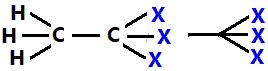 ,
condensed structural formula and skeletal formula
,
condensed structural formula and skeletal formula
1,1,1-trifluoroethane, 1,1,1-trichloroethane,
1,1,1-tribromoethane, 1,1,1-triiodoethane
Number of low resolution
NMR chemical shift
δ
signal peaks: 1 1H
and 2 13C
(email
if disagree?)
(2)
XCH2CHX2,
 ,
condensed structural formula and skeletal formula ,
condensed structural formula and skeletal formula
1,1,2-trifluoroethane, 1,1,2-trichloroethane,
1,1,2-tribromoethane, 1,1,2-triiodoethane
Number of low resolution
NMR chemical shift
δ
signal peaks: 2 1H
and 2 13C
(email
if disagree?)
1H NMR ratio of peaks: 2 : 1 (for equivalent protons)
Spectra can be used to distinguish
which halogen compound and which isomer e.g.
The
infrared spectrum of 1,1,1-trichloroethane
The
infrared spectrum of 1,1,2-trichloroethane
The mass
spectrum of 1,1,1-trichloroethane
The mass
spectrum of 1,1,2-trichloroethane
The H-1
NMR spectrum of 1,1,1-trichloroethane
The H-1
NMR spectrum of 1,1,2-trichloroethane
The
C-13 NMR spectrum of 1,1,1-trichloroethane
The
C-13 NMR spectrum of 1,1,2-trichloroethane
Summary of key points and extra notes on the isomers of molecular
formulae
C2H3F3, C2H3Cl3, C2H3Br3
and C2H3I3
A rich and exam-relevant isomer topic that blends structural
reasoning, periodic trends, and stereochemistry. Let’s break it down
systematically:
Molecular Overview of
C2H3F3, C2H3Cl3, C2H3Br3
and C2H3I3
Each compound has the molecular formula C2H3X3,
where X = F, Cl, Br, or I. These are halogenated
ethanes, specifically trihaloethanes, depending on
bonding. They can exhibit structural isomerism.
Types
of Isomerism for
C2H3F3, C2H3Cl3, C2H3Br3
and C2H3I3
|
Isomerism Type |
Description |
Exhibited by |
|
Structural
Isomerism -
Positional
Isomerism |
Same molecular formula,
different connectivity of atoms.
Halogens attached to
different carbon atoms |
All four compounds |
|
Geometrical
Isomerism |
Restricted rotation around
C=C bond leads to cis/trans isomers |
If compound contains C=C
(e.g. vinyl-type) NOT applicable here |
|
Optical Isomerism |
Chiral center with four
different groups → non-superimposable mirror images |
Rare, but possible in
asymmetrical isomers,
NOT applicable here |
Differences in Physical Properties of
C2H3F3, C2H3Cl3, C2H3Br3
and C2H3I3
|
Property |
Trend
Across C2H3X3
Series |
|
Boiling
Point |
Increases from F →
I due to increasing molecular mass and van der Waals forces |
|
Density |
Increases with
heavier halogens (I > Br > Cl > F) |
|
Polarity |
Fluorinated
isomers are more polar due to high electronegativity of F |
|
Solubility |
Fluorinated
isomers may be more soluble in polar solvents; iodinated ones in
nonpolar ones |
|
Volatility |
C2H3F3 is most
volatile; C2H3I3 least, follows
from increase in intermolecular bonding force with increase in
atomic number of the halogen. |
Differences in Chemical Properties of
C2H3F3, C2H3Cl3, C2H3Br3
and C2H3I3
|
Halogen |
Reactivity |
Bond
Strength |
Typical Reactions |
|
F |
Less reactive due
to strong C–F bond |
Very strong |
Limited
substitution; used in refrigerants |
|
Cl |
Moderate
reactivity of RCl |
Strong |
Nucleophilic
substitution, elimination |
|
Br |
RBr more reactive than
RCl |
Weaker than C–Cl |
Common in organic
synthesis |
|
I |
Highly reactive
due to weak C–I bond |
Weakest bond |
Most reactive, rapid
substitution; used in iodination |
Uses
of
C2H3F3, C2H3Cl3, C2H3Br3
and C2H3I3
|
Compound |
Common
Uses |
|
C2H3F3 |
Refrigerants (e.g.
HFC-143a), aerosol propellants |
|
C2H3Cl3 |
Intermediate in
chemical synthesis, solvents, degreasers |
|
C2H3Br3 |
Flame retardants,
organic synthesis intermediates |
|
C2H3I3 |
Less common; used
in specialized iodination reactions |
Common
Misconceptions about
C2H3F3, C2H3Cl3, C2H3Br3
and C2H3I3
-
“All halogenated compounds are toxic” → Not
necessarily; toxicity depends on structure and exposure.
-
“Heavier halogens always mean stronger bonds”
→ Actually, C–I is weakest; C–F is strongest and greatly affects
relative reactivity.
-
“Isomers have identical properties” →
Isomers can differ significantly in boiling point, reactivity, and polarity.
Exam
Tips
-
Draw all possible isomers: Use skeletal
structures to identify positional and geometrical variants.
-
Compare boiling points using intermolecular forces:
Heavier halogens → stronger dispersion forces.
-
Use electronegativity trends: F > Cl > Br >
I → affects polarity and reactivity, but bond strength more important
here.
-
Watch for chirality: Look for carbon atoms
bonded to four different groups, NOT applicable here.
-
Link structure to use: Fluorinated
compounds → refrigerants (relatively inert gases); iodinated → synthesis.
More on uses of these
tri-halogenated compounds like C2H3F3,
C2H3Cl3,
C2H3Br3,
and C2H3I3
They play diverse roles across industries due to their
volatility, reactivity, and physical properties. Here's a breakdown of their
key applications:
Industrial Applications of
C2H3F3, C2H3Cl3, C2H3Br3
and C2H3I3
|
Compound |
Industrial Uses |
|
C2H3F3 |
-
Refrigerants (e.g. HFC-143a) in HVAC systems and
aerosol propellants |
|
|
- Blowing
agents for foam production (e.g. polyurethane foams) |
|
|
-
Dielectric fluids in electronics due to low reactivity
and high stability |
|
C2H3Cl3 |
- Solvents
for degreasing and cleaning in metalworking and electronics |
|
|
-
Intermediate in synthesis of pharmaceuticals and
agrochemicals |
|
|
-
Precursors for vinyl chloride and PVC production |
|
C2H3Br3 |
- Flame
retardants in plastics and textiles |
|
|
- Reagents
in organic synthesis and bromination reactions |
|
|
-
Photographic chemicals (historically) |
|
C2H3I3 |
-
Specialty iodination in pharmaceutical and
radiochemical synthesis |
|
|
- Contrast
agents in medical imaging (iodine-rich compounds) |
|
|
- Limited
use due to high reactivity and cost |
Why
They’re Useful
-
Volatility: Makes them ideal for cleaning,
degreasing, and propellant roles.
-
Reactivity: Enables selective substitution
and synthesis of complex molecules in organic synthesis.
-
Density & Flame Resistance: Especially
useful in fire suppression (flame retardants) and insulation.
Safety
& Environmental Considerations
-
Fluorinated compounds: Often stable and
less toxic, but some are potent greenhouse gases.
-
Chlorinated and brominated compounds: Can
be toxic and persistent; regulated under environmental laws.
-
Iodinated compounds: Used in small
quantities due to cost and reactivity.
Learning objectives - questions to be answered?
How do you draw the structural formula
and skeletal formula of the isomers of molecular formula C2H3Cl3 C2H3Br3 C2H3F3 C2H3I3?
How many aliphatic structural isomers
are there of halogen compounds with molecular formula C2H3Cl3 C2H3Br3 C2H3F3 C2H3I3?
How many aliphatic carbon chain isomers
are there of halogen compounds with molecular formula C2H3Cl3 C2H3Br3 C2H3F3 C2H3I3?
How many positional isomers are there
of organic halogen molecules with molecular formula C2H3Cl3 C2H3Br3 C2H3F3 C2H3I3?
How many E/Z (geometrical) isomers are
there of molecular formula C2H3Cl3 C2H3Br3 C2H3F3 C2H3I3?
How many R/S (optical) isomers
(enantiomers) of molecular formula C2H3Cl3 C2H3Br3 C2H3F3 C2H3I3?
Are there any cyclic haloalkene isomers
of formula C2H3Cl3 C2H3Br3 C2H3F3 C2H3I3?
Are there any cyclo haloalkane isomers
of formula C2H3Cl3 C2H3Br3 C2H3F3 C2H3I3?
Are there any halodiene isomers of
molecular formula C2H3Cl3 C2H3Br3 C2H3F3 C2H3I3?
Are there any haloalkyne isomers of
molecular formula C2H3Cl3 C2H3Br3 C2H3F3 C2H3I3?
Are there any functional group isomers
with a molecular formula C2H3Cl3 C2H3Br3 C2H3F3 C2H3I3?
Do C2H3Cl3 C2H3Br3 C2H3F3 C2H3I3 organic halogen
molecules have any stereoisomers?
Are there any E/Z (geometrical) isomers
with a molecular formula C2H3Cl3 C2H3Br3 C2H3F3 C2H3I3?
Are there any R/S (optical) isomers
(enantiomers) with a molecular formula C2H3Cl3 C2H3Br3 C2H3F3 C2H3I3?
This page
will answer these questions for molecular formula
C2H3F3 C2H3Cl3 C2H3Br3
or
C2H3I3
Associated organic chemistry links
Index of sets of isomers for a given
molecular formula
The molecular structure and naming of
HALOALKANES (how
to name and draw alkane structures)
Index of revision notes on the chemistry
HALOALKANES
including reactions
Advanced Level pre-university
organic chemistry notes
IR, mass and H-1 and C-13 NMR
spectra of organic compounds
For isomerism in organic chemistry, see also the
notes
Isomerism: introduction, structural isomerism - chain,
positional, functional group, tautomerism
Stereoisomerism:
introduction, definition,
priority rules, E/Z isomerism (cis/trans isomerism)
Stereoisomerism - R/S isomerism (optical
isomerism) -
definition - examples explained
This is a big chemistry website, please allow time
to explore it
A summary chart of isomerism

| Website content © Dr
Phil Brown 2000+. All copyrights reserved on revision notes, images,
quizzes, worksheets etc. Copying of website material is NOT
permitted. Exam revision summaries & references to science course specifications
are unofficial. |
Keywords or phrases:
isomers of halogenoalkanes, how many isomers are
there of halogen compounds of molecular formula C2H3Cl3 C2H3Br3 C2H3F3 C2H3I3? what is the
structure of the halogen compound isomers of molecular formula how do you name the isomers of
molecular formula C2H3Cl3 C2H3Br3 C2H3F3 C2H3I3? what is the molecular structure of the
isomers of C2H3Cl3 C2H3Br3 C2H3F3 C2H3I3, what type of isomerism is exhibited by molecules
of formula C2H3Cl3 C2H3Br3 C2H3F3 C2H3I3, how do you work out the isomers of haloalkanes
formula C2H3Cl3 C2H3Br3 C2H3F3 C2H3I3, what are the structural isomers of C2H3Cl3 C2H3Br3 C2H3F3 C2H3I3, the carbon chain
isomers of C2H3Cl3 C2H3Br3 C2H3F3 C2H3I3 in the homologous series of alkanes, comparing
the many structural isomers does C2H3Cl3 C2H3Br3 C2H3F3 C2H3I3 have?
what are the possible isomers of C2H3Cl3 C2H3Br3 C2H3F3 C2H3I3? revision notes on
isomerism of C2H3Cl3 C2H3Br3 C2H3F3 C2H3I3 molecules, the molecular structure of
the isomers of C2H3Cl3 C2H3Br3 C2H3F3 C2H3I3 how to draw the
structural formula of isomers of C2H3Cl3 C2H3Br3 C2H3F3 C2H3I3, how to draw the displayed
formula of isomers of C2H3Cl3 C2H3Br3 C2H3F3 C2H3I3, how to draw the skeletal formula of
halogenoalkane compound isomers of formula C2H3Cl3 C2H3Br3 C2H3F3 C2H3I3, how to name the isomers of molecular formula C2H3Cl3 C2H3Br3 C2H3F3 C2H3I3, R/S optical isomers
enantiomers of C2H3Cl3 C2H3Br3 C2H3F3 C2H3I3 isomeric with molecular formula C2H3Cl3 C2H3Br3 C2H3F3 C2H3I3, structural isomers of molecular
formula C2H3Cl3 C2H3Br3 C2H3F3 C2H3I3, optical isomers R/S enantiomers isomeric with molecular
formula C2H3Cl3 C2H3Br3 C2H3F3 C2H3I3, positional isomers isomeric with halocycloalkenes,
haloalkanes, haloalkynes, haloalkenes of molecular formula C2H3Cl3 C2H3Br3 C2H3F3 C2H3I3,
which types of isomerism are exhibited by molecules of formula
C2H3Cl3 C2H3Br3 C2H3F3 C2H3I3 alkyl positional isomers of C2H3Cl3 C2H3Br3 C2H3F3 C2H3I3 branched carbon chain
isomers of C2H3Cl3 C2H3Br3 C2H3F3 C2H3I3,
stereoisomers of molecular formula C2H3Cl3 C2H3Br3 C2H3F3 C2H3I3,
optical isomers R/S enantiomers isomeric with molecular
formula C2H3Cl3 C2H3Br3 C2H3F3 C2H3I3, positional isomers isomeric with molecular formula C2H3Cl3 C2H3Br3 C2H3F3 C2H3I3,
which types of isomerism are exhibited by C2H3Cl3 C2H3Br3 C2H3F3 C2H3I3 halogen atom positional isomers of C2H3Cl3 C2H3Br3 C2H3F3 C2H3I3,
how to work out the halogen compound names of isomers of C2H3Cl3 C2H3Br3 C2H3F3 C2H3I3,
haloalkene C2H3Cl3 C2H3Br3 C2H3F3 C2H3I3 isomers, cycloalkane isomers of C2H3Cl3 C2H3Br3 C2H3F3 C2H3I3, cycloalkene
isomers of C2H3Cl3 C2H3Br3 C2H3F3 C2H3I3
|
