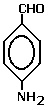
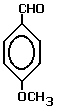
|
Part 7.8
The chemistry of
AROMATIC COMPOUNDS - electrophilic
substitution of benzene to synthesise aromatic ketones
[Author
© Dr
Phil Brown PhD: Doc
Brown's exam revision notes suitable
for A level chemistry students of advanced pre-university/college advanced level organic chemistry courses:
aromatic
chemistry revision notes on aromatic aldehydes and ketones
[aromatic page updated Mar 7th 2026 *]
email doc
brown - comments - query?
*
[privacy, cookies and disclaimer]
All my advanced level
aromatic chemistry notes
All my advanced A level organic
chemistry notes
Part 7.8
Electrophilic substitution -
acylation of arenes: benzene, methylbenzene and naphthalene (Friedel-Crafts reactions),
properties & uses of aromatic ketones & aldehydes
Sub-index for this page
on electrophilic substitution in
benzene and methylbenzene to yield aromatic ketones and their physical
and chemical properties
7.8.1
Preparation of aromatic ketones -
reagents, conditions, equations
7.8.2
The electrophilic substitution
mechanism for the Friedel-Crafts acylation of arenes
7.8.3
The physical properties of aromatic
aldehydes and aromatic ketones
7.8.4
Selected chemical reactions of aromatic
aldehydes and aromatic ketones
7.8.5
Selected uses of aromatic aldehydes and
aromatic ketones
TOP OF PAGE and sub-index
7.8.1 Preparation of aromatic ketones -
reagents, conditions, equations
A Friedel-Crafts synthesis of aromatic ketones.
The arene (e.g. benzene or methylbenzene) is refluxed
with an acid chloride and anhydrous aluminium chloride
catalyst AlCl3
and an aromatic ketone
is formed.
Aluminium bromide AlBr3, Iron(III)
chloride FeCl3 and iron(III) bromide FeBr3
can also be used as catalysts.
You can think of the catalyst as an acyl group carrier.
Despite their catalytic status, these compounds are not
easy to recycle, and relatively high temperatures may be
required, so the search is on to find much 'greener' catalysts which
can be more readily recycled and operate at a lower temperature
by offering a lower activation energy mechanistic route.
Examples of aromatic
Friedel Crafts acylation substitution reactions
(i)
 +
+
 ===>
===>
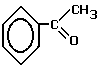 + HCl
+ HCl
benzene + ethanoyl chloride ===>
1-phenylethanone + hydrogen chloride
(ii)
+
 ===>
===>
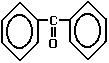 + HCl
+ HCl
benzene + benzoyl
chloride ==> diphenylmethanone + hydrogen chloride
for
R =
H, benzene:
C6H6
+ R'COCl ===> C6H5COR' + HCl
(iii) The acylation of methylbenzene e.g.
with ethanoyl chloride gives three possible isomeric aromatic ketones.
(b)
 +
===>
+
===>


 +
HCl +
HCl
For acylation of
methylbenzene typical yields are 11%, 4% and 85% for substitution at the 2, 3
and 4 positions (from left to right).
The compounds are called: 1-(2/3/4-methylphenyl)ethanone
(2/3/4-methylacetophenone)
Little, if any, further substitution
takes place because the ketone group deactivates the benzene ring.
If the atom of the original group is directly
bonded to the benzene ring does not have any π
bonding the ring is usually activated compared to benzene
itself. The methyl group tends to increase the electron density of the ring and
more so at the 2, 4 and 6 positions, compared to the 3 and 5 positions.
The small electron density shift is sometimes
described as a plus inductive shift (+I effect). Therefore the 2 and 4
positions become the preferred 2nd substitution points in the benzene ring so
the methyl group promotes 2- and -4 substitution by the electrophile -
you see this is reflected in the % yield of the three isomeric products.
(see section
7.14 for more details).
The acylation of naphthalene
another Friedel-Crafts reaction
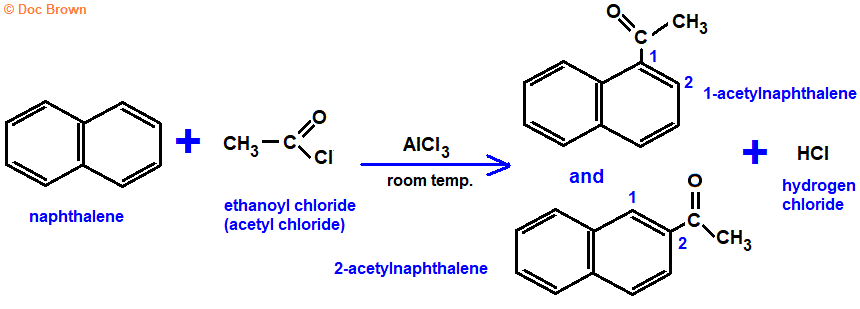
At room temperature, in the presence of
aluminium chloride catalyst, naphthalene readily reacts with ethanoyl
chloride (acetyl chloride) to yield a mixture of
1-acetylnaphthalene and 2-acetylnaphthalene.
The products are aromatic ketones.
This reaction is in principle the same electrophilic substitution reaction
undergone by benzene and methylbenzene.
TOP OF PAGE and sub-index
7.8.2 The electrophilic substitution mechanism for
the Friedel-Crafts acylation of
arenes
A Friedel-Crafts synthesis of aromatic ketones using an
acid/acyl chloride.
Note that the catalyst aluminium chloride (AlCl3) has a vacant orbital and can
act as a Lewis acid, accept a pair of electrons, and, in this context,
facilitate the formation of a more powerful electrophile [RC=O]+
in step
(1) of this acylation
of benzene electrophilic substitution mechanism. Its the same situation for
the catalysts AlBr3, FeCl3 and FeBr3.

mechanism 25 -
electrophilic substitution by an acyl group in the benzene ring
for
R =
H, benzene:
C6H6
+ R'COCl ===> C6H5COR' + HCl
[see mechanism 25 below]
[mechanism
25 above] If ethanoyl chloride, CH3COCl, was
used (R=CH3-), benzene forms phenylethanone, C6H5-CO-CH3.
Step (1)
Although the acid chloride molecule is polar, it is still not a strong
enough electrophile to disrupt the
pi
electron system of the benzene ring.
The aluminium chloride reacts
with an acid chloride molecule to form an acylium ion,
RCO+ (another type of carbocation), which is a
much stronger electron pair accepting positive electrophile
than the original acid chloride (either
RCO+ or an AlCl3-RCOCl
complex - details not needed for A level).
Step (2)
An electron pair from the
delocalised
pi
electrons of the
benzene ring forms a C-C bond with the electron pair accepting
carbocation forming a second highly unstable carbocation.
It is very
unstable because the stable electron arrangement of the benzene ring
pi electrons is partially broken to give a 'saturated' C (top right of ring.
Step 2 has the highest activation energy and is the rate
determining step (see mechanism diagram 81E below).
Step (3) is a proton transfer, as the
tetrachloroaluminate(III) ion [formed in step (1)], abstracts a
proton from the second highly unstable intermediate carbocation to
give the ketone product, 'waste' hydrogen chloride gas and reforming the
aluminium chloride catalyst.
In forming the aromatic ketone product, you retain the stabilising
effect of the complete pi electron system of the benzene ring.
for
R =
CH3, methylbenzene:
C6H5CH3
+ R'COCl ===> R'COC6H4CH3 +
HCl
and again
there is the potential to form three position isomers by
substituting in the 2, 3 or 4 position on the ring.
The overall acylation
reaction is the substitution of -H by RC=O

Mechanism diagram 81A:
The acylation of benzene using
ethanoyl chloride
In the first step the aluminium chloride abstracts a
chlorine atom from the ethanoyl chloride to give the acylium ion
CH3CO+
(a type of carbocation).
The acylium carbocation is a much more powerful
electrophile (electron pair acceptor) than the original acyl
chloride.
A pair of pi electrons are donated to the attacking
CH3CO+
electrophile forming a ring carbon - carbon bond in the benzene
molecule.
The intermediate is unstable because the stabilising
ring of pi electrons is broken - one of the benzene ring carbons is
temporarily saturated.
A tetrachloroaluminate ion abstracts a proton from the
intermediate to yield the final product of 1-phenylethanone.
With the formation of the aromatic ketone product,
the stable and complete pi electron ring system is reformed in the
benzene ring - overall electrophilic substitution instead of
electrophilic addition.
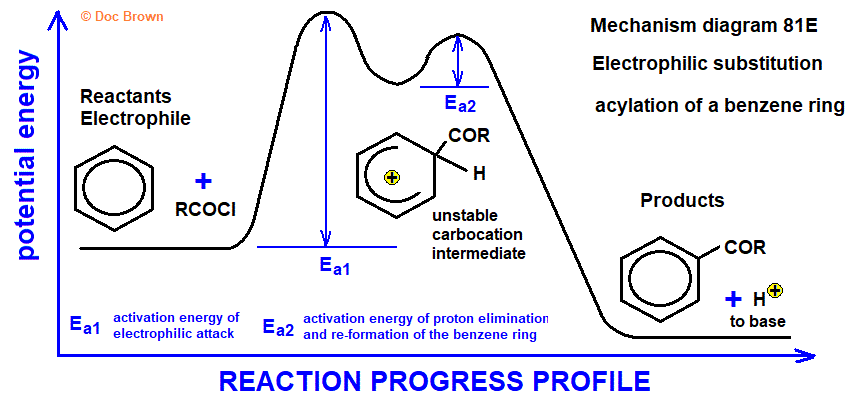
Mechanism diagram 81E shows the reaction progress profile
for the acylation of benzene with an acid chloride. Note the two transition
state 'humps'.
The first step here, forming the unstable intermediate
acylium ion (a type of carbocation), has the highest activation energy
and is the slower rate determining step.
The final step yielding the final product, with the
reformed stable benzene ring of the aromatic ketone, has the lower
activation energy and is much faster.
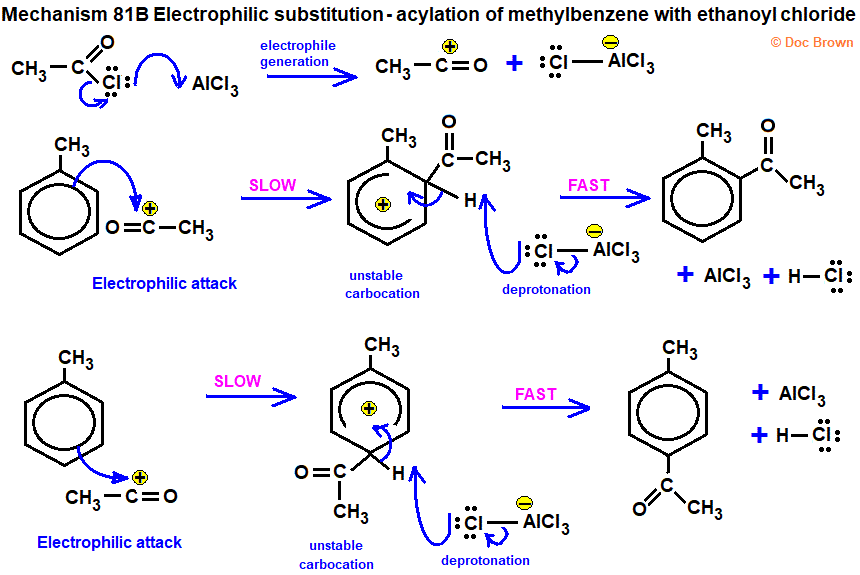
Mechanism diagram 81B:
The acylation of methylbenzene
using ethanoyl chloride
In the first step the aluminium chloride abstracts a
chlorine atom from the ethanoyl chloride to give the acylium ion
CH3CO+
(a type of carbocation).
The acylium carbocation is a much more powerful
electrophile (electron pair acceptor) than the original acyl
chloride.
A pair of pi electrons are donated to the attacking
CH3CO+
electrophile forming a 2nd ring carbon - carbon bond in the
methylbenzene molecule.
The intermediate is unstable because the stabilising
ring of pi electrons is broken - one of the benzene ring carbons is
temporarily saturated.
A tetrachloroaluminate ion abstracts a proton from the
intermediate to yield the final aromatic ketone product of 1-(2/3/4-methylphenyl)ethanone.
With the formation of the aromatic ketone product,
the stable and complete pi electron ring system is reformed in the
benzene ring - overall electrophilic substitution instead of
electrophilic addition.
I drawn the mechanism for substitution at the 2 and 4
ring positions of the benzene ring, since these are the two principal
products.
TOP OF PAGE and sub-index
7.8.3 The physical properties of aromatic aldehydes and aromatic
ketones
Abbreviations used:
mpt =
melting point oC; bpt = boiling point oC;
sub. = sublimes
dec. = thermally
decomposes; liq. = liquid at room temperature ~20oC
Further comments on the data table
(a) Most of those listed above are colourless or
pale yellow liquids at room temperature.
(b) Those with a hydroxy group in the ring can
hydrogen bond and that usually raises the melting point above room
temperature.
Others, with another highly polar group e.g.
nitro NO2, are also usually solids at room
temperature with the increased contribution to the
intermolecular attractive forces of the permanent dipole -
permanent dipole interactions.
TOP OF PAGE and sub-index
7.8.4
Selected chemical reactions of aromatic aldehydes and aromatic
ketones
(a) The reaction with 2,4-dinitrophenylhydrazone
(24DNPH for short)

The above diagram gives the equations for benzaldehyde
and 1-phenylethanone reacting with 2,4-dintrophenylhydrazine to give
orange-yellow precipitates of the 2,4-dinitrophenylhydrazones.
This is a test for a carbonyl compound, but does not
distinguish between aldehydes and ketones because they both undergo
the same condensation reaction.
(b) The reaction
with hydrogen cyanide
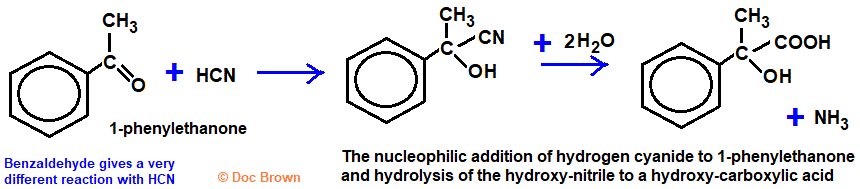
1-phenylethanone undergoes nucleophilic addition of
hydrogen cyanide to form a hydroxynitrile.
The hydroxynitrile, 2-hydroxy-2-phenylpropanenitrile,
can hydrolysed by refluxing with strong acid or alkali solution to give
a hydroxy carboxylic acid, 2-hydroxy-2-phenylpropanoic acid.
The ammonia would not be free, the reaction is far
to slow with water, and the ammonium salt of the acid would form
i.e. RCOO-NH4+. You need a strong
acid or base to effect the hydrolysis.
Refluxing the nitrile with sodium hydroxide produces
free ammonia, which is boiled off, leaving the sodium salt of the
carboxylic acid in solution, RCOO-Na+.
The organic acid is freed by adding stronger
mineral acid.
RCOO- + H+
==> RCOOH
Refluxing the nitrile with dilute
hydrochloric/sulfuric acid yields the free acid and the
corresponding ammonium salt.
(c)
Reduction
of aromatic aldehydes and ketones using lithium tetrahydridoaluminate(III),
LiAlH4

The reaction is carried out in dry ethoxyethane
('ether') and the product hydrolysed with dilute mineral acid.
Benzaldehyde is reduced to phenylmethanol (primary
alcohol).
1-phenylethanone is reduced to 1-phenylethanol
(secondary alcohol(.
(d) The iodoform reaction

Only aromatic methyl-ketones can give the iodoform
reaction.
If 1-phenylethanone is gently warmed with iodine and
sodium hydroxide solution, a yellow precipitate of triiodomethane forms.
Sodium benzoate is left in solution.
would
all give the iodoform reaction.
(e) Other tests for aldehydes and ketones
Tests for aromatic aldehydes and aromatic ketones (apart
from 24DNPH reaction)
 Benzaldehyde gives a
silver mirror with ammoniacal
silver nitrate (Tollen's reagent), which would distinguish it from other
aromatic ketones. Benzaldehyde gives a
silver mirror with ammoniacal
silver nitrate (Tollen's reagent), which would distinguish it from other
aromatic ketones.
BUT, Fehling's solution is a weaker oxidising agent and
no red-brown precipitate is given by benzaldehyde and most other
aromatic aldehydes.
The pi electrons of the benzene ring overlap with the pi
electrons of the carbonyl bond, stabilising benzaldehyde and lowering
the reducing power of benzaldehyde - enough to give a negative test with
Fehling's solution.


 would give similar results.

The diagram shows the overlap of the electron clouds of
the benzene ring (C6H5) and the carbonyl group
(C=O) of the aldehyde function group in benzaldehyde.
The nitration of 1-phenylethanone and reduction of the product to an
aromatic amine

1-phenylethanone can be nitrated using a nitrating mixture
of conc. nitric acid and conc. sulphuric acid. It also works with 'fuming'
nitric acid (nasty!). The major product is 3-nitroacetophenone.
This is a typical electrophilic substitution reaction of
an aromatic compound with a benzene ring.
add orientation rule to various
pages
The major products can separated and reduced to
3-aminoacetophenone H2NC6H4COCH3.
TOP OF PAGE and sub-index
7.8.5 The uses of aromatic aldehydes and aromatic ketones
The aromatic nature of these compounds gives them
characteristic odours and many are used in scents and fragrances.
Some are found in nature and are used as flavourings in the
food industry.
Many of such useful compounds are synthetically manufactured
and the 'collection' added to by synthetic analogues to those found in
nature.
|
Website content © Dr
Phil Brown 2000+. All copyrights reserved on Doc Brown's Chemistry revision notes, images,
quizzes, worksheets etc. Copying of website material is NOT
permitted. Doc Brown's chemistry of aromatic compounds exam revision notes,
Website content © Dr Phil Brown 2000+. All
copyrights reserved on revision notes, images, quizzes, worksheets etc. Copying
of website material is NOT permitted. Exam revision summaries & references to
science course specifications are unofficial.
Website content © Dr Phil Brown 2000+. All
copyrights reserved on these organic chemistry exam revision
notes on preparation of aromatic ketones by the Friedel-Craft reaction, these A level chemistry revision notes are suitable for use of pre-university students studying AQA advanced level
organic chemistry revision notes on preparation of aromatic ketones
by the Friedel-Craft reaction, Edexcel advanced level
organic chemistry revision notes on preparation of aromatic ketones
by the Friedel-Craft reaction, OCR advanced level
organic chemistry revision notes on preparation of aromatic ketones
by the Friedel-Craft reaction, IB advanced level
organic chemistry revision notes on preparation of aromatic ketones
by the Friedel-Craft reaction, WJEC (Eduqas) advanced level
organic chemistry revision notes on preparation of aromatic ketones
by the Friedel-Craft reaction, CIE Cambridge advanced level
organic chemistry revision notes on preparation of aromatic ketones
by the Friedel-Craft reaction, CCEA advanced level
organic chemistry revision notes on preparation of aromatic ketones
by the Friedel-Craft reaction, and useful for US grade 11
grade 12 AP honors organic chemistry courses involving
preparation of aromatic ketones by the Friedel-Craft
reaction,
Explaining the importance of
electrophilic substitution mechanism for the acylation of
aromatic hydrocarbons to form ketones
in organic chemistry, What you need to know about electrophilic
substitution mechanism for the acylation of aromatic
hydrocarbons to form ketones for organic
chemistry,
Explaining the use of electrophilic substitution mechanism for the
acylation of aromatic hydrocarbons to form ketones knowledge in organic chemistry, Examples of
electrophilic substitution mechanism for the acylation of
aromatic hydrocarbons to form ketones explained
when studying organic chemistry, What is
the significance of electrophilic substitution mechanism for the
acylation of aromatic hydrocarbons to form ketones in organic chemistry, What is the use of
electrophilic substitution mechanism for the acylation of
aromatic hydrocarbons to form ketones
in organic chemistry Describing and
explaining the theory of electrophilic substitution mechanism for the
acylation of aromatic hydrocarbons to form ketones when studying organic chemistry, exam revision
notes for electrophilic substitution mechanism for the acylation of
aromatic hydrocarbons to form ketones in exams, online help for
electrophilic substitution mechanism for the acylation of
aromatic hydrocarbons to form ketones, revision notes for
electrophilic substitution mechanism for the acylation of
aromatic hydrocarbons to form ketones,
what do I need to learn for electrophilic substitution mechanism for the
acylation of aromatic hydrocarbons to form ketones in exams? revision summary for
electrophilic substitution mechanism for the acylation of
aromatic hydrocarbons to form ketones, help in
teaching electrophilic substitution mechanism for the acylation of
aromatic hydrocarbons to form ketones, learning notes for
electrophilic substitution mechanism for the acylation of
aromatic hydrocarbons to form ketones, help to pass the
electrophilic substitution mechanism for the acylation of
aromatic hydrocarbons to form ketones exam, how to
prepare for examination questions on electrophilic substitution
mechanism for the acylation of aromatic hydrocarbons to form
ketones? Explaining the importance of reactions of aromatic
ketones & aldehydes & their uses
in organic chemistry, What you need to know about reactions of aromatic
ketones & aldehydes & their uses for organic
chemistry,
Explaining the use of reactions of aromatic ketones & aldehydes & their
uses knowledge in organic chemistry, Examples of reactions
of aromatic ketones & aldehydes & their uses explained
when studying organic chemistry, What is
the significance of reactions of aromatic ketones & aldehydes & their
uses in organic chemistry, What is the use of reactions of
aromatic ketones & aldehydes & their uses
in organic chemistry Describing and
explaining the theory of reactions of aromatic ketones & aldehydes &
their uses when studying organic chemistry, exam revision
notes for reactions of aromatic ketones & aldehydes & their uses in exams, online help for
reactions of aromatic ketones & aldehydes & their uses, revision notes for
reactions of aromatic ketones & aldehydes & their uses,
what do I need to learn for reactions of aromatic ketones & aldehydes &
their uses in exams? revision summary for reactions of
aromatic ketones & aldehydes & their uses, help in
teaching reactions of aromatic ketones & aldehydes & their uses, learning notes for
reactions of aromatic ketones & aldehydes & their uses, help to pass the
reactions of aromatic ketones & aldehydes & their uses exam, how to
prepare for examination questions on reactions of aromatic ketones &
aldehydes & their uses?
[SEARCH
BOX]
All my advanced level
aromatic chemistry revision notes
All my advanced A level organic
chemistry notes |
|