|
3h. Describing and explaining the covalent bonding in the ammonia molecule
NH3
with extra notes on properties and uses
[Author
©
Dr Phil Brown GRIC, PhD:
Doc Brown's chemistry exam revision notes on
chemical bonding and
covalent molecules - ammonia ,
suitable for students of UK GCSE Science level
AQA, Edexcel, OCR, WJEC and CCEA GCSE chemistry
courses, ~US grades 9-10 chemistry, also useful for more advanced
pre-university A level chemistry courses
[ammonia covalent bonding page updated
RE-EDIT]
[email doc
b with any query ]
*
[privacy policy, cookies,
disclaimer]
*
]SEARCH
science website]
GCSE
level chemistry - practise exam questions on
ammonia
- bonding and properties
or the wider ranging multiple choice quizzes
Foundation
tier (easier)
m/c QUIZ on structure, properties & chemical bonding
of materials
Higher
tier (harder) m/c QUIZ on structure, properties and chemical bonding of
materials
INDEX of ALL notes on
Covalent Bonding: small molecules and properties
OR
What next?
Covalent bonding diagrams for AMMONIA
covalent molecule, molecular formula NH3
But first, where are
nitrogen and hydrogen in the periodic table?

The 'approximate' division
between metals \ non-metals (diagonal zig-zag line)
|
Pd |
metals |
Part of the modern Periodic Table
Pd = period,
Gp = group |
metals => non–metals |
|
Gp1 |
Gp2 |
Gp3 |
Gp4 |
Gp5 |
Gp6 |
Gp7 |
Gp0 |
|
1 |
1H Note
that hydrogen does not readily fit into any group but is a
non-metal |
2He |
|
2 |
3Li |
4Be |
atomic number
Chemical Symbol
e.g. 4Be |
5B |
6C |
7N |
8O |
9F |
10Ne |
|
3 |
11Na |
12Mg |
13Al |
14Si |
15P |
16S |
17Cl |
18Ar |
|
4 |
19K |
20Ca |
21Sc |
22Ti |
23V |
24Cr |
25Mn |
26Fe |
27Co |
28Ni |
29Cu |
30Zn |
31Ga |
32Ge |
33As |
34Se |
35Br |
36Kr |
|
5 |
37Rb |
38Sr |
39Y |
40Zr |
41Nb |
42Mo |
43Tc |
44Ru |
45Rh |
46Pd |
47Ag |
48Cd |
49In |
50Sn |
51Sb |
52Te |
53I |
54Xe |
|
6 |
55Cs |
56Ba |
Transition Metals |
81Tl |
82Pb |
83Bi |
84Po |
85At |
86Rn |
|
The
covalent molecule ammonia from nitrogen combining with hydrogen |
 Three atoms of hydrogen (1) combine with one atom of nitrogen (2.5) to form the
molecule of the compound
ammonia NH3 Three atoms of hydrogen (1) combine with one atom of nitrogen (2.5) to form the
molecule of the compound
ammonia NH3
Each hydrogen atom is one electron
short of a helium structure (full shell) and nitrogen is three electrons short
of a full outer shell (of 8), so three hydrogen atoms share their electrons with
the five outer electrons of nitrogen, so all four atoms effectively have full
outer shells.
three of
 and one and one
 combine to form
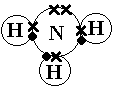 so that the hydrogen atoms are electronically like helium and the nitrogen atom becomes like neon
(only the outer shell of nitrogen's electrons are shown).
so that the hydrogen atoms are electronically like helium and the nitrogen atom becomes like neon
(only the outer shell of nitrogen's electrons are shown).
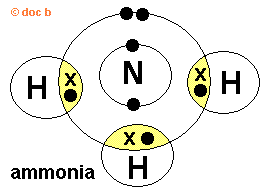 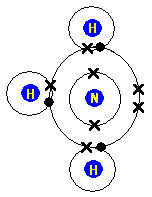 Electronically, hydrogen (1)
becomes like helium (2) and nitrogen (2.5) becomes like neon (2.8), so the
hydrogen and nitrogen atoms effectively have full outer shells in forming the
covalent bonds when the atoms share their outer electrons. Electronically, hydrogen (1)
becomes like helium (2) and nitrogen (2.5) becomes like neon (2.8), so the
hydrogen and nitrogen atoms effectively have full outer shells in forming the
covalent bonds when the atoms share their outer electrons.
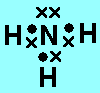 (Lewis diagram of ammonia)
simplified 'dot and cross' electronic diagram for the covalently bonded
ammonia molecule
(Lewis diagram of ammonia)
simplified 'dot and cross' electronic diagram for the covalently bonded
ammonia molecule
The triatomic
ammonia molecule is held
together by the strong N–H nitrogen–hydrogen single covalent bonds by sharing
a pair of electrons.

The Venn diagram
above on the far right is the best style for ammonia, clearly showing the
sharing of the pairs of electrons for the single covalent bonds in the ammonia
molecule (in a sort of Venn diagram style).
Note
that the inner shell of nitrogen's electrons are not shown (as in the
diagrams on the right), only the outer shell of nitrogen's electrons are
involved in the covalent bonding here.
The molecule can be shown as
(displayed formula)
with three nitrogen – hydrogen single covalent
bonds (AS note: called a trigonal pyramid shape, the H–N–H bond angle is
107o. This displayed formula does indicate the shape of the
ammonia molecule as well as how the three N-H single covalent bonds are
arranged, but no relative size of atoms or electronic detail of covalent bond
formation by electron sharing. It does indicate the pyramidal shape of the
molecule (A level comment).
The double dots represent a pair of electrons not involved in
the covalent bonding in ammonia. PH3 will be similar
since phosphorus (2.8.5) is in the same Group 5 as nitrogen. Valency of nitrogen
or phosphorus is 3 here.
Above on the right two of
the full 'dot and cross' electronic Lewis diagram for the covalent bonding in the
ammonia molecule.
Covalent bond molecule diagrams come in a
variety of forms e.g. for ammonia, as well as those above ...

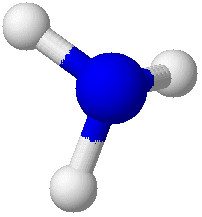
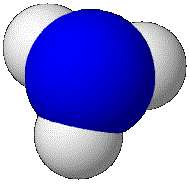
dot and cross electronic diagram, 3D ball and stick model, 3D
space-filling model and 2D displayed formula and
all represent ammonia!
At advanced level chemistry
this is described as a trigonal pyramid shape.
See advanced level chemistry notes
on the shapes of molecules
Its worth making the following comments on the different
representations of simple covalent molecules of >2 atoms.
So, reminders:
(i) Dot and cross diagrams are good for
showing the electronic detail of the structure, and whether the bonds are
single (ox) or double (ox) etc. However, it gives no idea on the
shape of the ammonia molecule i.e. the 3D spatial arrangement of the bonds and atoms
(its effectively a 2D diagram, but the molecule might not be flat!) and no
information about the relative size of the atoms.
(ii) Displayed formulae clearly shows how the atoms are bonded together,
e.g. the
arrangement of the three N-H single bonds, but only gives a 2D view of the molecule.
(iii) It needs a 3D ball and
stick model diagram to give an idea of the spatial arrangement of the atoms
in ammonia,
but not the relative size of the atoms. A space filling model would give the
shape of the molecule and the relative size of the atoms. However, neither
of these two models show any electronic details of how the
covalent bond is formed.
Comments on
ammonia's bonding and properties
Melting point of ammonia -78 oC
Boiling point of ammonia -33 oC
You would expect these low
state change values
for ammonia because of the weak intermolecular forces between small covalent molecules.
However, the melting point and
boiling point are higher than expected for such a small molecule because the
strongest intermolecular bonding force of hydrogen bonding acts to attract
ammonia molecules.
Ammonia is a colourless pungent
smelling gas at
room temperature.
Ammonia forms an alkaline
solution when dissolved in water where some of the ammonia reacts with water
to give ammonium ions and hydroxide ions.
NH3(aq)
+ H2O(l)
 NH4+(aq) + OH-(aq)
Extra structured and exam-board-aligned
notes on
ammonia (NH3)
Tailored for GCSE/IGCSE Chemistry students
across WJEC, CCEA, CIE, AQA, Edexcel, OCR Gateway, and OCR 21st Century
specifications.
Bonding and Structure of Ammonia (NH3)
Type of Bonding in ammonia
- Covalent bonding between nitrogen and hydrogen atoms.
- Nitrogen shares three electrons with three hydrogen
atoms.
- Each covalent bond involves a shared pair of electrons.
Electron Configurations for ammonia
- Nitrogen: 5 outer electrons → needs 3 more for a full shell.
- Hydrogen: 1 outer electron → needs 1 more.
- Dot-and-cross diagrams show three bonding pairs and
one lone pair on nitrogen.
Molecular Geometry of ammonia
(advanced note)
- Trigonal pyramidal shape.
- Bond angle ≈ 107° due to lone pair repulsion.
- Not a perfect tetrahedron (109.5°) because lone pairs repel more
strongly than bonding pairs.
Intermolecular Forces in ammonia
- Weak van der Waals forces between molecules,
hence the low melting and boiling points.
- Hydrogen bonding possible due to lone pair on nitrogen
and hydrogen atoms.
Physical Properties of ammonia
| Property |
Explanation |
| Low boiling point |
Weak intermolecular forces (not covalent bonds) |
| Soluble in water |
Forms alkaline solution (ammonium hydroxide) |
| Pungent smell |
Characteristic of ammonia gas |
Uses of Ammonia NH3
Industrial Uses of ammonia
| Use |
Explanation |
| Fertiliser production |
Used to make ammonium nitrate, urea,
etc. |
| Nitric acid manufacture |
Via oxidation of ammonia (Ostwald process) |
| Cleaning agents |
Found in household and industrial cleaners |
| Explosives |
Used in production of TNT,
nitroglycerin |
| Refrigeration |
Used as a refrigerant in older systems |
| Nylon production |
Intermediate in making
polyamides |
Laboratory and
industrial uses
Common Misconceptions about ammonia
| Misconception |
Clarification |
| Ammonia has ionic bonds |
It has covalent bonds between non-metals |
| Ammonia is a giant covalent structure |
It is a simple molecular substance |
| Covalent bonds break during boiling |
Only intermolecular forces break, not the
covalent bonds |
| Ammonia is acidic |
It is alkaline due to formation of OH⁻ ions in
water |
| Lone pairs don't affect shape |
Lone pairs cause bond angle reduction due to
greater repulsion (advanced level note) |
Exam Tips about questions involving ammonia
- Use dot-and-cross diagrams to show bonding clearly
(Venn diagram (xo) style best).
- Mention lone pair when explaining shape and bond
angles (advanced level).
- Link structure to properties (e.g. low boiling point
due to weak forces).
- Know the Haber Process conditions:
e.g. 450°C, 200 atm,
iron catalyst.
- Be precise: distinguish between ammonia (NH3)
as a gas or in solution and
ammonium ion (NH4+)
in ammonium salts - crystals or in aqueous
solution.
Learning objectives
for the bonding in an ammonia molecule
Recognise the position of
hydrogen and nitrogen in the periodic
table - both non-metals.
Know that when two non-metallic elements combine, the
chemical bond is most likely to be covalent.
Know that for simple molecules
like ammonia, the atoms try to attain an
electronic structure like a noble gas by sharing their out electrons.
Know and be able to describe and explain with a diagram the
formation of the covalent bonds in the ammonia molecule by electron
sharing (between the two positive nuclei of the nitrogen and hydrogen atoms).
Know what is meant by, and be
able to describe and explain the formation of single bonds in the ammonia molecule.
Know that ammonia has a very low melting point and
boiling point because the forces between the molecules are very weak - weak
intermolecular forces/bonding.
|
QUESTIONS
GCSE
level chemistry - practise exam questions on
ammonia - bonding and
properties
A re-edited
joint AI-doc b question exercise experiment
Jot
down your responses and check out the answers:
ANSWERS
Qs 7-12 are more appropriate for A-level
chemistry students
If you think there are
any errors, please email me asap at
chem55555@hotmail.com
I don't mind if students/teachers do a selected printout
of these questions and answers.
You can use a periodic table to help you answer the questions
Q1. What type of
bonding is present within an ammonia molecule (NH3)?
A.
Ionic bonding
B.
Covalent bonding
C.
Metallic bonding
D.
Hydrogen bonding
Q2. How many
covalent bonds are present in one molecule of ammonia?
A.
1 B. 2 C. 3
D. 4
Q3. Why does
ammonia have a relatively high boiling point compared
with similar-sized molecules?
A.
It is ionic
B.
It forms hydrogen bonds
C.
It is metallic
D.
It has a giant covalent structure
Q4. What is the
state of ammonia at room temperature and pressure?
A.
Solid B. Liquid
C. Gas D. Plasma
Q5. What happens
when ammonia dissolves in water?
A.
It forms hydrogen gas
B.
It forms ammonium ions and hydroxide ions
C.
It forms nitrogen gas
D.
It forms ammonia solid
Q6. Which
statement correctly describes the N–H bond in ammonia?
A.
A shared pair of electrons between N and H
B.
A transfer of electrons from H to N
C.
A metallic bond between N and H
D.
A hydrogen bond within the molecule
Q7. What type of
intermolecular force is strongest between ammonia
molecules?
A.
Van der Waals forces only
B.
Permanent dipole–dipole forces only
C.
Hydrogen bonding
D.
Metallic attraction
Q8. What is the
shape of an ammonia molecule?
A.
Linear B. Tetrahedral
C. Trigonal pyramidal D. Bent
(V‑shaped)
Q9. Why is ammonia
very soluble in water?
A.
It is non‑polar
B.
It reacts violently with water
C.
It forms hydrogen bonds with water molecules
D.
It is metallic
Q10. Why does
ammonia act as a base?
A.
It donates protons
B.
It accepts protons using its lone pair of electrons
C.
It contains hydrogen atoms
D.
It is a gas
Q11. Why is
ammonia a polar molecule?
A.
Nitrogen and hydrogen have equal electronegativity
B.
Nitrogen is more electronegative, creating a dipole
C.
Hydrogen is more electronegative, creating a dipole
D.
Ammonia has no lone pair
Q12. Why does
ammonia have a trigonal pyramidal shape?
A.
It has no lone pairs
B.
The lone pair repels bonding pairs more strongly
C.
Nitrogen is a metal
D.
Hydrogen atoms repel each other equally
Jot
down your responses and check out the answers:
ANSWERS
Qs 7-12 are more appropriate for A-level
chemistry students
If you think there are
any errors, please email me asap at
chem55555@hotmail.com
|
What
next?
Test yourself with practice exam questions on chemical bonding?
Foundation
tier (easier)
m/c QUIZ on structure & bonding
& properties of materials
Higher
tier (harder) m/c QUIZ on structure & bonding & properties of materials
Recommend next:
The covalent bonding in the methane
molecule
Explaining the properties of small
covalently bonded molecules
Sub-index for
Part 3.
Covalent Bonding: small molecules & properties
Index for
ALL chemical
bonding and structure notes
Perhaps of interest?
Use My Google search box
All my
GCSE level chemistry revision
notes
All my advanced level chemistry revision notes
All my
structure and bonding notes
Part 3
Covalent Bonding: small molecules & properties
how do describe the
covalent bonding in ammonia NH3 how do you draw and construct the
covalent bonding diagram for ammonia NH3, how to explain the dot and
cross electronic diagram for the covalent compound molecule ammonia NH3,
the properties of ammonia NH3, the uses of ammonia NH3, the manufacture
of ammonia NH3, reactions of ammonia NH3 molecules, reactions of ammonia
NH3
|
ANSWERS
If you think there are
any errors, please email me asap at
chem55555@hotmail.com
Q1. What type
of bonding is present within an ammonia molecule (NH3)?
A. Ionic bonding
B. Covalent bonding
C. Metallic bonding
D. Hydrogen bonding
Correct answer: B
Misconception: Students sometimes choose A
because nitrogen is “negative” in some diagrams —
but NH3 contains shared electron pairs,
not transferred electrons.
Q2. How many
covalent bonds are present in one molecule of
ammonia?
A. 1 B. 2
C. 3 D. 4
Correct answer: C
Misconception: Some pick D by counting the
lone pair as a “bond”. A lone pair is not a bond.
Q3. Why does
ammonia have a relatively high boiling point
compared with similar-sized molecules?
A. It is ionic
B. It forms hydrogen bonds
C. It is metallic
D. It has a giant covalent structure
Correct answer: B
Misconception: Some choose D because
“covalent” sounds strong — but NH3 is
simple molecular, not giant.
Q4. What is
the state of ammonia at room temperature and
pressure?
A. Solid B. Liquid
C. Gas D. Plasma
Correct answer: C
Misconception: Students may choose B
because ammonia is very soluble in water — but pure
NH3 is a gas at RTP.
Q5. What
happens when ammonia dissolves in water?
A. It forms hydrogen gas
B. It forms ammonium ions and hydroxide ions
C. It forms nitrogen gas
D. It forms ammonia solid
Correct answer: B
Misconception: Students may choose A
thinking “alkaline solutions release hydrogen” — but
NH3 simply accepts a proton.
Q6. Which
statement correctly describes the N–H bond in
ammonia?
A. A shared pair of electrons between N and H
B. A transfer of electrons from H to N
C. A metallic bond between N and H
D. A hydrogen bond within the molecule
Correct answer: A
Misconception: Students often confuse
hydrogen bonds with N–H covalent bonds — hydrogen
bonds occur between molecules, not within.
Q7. What type
of intermolecular force is strongest between ammonia
molecules?
A. Van der Waals forces only
B. Permanent dipole–dipole forces only
C. Hydrogen bonding
D. Metallic attraction
Correct answer: C
Misconception: Students sometimes pick B
because NH3 is polar — but the N–H bond
allows hydrogen bonding, which is stronger.
Q8. What is
the shape of an ammonia molecule?
A. Linear B. Tetrahedral
C. Trigonal pyramidal D. Bent
(V‑shaped)
Correct answer: C
Misconception: Students often choose B
because NH3 has four electron pairs — but
only three are bonding pairs, giving a pyramidal
shape.
Q9. Why is
ammonia very soluble in water?
A. It is non‑polar
B. It reacts violently with water
C. It forms hydrogen bonds with water molecules
D. It is metallic
Correct answer: C
Misconception: Some pick B because ammonia
solution is alkaline — but NH3
dissolves first, then reacts slightly to form NH4+
and OH-.
Q10. Why does
ammonia act as a base?
A. It donates protons
B. It accepts protons using its lone pair of
electrons
C. It contains hydrogen atoms
D. It is a gas
Correct answer: B
Misconception: Some pick C because acids
contain hydrogen — but bases accept protons; NH3
uses its lone pair.
Q11. Why is
ammonia a polar molecule?
A. Nitrogen and hydrogen have equal
electronegativity
B. Nitrogen is more electronegative, creating a
dipole
C. Hydrogen is more electronegative, creating a
dipole
D. Ammonia has no lone pair
Correct answer: B
Misconception: Some choose A because NH3
looks symmetrical — but the lone pair makes the
molecule asymmetrical and polar.
Q12. Why does
ammonia have a trigonal pyramidal shape?
A. It has no lone pairs
B. The lone pair repels bonding pairs more strongly
C. Nitrogen is a metal
D. Hydrogen atoms repel each other equally
Correct answer: B
Misconception: Some choose D thinking
repulsion is only between atoms — but electron pair
repulsion controls molecular shape.
If you think there are
any errors, please email me asap at
chem55555@hotmail.com
|
|
 For searching