|
 4e.
The Dangers of Radioactive Emissions 4e.
The Dangers of Radioactive Emissions
Beware
of ionising radiations from radioisotopes!
Health and
safety issues - dangers, taking precautions, monitoring exposure to
radioactive emissions and the handling of radioactive substances.
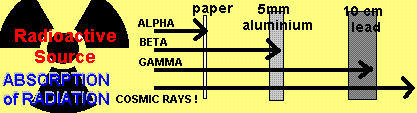
The penetration trends and the effects of
Ionisation from radioisotopes

TOP OF PAGE
4f. Appendix 1.
Explaining the effect of ionizing radiations on atoms and molecules
(a) Excitation of atoms by absorbing EM
radiation which then give out (emit) EM radiation

When the EM radiation has less energy
than that required for ionisation, you still 'excite' an atom into a more
energised state by promoting an electron from the outer shell to another, but
higher level shell (which may or may not be empty).
The excited atom is unstable
and will 'relax' back to its normal stable state by emitting EM radiation
photons.
The diagram above illustrates the process:
1. An
electron in an outer shell absorbs incoming EM radiation energy and is
promoted up to the next higher empty shell (in this case, but can be a partially
filled shell).
This called electron 'excitation'
and the incoming photon must have the precise energy
to bring about the energy level change the electron
experiences.
The further the electron
moves up the energy levels i.e. further from the nucleus,
the more energy it has.
2. The
atom is now in an 'excited' state and unstable because the
electron has gained excess energy and if possible the atom would like to return
its original stable state.
3.
So, the
promoted electron now loses energy and drops back down to the 'stable'
original level stabilising the atom.
The excess energy is lost as EM radiation
or heat.
NOTE danger!
The
excited atoms that can be dangerous, and promote chemical
reactions you might not wish to happen (e.g. in living cells)
and also release their excess energy as heat.
(b) The complete ionisation of an atom
An atom is ionised if it
completely loses one or more electrons.
This is a bit more energetic
than 'excitation' described above.
Ionisation by EM radiation of atoms to
form a positive ion
The higher energy uv, and both X-ray
and gamma radiations have enough energy to cause complete ionisation.
This is going 'energetically'
further than just excitation of a atom (or molecule).

 == high energy uv/X-ray/gamma ray photon ==>
 +
+ e- +
+ e-
The energy carried by ultraviolet light
radiation, X-rays and gamma radiation is sufficient to cause ionisation of atoms
by knocking off negative outer shell electrons to form a positive ion - the atom
has been ionised - see diagrams and explanation below.
This represents the ionisation of a sodium
atom to form a positive sodium ion and a free electron:
Na ==> Na+ + e¯
(electron configuration change of sodium from 2.8.1 ==> 2.8, as in chemistry
notes!)
In this case the incoming EM radiation must
have sufficient energy to promote the electron all the way up the energy levels
until it is completely free of the attraction of the positive nucleus - so the
atom has been ionised.
Dangers of ionising radiation
From (b) we see that excited
atoms that can be dangerous and promote chemical reactions you might
not wish to happen.
BUT, ions can be even more
destructive on cells and break chemical bonds and cause even more
genetic damage - this is usually due to the high reactivity of
ionised molecules or free radicals (bits of split molecules).
This is the essence of the
dangers of ionising radiation - burns and cell DNA damage leading to
cell death or rogue multiplication of mutated cancer cells and the
effect is greater than that from just excited atoms.
More on the dangers
has already been discussed on this page
Note on the use of fluorescence
tubes for lighting
Fluorescent tubes for lighting
purposes, contain mercury vapour.
When you switch them on, the
p.d. accelerates electrons down the tube.
The electrons hit mercury atoms
and knock electrons off them - ionisation to give mercury
ions and more free electrons.
The outer electrons and
therefore the mercury atoms/ions are excited to higher energy
levels.
When the electrons drop down to
their lower more stable levels, they emit ultraviolet EM
radiation.
On the inner surface of the tube
is a phosphorus coating that absorbs the uv radiation and the
atoms are excited to higher energy levels causing a fluorescent
effect because ....
... as the excited electrons fall
back down to their lower levels they emit a full range of
frequencies in the visible region of the electromagnetic
spectrum.
Unfortunately, mercury is a
highly poisonous metal and so old tubes are a highly hazardous
toxic waste and must be separated and dealt with appropriately from
most other waste.
|
4g. The destructive
power of an alpha particle inside your body!
APPENDIX
2. One day I asked myself
the following questions
(ignore if you are not interested, you
don't need it for GCSE or A level physics!
What is the velocity-speed of
alpha particle radiation? What is the relative kinetic energy of alpha
radiation (alpha particles)?
What is the
velocity-speed of beta particle radiation? What is the relative kinetic energy
of beta radiation (beta particles)?
What is the velocity of gamma
radiation? What is the kinetic energy of gamma radiation (gamma photons)?
How do these values of velocity and
kinetic energies relate to the relative penetration properties and ionising power
of alpha, beta and gamma radiations?
Why can these radiation cause genetic damage
by breaking chemical bonds in DNA molecules?
These questions have been partly (and
sufficiently) answered for GCSE chemistry/physics and A level chemistry in
section 4a on the properties of alpha, beta and gamma radiation.
So, the calculations I've done below are (as
far as I know) NOT required for pre-university examinations, but I hope
you might find them, and my resulting comments, interesting. The calculations
are a bit simplistic in some ways but the results serve my purpose.
The energy of emitted particles from
radioactive decay are usually quoted in megaelectronvolts (MeV)
An electronvolt is a unit of energy equal to
the work done on an electron in accelerating it through a potential difference
of one volt. A megaelectronvolt is 106 electron volts, which is also
equal to 1.60 x 10⁻¹³ joules
So 1 MeV = 1.60 x 10⁻¹³ J and 1
MeV = 10-16 kJ
On average the MeV energy sequence is alpha
particles > beta particles > gamma photons
BUT there is wide variation and much overlap
between the energy ranges of these three radioactive emissions.
Alpha typically 3 to 9 MeV, beta typically
0.1 to 10 MeV, gamma typically 0.03 to 5 MeV
Now as a chemist I am used to thinking in
terms of molar quantities, so I'm going to multiply some MeV energy values by
the Avogadro Constant (6.02 x 10²³ specified entity per mole) to give
the energy of the particles per mole.
so using MeV x 10-16 x Avogadro
Constant = kJ per mole of particles
0.03 x 10-16 x 6.02 x 1023
= 1.8 x 10⁶ kJ per mole of 'particle'
10 x 10-16 x 6.02 x 1023
= 6.02 x 10⁸ kJ per mole of 'particle'
Typical chemical covalent bond energies lie in the range 1-5
x 102 kJmol-1
You can readily deduce that an individual alpha particle,
beta particle or gamma photon, has an enormous potential to break a lot of
covalent bonds in organic molecules e.g. DNA cell damage due to radioactivity
near a cell.
Theoretically, therefore, there is enough energy in
particle/photon to break between 3.6 x 10³ and 6 x 10⁶
chemical bonds, though the energy is also dissipated in ionisation collisions
and exchange of kinetic energy releasing heat.
Can do a Planck's
equation calculation
|
 uses of alpha, beta and gamma radiation
and
nuclear equations for alpha and beta decay
4h.
Key revision points about alpha, beta and gamma radiation
Alpha,
beta and gamma differ in mass, charge, ionising and penetrating
power; alpha is heavy, highly ionising but easily stopped, beta is
light and moderately penetrating, gamma is massless, weakly ionising
but highly penetrating.
Know what stops each type, how
exposure is monitored, and basic safety/handling rules for exams.
Properties
at a glance
| Radiation |
Mass |
Charge |
Ionising power |
Penetration |
Stopped by |
| Alpha |
High |
Positive |
Very high |
Low
(short range in air) |
Paper, skin |
| Beta |
Low (electron) |
Negative |
Moderate |
Medium (metres in air) |
Thin aluminium |
| Gamma |
None (photon) |
Neutral |
Low |
High (travels far) |
Thick lead or metres of
concrete |
Sources: summary synthesis of
GCSE/A‑level guidance and teaching notes.
Why these
differences matter (dangers)
- Alpha:
Very dangerous if ingested/inhaled because of high
ionisation in tissue; external alpha rarely penetrates skin.
- Beta:
Can penetrate skin and damage living cells; internal exposure also
hazardous.
- Gamma:
Penetrates deeply and can irradiate whole body; shielding and
distance are key controls.
Health &
safety, handling and monitoring
- ALARP principle:
keep exposure As Low As Reasonably Practicable using time,
distance, shielding. Minimise time near sources, maximise
distance, use appropriate shielding.
- Handling:
use tongs, gloves, sealed sources, and store in labelled lead
containers; never touch sources directly.
- Monitoring:
personal dosimeters/film badges for workers; Geiger–Müller counters
and scintillation detectors for area checks; always subtract
background when reporting count rates.
- Emergency:
isolate area, evacuate, inform radiation officer; avoid
contaminating clothing or surfaces.
Measurement
& exposure notes
- Activity
measured in becquerels (Bq); dose
in grays (Gy) and biological effect in sieverts (Sv). Understand
difference between count rate and activity;
detectors measure counts, not intrinsic activity directly.
Student
exam tips
- Always state units
(Bq, Gy, Sv) and subtract background in count‑rate
questions.
- For shielding questions,
name material and justify (e.g., lead for gamma; aluminium
for beta).
- In health‑and‑safety scenarios,
mention time, distance, shielding, PPE, monitoring and
reporting.
- Learn one clear example
of internal versus external hazard (e.g., alpha inside body versus
gamma external).
Typical
pupil misconceptions
- Confusing activity
with count rate; forgetting to subtract background;
thinking gamma is harmless because it’s less
ionising; assuming all isotopes are radioactive;
misidentifying what stops each radiation type.
What next?
Associated Pages
RADIOACTIVITY
and NUCLEAR PHYSICS NOTES INDEX
See also
Electromagnetic radiation,
types, properties, uses and dangers
GCSE
Level (~US grade 8-10) School Physics Notes
(students age ~14-16)
GCSE
Level (~US grade 8-10) School Chemistry Notes
(students age ~14-16)
Find your GCSE
science course for more help links to revision notes
ALL my Advanced Level pre-university
Chemistry Notes
(students aged ~17-18)
This is a BIG website, you need to take time to explore it
[ SEARCH
BOX]
Email doc
brown - comment? query
Atomic structure, radioactivity and
nuclear physics revision notes index
Atomic structure, history, definitions,
examples and explanations including isotopes
1. Atomic
structure and fundamental particle knowledge needed to understand radioactivity
2.
What
is Radioactivity? Why does it happen? Three types of atomic-nuclear-ionising radiation
3.
Detection of
radioactivity, its measurement
and radiation dose units,
ionising
radiation sources
- radioactive materials, background radiation
4.
Alpha, beta & gamma radiation - properties of 3 types of radioactive
nuclear emission & symbols
,dangers of radioactive emissions - health and safety issues and ionising radiation
5.
Uses of radioactive isotopes emitting alpha, beta (+/–) or gamma radiation in
industry and medicine
6. The half-life of a radioisotope - how
long does material remain radioactive? implications!, uses of decay data and half-life values
-
archaeological radiocarbon dating, dating ancient rocks
7. What
actually happens to the nucleus in alpha and beta radioactive decay and why? nuclear
equations!, the
production of radioisotopes - artificial sources of radioactive-isotopes,
cyclotron
8.
Nuclear
fusion reactions and the formation of 'heavy elements' by bombardment techniques
9.
Nuclear Fission Reactions, nuclear power
as an energy resource

RADIOACTIVITY
multiple choice QUIZZES and WORKSHEETS
Easier Foundation
Tier Radioactivity multiple choice QUIZ
Harder Higher
Tier Radioactivity multiple choice QUIZ
Worksheet QUIZ Question 1 on
RADIOACTIVITY - absorption of alpha, beta and gamma radiation
Worksheet QUIZ Question 2 on
RADIOACTIVITY - dangers & monitoring ionising radiation levels
Worksheet QUIZ Question 3 on
RADIOACTIVITY - revision of atomic structure
Worksheet
QUIZ Question 4 on RADIOACTIVITY -
what happens to atoms in radioactive decay?
Worksheet QUIZ Question 5 on
RADIOACTIVITY - uses of radioisotope and half-life data
ANSWERS to the WORD-FILL WORKSHEET QUIZZES
Crossword
puzzle on radioactivity
and
ANSWERS!
|
Website content © Dr
Phil Brown 2000+. All copyrights reserved on Doc Brown's Chemistry
and Doc Brown's Physics revision notes, images,
quizzes, worksheets etc. on radioactivity, causes, effects, uses and
other aspects of nuclear physics for GCSE physics.
Website content © Dr
Phil Brown 2000+. All copyrights reserved on Doc Brown's Chemistry revision notes, images,
quizzes, worksheets etc. Copying of website material is NOT
permitted. Exam revision summaries & references to science course specifications
are unofficial. keywords and phrases:
revision study notes based
on the syllabus-specifications for students taking the IGCSE/GCSE
level chemistry examinations revision notes on hazards & properties
of ionising radiation from radioisotopes, alpha, beta, gamma &
positron particles & emissions
,
revision notes on hazards &
properties of ionising radiation from radioisotopes, alpha, beta,
gamma & positron particles & emissions based on the syllabus-specifications for students
taking the IGCSE/GCSE level chemistry examinations on
hazards & properties of ionising radiation from radioisotopes,
alpha, beta, gamma & positron particles & emissions for the gcse chemistry revision notes on
hazards & properties of ionising radiation from radioisotopes,
alpha, beta, gamma & positron particles & emissions, AQA igcse/gcse chemistry notes
on hazards & properties of ionising radiation from radioisotopes,
alpha, beta, gamma & positron particles & emissions, Edexcel gcse
notes on hazards & properties of ionising radiation from
radioisotopes, alpha, beta, gamma & positron particles & emissions, OCR 21st century chemistry revision
notes on hazards & properties of ionising radiation from radioisotopes,
alpha, beta, gamma & positron particles & emissions, OCR gateway GCSE chemistry revision notes on
hazards & properties of ionising radiation from radioisotopes,
alpha, beta, gamma & positron particles & emissions, CIE Cambridge igcse chemistry
revision notes on hazards & properties of ionising radiation from
radioisotopes, alpha, beta, gamma & positron particles & emissions, WJEC gcse chemistry revision notes on
hazards & properties of ionising radiation from radioisotopes,
alpha, beta, gamma & positron particles & emissions,
CCEA gcse revision notes for students on hazards & properties of
ionising radiation from radioisotopes, alpha, beta, gamma & positron
particles & emissions, revision notes for US grade 9-10 chemistry courses
Website content © Dr
Phil Brown 2000+. All copyrights reserved on Doc Brown's Physics revision notes, images,
quizzes, worksheets etc. Copying of website material is NOT
permitted. Exam revision summaries & references to science course specifications
are unofficial. keywords and phrases:
revision study notes based
on the syllabus-specifications for students taking the IGCSE/GCSE
level physics examinations revision notes on hazards & properties of
ionising radiation from radioisotopes, alpha, beta, gamma & positron
particles & emissions ,
revision notes on hazards &
properties of ionising radiation from radioisotopes, alpha, beta,
gamma & positron particles & emissions based on the syllabus-specifications for students
taking the IGCSE/GCSE level physics examinations on hazards & properties of
ionising radiation from radioisotopes, alpha, beta, gamma & positron
particles & emissions for the gcse physics revision notes on
hazards & properties of ionising radiation from radioisotopes,
alpha, beta, gamma & positron particles & emissions, AQA igcse/gcse physics notes on
hazards & properties of ionising radiation from radioisotopes,
alpha, beta, gamma & positron particles & emissions, Edexcel gcse
notes on hazards & properties of ionising radiation from
radioisotopes, alpha, beta, gamma & positron particles & emissions, OCR 21st century physics revision
notes on hazards & properties of ionising radiation from radioisotopes,
alpha, beta, gamma & positron particles & emissions, OCR gateway GCSE physics revision notes on
hazards & properties of ionising radiation from radioisotopes,
alpha, beta, gamma & positron particles & emissions, CIE Cambridge igcse
physics
revision notes on hazards & properties of ionising radiation from
radioisotopes, alpha, beta, gamma & positron particles & emissions, WJEC gcse physics revision notes on
hazards & properties of ionising radiation from radioisotopes,
alpha, beta, gamma & positron particles & emissions,
CCEA gcse revision notes for students on hazards & properties of
ionising radiation from radioisotopes, alpha, beta, gamma & positron
particles & emissions, revision notes for US grade 9-10
physics courses
Website content © Dr
Phil Brown 2000+. All copyrights reserved on Doc Brown's Chemistry revision notes, images,
quizzes, worksheets etc. Copying of website material is NOT
permitted. Exam revision summaries & references to science course specifications
are unofficial. keywords and phrases:
revision study notes based
on the syllabus-specifications for students taking the A level
chemistry examinations revision notes on hazards & properties of
ionising radiation from radioisotopes, alpha, beta, gamma & positron
particles & emissions ,
revision notes on hazards &
properties of ionising radiation from radioisotopes, alpha, beta,
gamma & positron particles & emissions based on the syllabus-specifications for students
taking the A level chemistry examinations on hazards & properties of ionising
radiation from radioisotopes, alpha, beta, gamma & positron
particles & emissions for the A level chemistry revision notes on
hazards & properties of ionising radiation from radioisotopes,
alpha, beta, gamma & positron particles & emissions, AQA
A level chemistry notes on hazards & properties of ionising
radiation from radioisotopes, alpha, beta, gamma & positron
particles & emissions, Edexcel A level notes on hazards & properties
of ionising radiation from radioisotopes, alpha, beta, gamma &
positron particles & emissions, OCR A
level chemistry revision
notes on hazards & properties of ionising radiation from radioisotopes,
alpha, beta, gamma & positron particles & emissions, Salters & OCR A level chemistry revision notes on
hazards & properties of ionising radiation from radioisotopes,
alpha, beta, gamma & positron particles & emissions, CIE Cambridge
A level chemistry
revision notes on hazards & properties of ionising radiation from
radioisotopes, alpha, beta, gamma & positron particles & emissions, WJEC A level chemistry revision notes on
hazards & properties of ionising radiation from radioisotopes,
alpha, beta, gamma & positron particles & emissions,
CCEA A level revision notes for students on hazards & properties of
ionising radiation from radioisotopes, alpha, beta, gamma & positron
particles & emissions, revision notes for US grade
11-12 K12 AP Honors chemistry courses
Website content © Dr
Phil Brown 2000+. All copyrights reserved on Doc Brown's Physics revision notes, images,
quizzes, worksheets etc. Copying of website material is NOT
permitted. Exam revision summaries & references to science course specifications
are unofficial. keywords and phrases:
revision study notes based
on the syllabus-specifications for students taking the A level
physics examinations revision notes on hazards & properties of
ionising radiation from radioisotopes, alpha, beta, gamma & positron
particles & emissions ,
revision notes on hazards &
properties of ionising radiation from radioisotopes, alpha, beta,
gamma & positron particles & emissions based on the syllabus-specifications for students
taking the A level physics examinations on hazards & properties of ionising
radiation from radioisotopes, alpha, beta, gamma & positron
particles & emissions for the A level physics revision notes on
hazards & properties of ionising radiation from radioisotopes,
alpha, beta, gamma & positron particles & emissions, AQA
A level physics notes on hazards & properties of ionising radiation
from radioisotopes, alpha, beta, gamma & positron particles &
emissions, Edexcel A level notes on hazards & properties of ionising
radiation from radioisotopes, alpha, beta, gamma & positron
particles & emissions, OCR A
level physics revision
notes on hazards & properties of ionising radiation from radioisotopes,
alpha, beta, gamma & positron particles & emissions, Salters & OCR A level physics revision notes on
hazards & properties of ionising radiation from radioisotopes,
alpha, beta, gamma & positron particles & emissions, CIE Cambridge
A level physics
revision notes on hazards & properties of ionising radiation from
radioisotopes, alpha, beta, gamma & positron particles & emissions, WJEC A level physics revision notes on
hazards & properties of ionising radiation from radioisotopes,
alpha, beta, gamma & positron particles & emissions,
CCEA A level revision notes for students on hazards & properties of
ionising radiation from radioisotopes, alpha, beta, gamma & positron
particles & emissions, revision notes for US grade
11-12 K12 AP Honors physics courses |
What next?
Associated Pages
|


 e+
e+


 Beta- particle radiation:
 The
nuclear industry.
The
nuclear industry. You can also reduce the pressure in the fume cupboard so
there is no chance of pressure leakage out into the laboratory area.
You can also reduce the pressure in the fume cupboard so
there is no chance of pressure leakage out into the laboratory area.