|
GCSE level Physics exam revision notes on OPTICS
Optics: Lenses: Part 9.
Eye defects, their causes and correction using convex and concave lenses
[Author
©
Dr Phil Brown PhD:
Doc Brown's physics exam revision notes suitable for students of UK
IGCSE & GCSE level physics courses, ~ US grades 9-10 physics
[waves-lenses- page updated April 17th 2026 *]
email doc
brown: comments? query?
*
[privacy & cookies policies & disclaimer]
[ KEY
POINTS and learning objectives for this page, after initial notes]
The causes of eye defects causing lack of focus, their
correction using convex lenses and concave lenses, myopia is short-sightedness
and hyperopia is long-sightedness.
INDEX of notes on optics: lens
types, properties, correcting eye defects
9.
Eye defects, their causes and correction using convex and concave lenses
The eye contains a convex lens structure that,
ideally, focuses the incoming light rays to produce a sharp image on the
retina at the back of the eyeball.
The light receptors in the retina then
produce and transmit the electrical signals to the brain giving you vision.
It is the energy of the light photons that cause a
change in light sensitive molecules that trigger the electrical signal
to the brain.
However, the
eye does not always sharp images, but it is possible to correct these
defects using glass lenses.
See also
The
eye - structure, function and vision defects GCSE level biology
revision notes - This page deals with all the GCSE level biology required on
the eye and more notes on other methods of dealing with eye defects.
Cause of vision defects causing
lack of focus i.e. causing blurred image on retina
A malfunction of the eye in some way to
give blurred vision because the incoming light rays do not form a sharp
image on the retina.
1. Causes of short-sightedness
(the medical term for short sightedness is myopia)
There are two principal
reasons why a person can suffer from short-sightedness (both
indicated on the diagrams).
Short sighted people can't
focus correctly on distant objects.
There are many 'biological'
causes to make a person short-sighted, but here we are most
concerned with optics of the situation and how to use concave lenses
to correct the defect.
The eyeball can be too long so
the image is formed in front of the retina.
Distant objects will seem
blurred, though close objects may be in focus.
The same effect is caused if the
lens is the wrong shape i.e. it is too powerful - too thick - with too short a principal focus,
so your vision is blurred.
This can be corrected with a
diverging concave lens (see the diagrams and explanation below).
2. Causes of long-sightedness
(the medical term for long sightedness hyperopia)
Long sighted people can't
focus correctly on near objects.
There are many 'biological'
causes to make a person long-sighted, but here we are most concerned
with optics of the situation and how to use convex lenses to correct
the defect.
There are two principal
reasons why a person can suffer from short-sightedness
(both indicated on the diagrams).
The eyeball may be too short so
the image is formed behind the retina.
Distant objects might be in focus
but any relatively close objects will appear blurred.
The same effect is caused if the
lens is the wrong shape - too weak - too thin - with too long a principal focus, so
your vision is blurred.
This can be corrected with a
converging convex lens (see the diagrams and explanation below).
Using lenses to correct for eye
defects
1. Correcting for
short-sightedness
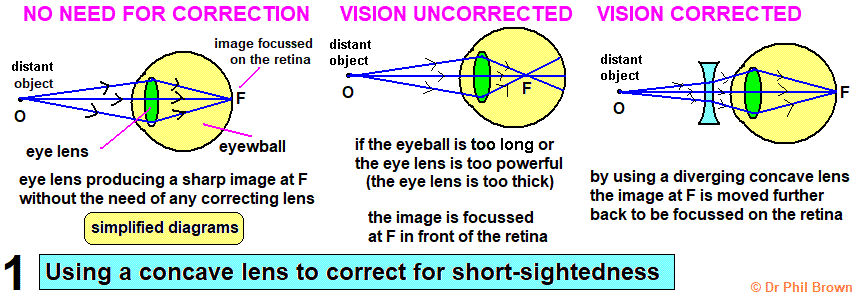
Reminder:
Short sighted people
can't focus correctly on distant objects.
The eyeball is too long or the
lens to thick (too strong) to produce a sharp image on the retina.
Prior to correction, the
focussed image is
formed in front of the retina.
In order to move the image back
to give it a sharp focus on the retina you need to diverge the rays.
This is done with a diverging concave lens in front of the eye.
The diverged rays are then
brought to a focus further back by the eye lens onto the retina.
The diagrams (1) show the normal
correct function of the eye, the effect of short-sightedness and the
correction produced by the concave lens.
2. Correcting for longsightedness

Reminder:
Long sighted people
can't focus correctly on near objects.
The eyeball is too short or the
lens to thin (too weak) to produce a sharp image on the retina.
Prior to correction, the image is
formed behind the retina.
In order to form a sharp image on
the retina, you to use a converging convex lens in front of the eye
to bring the rays to a focus further forward.
The combined converging power of
the glass lens plus the eye lens bring the rays to a focus on the
retina on the inner surface of the eyeball.
The diagrams (2) show the normal
correct function of the eye, the effect of long-sightedness and the
correction produced by the convex lens.
See also
The eye -
structure, function and vision defects
GCSE biology revision notes
This page deals with all the GCSE biology required on the eye and more
notes on other methods of dealing with eye defects.
Key points Introduction to the optics of
lenses: Eye defects and their correction
Information
sources for Doc Brown's key points: IGCSE-GCSE physics are based on
textbooks & syllabus-specifications for students taking the UK AQA, Edexcel,
OCR 21st Century Science, OCR Gateway science suite, WJEC, CCEA and CIE GCSE
physics 9-1 level science examinations
A comprehensive set of revision notes on eye defects
and their correction, tailored to the GCSE/IGCSE
Physics specifications across major UK exam boards including
WJEC, CCEA, CIE, AQA, Edexcel, and OCR.
The Human Eye Defects and Their Correction
Overview
The human eye focuses light onto the retina using the cornea and
lens.
Vision defects occur when light is not focused correctly, leading
to blurred images.
These defects can be corrected using lenses or surgical methods.
Key Eye Defects - cause, effect, symptoms
and correction
1.
Myopia (Short-sightedness)
- Cause: Eyeball too long or lens too curved.
- Effect: Light from distant objects focuses in front
of the retina.
- Symptoms: Difficulty seeing distant objects
clearly.
- Correction: Concave lens (diverges
light rays before they enter the eye).
2.
Hypermetropia (Long-sightedness)
- Cause: Eyeball too short or lens not curved enough.
- Effect: Light from close objects focuses behind the
retina.
- Symptoms: Difficulty seeing nearby objects clearly.
- Correction: Convex lens (converges
light rays before they enter the eye).
3.
Presbyopia
- Cause: Age-related stiffening of the lens.
- Effect: Difficulty focusing on close objects.
- Correction: Bifocal or varifocal lenses.
4.
Astigmatism
- Cause: Irregular curvature of the cornea or lens.
- Effect: Distorted or blurred vision at all
distances.
- Correction: Cylindrical lenses.
Physics Behind Correction of eye defects
| Defect |
Lens Type |
Lens Effect |
Diagram Tip |
| Myopia |
Concave |
Diverges rays to move focus back |
Show rays diverging before
entering eye |
| Hypermetropia |
Convex |
Converges rays to move focus
forward |
Show rays converging before
entering eye |
Common Misconceptions about eye defects
and their correction
- Myopia is corrected with convex lenses ❌
→ Correction: Myopia requires concave lenses.
- Hypermetropia affects distant vision ❌
→ Correction: It affects near vision.
- All vision defects are caused by the lens ❌
→ Correction: The shape of the eyeball also plays a
role.
Exam Tips on eye defects and their
correction
- Use ray diagrams to show how lenses correct
defects.
- Label diagrams clearly: retina, lens, focal point, incident rays.
- Know the lens types and their effects on light
rays.
- Be ready to apply knowledge to real-world contexts
(e.g. glasses, contact lenses, laser surgery).
- Practice calculating focal lengths and using lens
equations if required by your board.
Typical Board-Specific Notes on eye
defects and their correction
|
Notes |
| Focus on ray diagrams and lens
types. May include laser surgery. |
| Includes labelled diagrams and
image formation. |
| Covers presbyopia and bifocal
lenses. |
| Emphasises practical applications
and lens effects. |
| May include more detailed physics
of refraction and lens equations. |
Keywords, phrases and learning objectives for
properties and uses of lenses
Know the types and causes of eye defects and how to correct
them using convex lenses or
concave.
Be able to draw or interpret ray diagrams for the
eye, with and without the correcting lenses.
Know what lenses are used to correct myopia (short-sightedness)
and hyperopia (long-sightedness)
Be able to construct ray diagrams to show the formation of images by converging and diverging lenses.
You may be asked to complete ray diagrams drawn on graph paper.
Know that the magnification produced by a lens is calculated using the equation:
-
magnification = image height
/ object height
-
Know the structure and
function of the parts of the eye.
You should know about the
function of the:
retina
lens
cornea
pupil / iris
ciliary muscle
suspensory ligaments.
You should understand how the action of the ciliary muscle causes changes in the shape of the lens, which allows the light to be focused at varying distances.
-
Know and understand that correction of vision using convex and concave lenses to produce an image on the retina:
long
sight, caused by the eyeball being too short, or the eye lens being unable to focus,
short sight, caused by the eyeball being too long, or the eye lens being unable to focus.
-
Appreciate the concept of range of vision
- the eye can focus on objects between the near point and the far point.
You should know that the near
point is approximately 25 cm and the far point is infinity
-
Be able to compare the structure of the eye and the camera.
You should be aware that the film in a camera or the CCDs in a digital camera is the equivalent of the retina in the eye.
Practical work you may have done
-
demonstrating long and
short sight by placing a screen, not at the focal point, and rectifying the
image through the use of appropriate lenses
-
using a round bottom flask
filled with a solution of fluoresce in to represent
the eye
-
investigating total internal reflection using a semi-circular glass block.
-
Revise any investigations on the use of
converging lenses to:
-
measure the focal length using a distant object
-
investigate factors which affect the magnification of a converging lens
(formulae are not needed)
-
explain how the eyepiece of a simple telescope magnifies the image of a
distant object produced by the objective lens (ray diagrams are not necessary).
WHAT NEXT?
TOP of page
INDEX of physics optics notes
on LENSES
INDEX of all notes on waves, radiation,
astronomy etc.
Revision notes on eye defects & causes
described & explained based on the syllabus-specifications
for students taking IGCSE/GCSE level physics examinations, summary
revision notes and key points on eye defects & causes described &
explained for students taking the AQA
igcse/gcse physics notes on eye defects & causes described & explained, Edexcel gcse
physics notes on eye defects & causes described & explained, OCR 21st century GCSE
physics notes on eye defects & causes described & explained, OCR gateway
GCSE physics notes on eye defects & causes described & explained, WJEC gcse physics notes on
eye defects & causes described & explained, CCEA
gcse physics notes on eye defects & causes described & explained for students taking CIE Cambridge igcse
physics, exam revision notes on
eye defects & causes described & explained, useful for US grade 9-10 physics courses,
importance of correction of short
sightedness myopia eye defect using a concave lens
in GCSE level physics, What you need to know about correction of short
sightedness myopia eye defect using a concave lens for
GCSE level
physics,
Explaining the use of correction of short sightedness myopia eye defect
using a concave lens knowledge in GCSE level physics, Examples of
correction of short sightedness myopia eye defect using a concave
lens explained
when studying GCSE level physics, What is
significant about correction of short sightedness myopia eye defect
using a concave lens, describing the theory of correction of
short sightedness myopia eye defect using a concave lens when studying
GCSE level physics, revision notes for correction of short sightedness
myopia eye defect using a concave lens in exams, online exam help
for correction of short sightedness myopia eye defect using a concave
lens, revision notes about correction of short sightedness myopia
eye defect using a concave lens, what do I need to learn about
correction of short sightedness myopia eye defect using a concave
lens for
by GCSE physics exam?
help to understand the correction of short sightedness myopia eye defect
using a concave lens topic in preparation for GCSE physics exam
question, how to
prepare for questions involving correction of short sightedness myopia
eye defect using a concave lens in a GCSE physics examination? importance of
correction of long sightedness hyperopia eye defect using a convex
lens
in GCSE level physics, What you need to know about correction of long
sightedness hyperopia eye defect using a convex lens for
GCSE level
physics,
Explaining the use of correction of long sightedness hyperopia eye
defect using a convex lens knowledge in GCSE level physics, Examples of
correction of long sightedness hyperopia eye defect using a convex
lens explained
when studying GCSE level physics, What is
significant about correction of long sightedness hyperopia eye defect
using a convex lens, describing the theory of correction of
long sightedness hyperopia eye defect using a convex lens when studying
GCSE level physics, revision notes for correction of long sightedness
hyperopia eye defect using a convex lens in exams, online exam help
for correction of long sightedness hyperopia eye defect using a convex
lens, revision notes about correction of long sightedness hyperopia
eye defect using a convex lens, what do I need to learn about
correction of long sightedness hyperopia eye defect using a convex
lens for
by GCSE physics exam?
help to understand the correction of long sightedness hyperopia eye
defect using a convex lens topic in preparation for GCSE physics exam
question, how to
prepare for questions involving correction of long sightedness hyperopia
eye defect using a convex lens in a GCSE physics examination?
SITEMAP
Website content © Dr
Phil Brown 2000+. All copyrights reserved on Doc Brown's physics revision notes, images,
quizzes, worksheets etc. Copying of website material is NOT
permitted. Exam revision summaries and references to GCSE science course specifications
are unofficial.
|
