|
GCSE level Physics exam revision notes on colour
Visible spectrum and colour: 6.
Visible light
filters and the observed colour of objects illuminated by a variety of light
filtered colours
[Author
©
Dr Phil Brown PhD:
Doc Brown's physics exam revision notes suitable for students of UK
IGCSE & GCSE level physics courses, ~ US grades 9-10 physics
[waves-colour- page updated April 13th 2026 *]
email doc
brown: problems?, comments? query?
*
[privacy & cookies policies & disclaimer]
[KEY
POINTS and learning objectives for this page, after initial notes]
 INDEX of physics my notes: The
visible spectrum and colour of objects INDEX of physics my notes: The
visible spectrum and colour of objects
6.
Visible light
filters and the observed colour of objects subjected illuminated by variety of light colours
How does a light filter work to produce
particular colours?
Why are stained glass windows a complex
mixture of light filters?

The diagram is presented in terms of primary and
secondary colours only, but the principles described below apply to all the
'intermediate' colours.
Transparent materials allow some/most of visible light through
Colour filters are so called because they only
let some
light wavelengths through, but the image is not distorted.
Colour filters are designed to filter out different wavelengths of light, so only certain wavelengths
are transmitted.
Tissue paper is
translucent
because the light is scattered by all the fibres of the paper, so no
clear image is seen through it, though all light colours might come through
if white paper.
A
colour filter absorbs some colours from
white light but allows your
desired colours to be transmitted.
A basic set of six filters is illustrated above.
1 to 3 are primary colour filters because they only allow
the transmission of one of the three primary colour band of wavelengths - red, green and blue
on passing a beam of white light through them.
If you view a red object illuminated
with white light through a red filter, it will look red because red
light is reflected off the surface and will pass back through the filter.
If
you view it through a green or blue filter it will look black because
neither of these colours is transmitted back through a red filter, they are
absorbed, so no light seen - black.
You can logically analyse other
situations by 'theoretically' viewing primary/secondary coloured objects
through primary coloured filters.

4 to 6 are secondary colour filters because they allow two
of the three primary colours through to produce a secondary colour AND the
colour of the filter itself. Looking at the spectrum diagram above, you can
see all the primary and secondary colours somewhere in the spectrum.
A cyan
filter allows green, blue AND cyan through,
a
magenta filter allows red, blue and magenta (sort of purple) through
and yellow filter allows green, red
and yellow through,
on passing a beam of white light through them.
If you observe a green or blue object
illuminated with white light through a cyan filter you see the object in
its true colour (of green or blue). This because a cyan filter allows
both green and blue light through.
If you observe the same two objects
through a magenta filter the blue object will look blue, but the green
object will look black because the magenta filter absorbs green light.
The yellow petals of a daffodil will
appear black in blue light, but will appear yellow in yellow light. The
petals will appear red in red light and green in green light since they
reflect both those colours.
You can logically analyse other
situations by 'theoretically' viewing primary/secondary coloured objects
through secondary coloured filters.
By using various coloured mineral
pigments or organic molecule pigments you can
produce any shade or any colour you desire.
Stained glass windows use mineral
pigments that absorb or transmit particular visible light wavelengths so
when light streams through you see a selection of bright colours. A stained
glass window is essentially a complex arrangement of visible light filters.

St Mary's RC Cathedral, Newcastle - stained glass
window of the industrial heritage of north-east England
A wonderful masterpiece of the art of stained glass
windows.

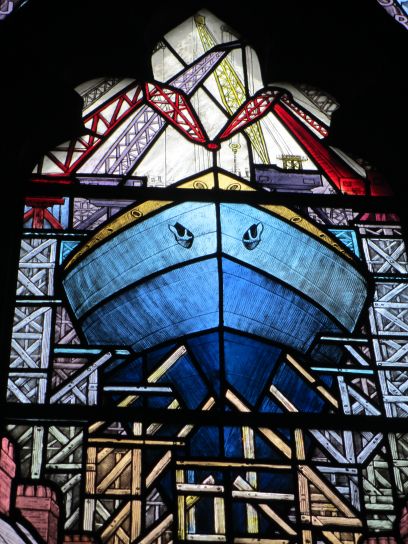
Many of the pigments are based on
coloured
transition metal compounds.
Now that's what you call a light filter
display from stained glass window panels! (medieval Chester Cathedral)
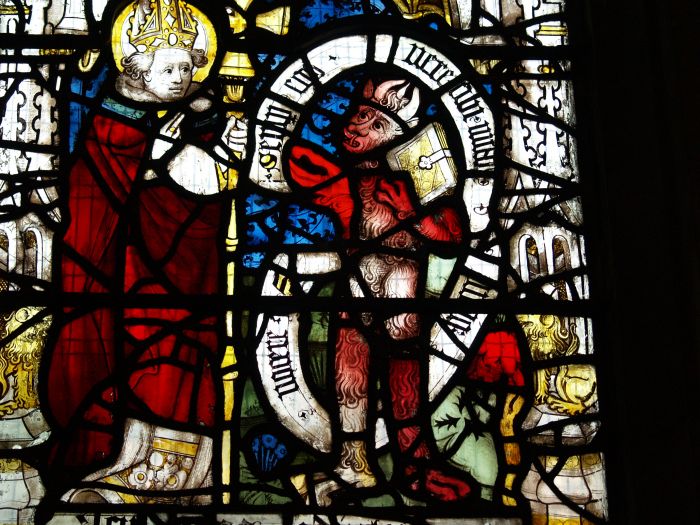
I love the 'red devil' in this medieval
stained glass window, St Martin-le-Grand Church, York, England
Medieval monks were skilled at mixing
mineral pigments to colour the glass - very expensive work!
They made good use of all the primary
colours of red, green and blue and the secondary colour yellow.
Over a thousand years ago they were
producing yellow and green stained glass using iron oxides, but other
colours soon came along. Copper minerals could produce red or blue glass and
lots of colour appeared in the great cathedrals of Europe from the late 12th
century onwards.
Art and chemistry, what a combination!
OK it is physics too! So,
including the wonderful appreciative
'eye', lets called it art + science = manufactured beauty!
Light filters are widely used at pop concerts and stage
lighting in the theatre.
INDEX of my physics notes: The
visible spectrum and colour of objects
Key points for
COLOUR - visible light filters and their applications
Information
sources for Doc Brown's key points: IGCSE-GCSE physics are based on textbooks
& syllabus-specifications for students taking the UK AQA,
Edexcel, OCR 21st Century Science, OCR Gateway science suite, WJEC, CCEA &
CIE GCSE
physics 9-1 level science examinations.
A syllabus-aligned
revision guide on visible light filters and the
observed colour of objects under different lighting, tailored
for students preparing for GCSE/IGCSE Physics across
WJEC, CCEA, CIE, AQA, Edexcel, and OCR:
What Are Colour Filters?
- Colour filters
work by absorbing certain wavelengths of light and
transmitting others.
- The colour of the filter is the
only colour of light it allows through.
- A red filter
transmits only red light and absorbs all other colours.
- A blue filter
transmits only blue light, and so on.
Tip:
Think of filters as “light colour selectors” — they let through only
their own colour.
Observed Colour of Objects Under Filtered
Light
The colour an object appears
depends on:
- The colour of light
illuminating it.
- The colour(s) the object
reflects.
Examples:
| Object Colour |
Light Colour |
Observed Colour |
Why? |
| Red |
White |
Red |
Reflects red, absorbs others |
| Red |
Green |
Black |
No red light to reflect |
| White |
Blue |
Blue |
Reflects all colours, so reflects
blue |
| Blue |
Red |
Black |
No blue light to reflect |
| Yellow |
Red |
Red |
Yellow reflects red + green; only
red is available |
| Cyan |
Blue |
Blue |
Cyan reflects blue + green; only
blue is available |
Tip:
If the object can’t reflect the colour of the light shining
on it, it appears black.
Secondary Colour Filters
- Cyan filter
transmits blue and green.
- Magenta filter
transmits red and blue.
- Yellow filter
transmits red and green.
These are useful for analysing how
combinations of colours affect object appearance.
Required Practical Applications
- Shine white light
through different filters onto coloured objects.
- Observe and record the
apparent colour of the object.
- Use this to understand
absorption and reflection of light.
Exam Tips for Students
- Use correct terminology:
transmit, absorb, reflect.
- Be ready to explain why an
object appears black under certain lighting.
- Practice drawing ray diagrams
showing filtered light hitting objects.
- Revise additive colour mixing
to understand how filters affect light.
- Apply logic:
Ask “Is the object able to reflect the light that’s hitting it?”
Keywords, phrases and learning objectives for
visible light and colour filter
effects
Know and be able to explain the effects of visible light filters
on the observed colour of objects illuminated by variety of coloured
filters.
Be able to predict the observed colour of an object
when illuminated with 'filtered' light.
WHAT NEXT?
TOP of page
INDEX of physics notes: The
visible spectrum and colour
INDEX of all notes on waves, radiation,
astronomy etc.
INDEX of all my PHYSICS NOTES
email doc
brown - comments - query?
BIG website, using the [SEARCH
BOX] below, maybe quicker than navigating the
many sub-indexes
HOME PAGE of Doc Brown's Science
Basic Science Quizzes for
UK KS3 science students aged ~12-14, ~US grades 6-8
Biology * Chemistry
* Physics for UK
GCSE level students aged ~14-16, ~US grades 9-10
Advanced Level Chemistry
for pre-university age ~16-18 ~US grades 11-12, K12 Honors
Find your GCSE/IGCSE
science course for more help links to all science revision notes
Revision notes on explaining &
describing the use of visible light filters based on the syllabus-specifications
for students taking IGCSE/GCSE level physics examinations, summary
revision notes and key points on explaining & describing the use of
visible light filters for students taking the AQA
igcse/gcse physics notes on explaining & describing the use of visible light
filters, Edexcel gcse
physics notes on explaining & describing the use of visible light
filters, OCR 21st century GCSE
physics notes on explaining & describing the use of visible light
filters, OCR gateway
GCSE physics notes on explaining & describing the use of visible
light filters, WJEC gcse physics notes on explaining & describing
the use of visible light filters, CCEA
gcse physics notes on explaining & describing the use of visible light
filters for students taking CIE Cambridge igcse
physics, exam revision notes on
explaining & describing the use of visible light filters, useful for US grade 9-10 physics courses,
importance of the colour of objects
subjected to filtered visible light
in GCSE level physics, What you need to know about the colour of objects
subjected to filtered visible light for
GCSE level
physics,
Explaining the use of the colour of objects subjected to filtered
visible light knowledge in GCSE level physics, Examples of
the colour of objects subjected to filtered visible light explained
when studying GCSE level physics, What is
significant about the colour of objects subjected to filtered visible
light, describing the theory of the colour of objects subjected
to filtered visible light when studying
GCSE level physics, revision notes for the colour of objects subjected
to filtered visible light in exams, online exam help
for the colour of objects subjected to filtered visible light, revision notes about
the colour of objects subjected to filtered visible light, what do I need to learn about
the colour of objects subjected to filtered visible light for
by GCSE physics exam?
help to understand the colour of objects subjected to filtered
visible light topic in preparation for GCSE physics exam
question, how to
prepare for questions involving the colour of objects subjected to
filtered visible light in a GCSE physics examination?
SITEMAP
Website content © Dr
Phil Brown 2000+. All copyrights reserved on Doc Brown's physics revision notes, images,
quizzes, worksheets etc. Copying of website material is NOT
permitted. Exam revision summaries and references to GCSE science course specifications
are unofficial.
INDEX of my physics notes: The
visible spectrum and colour of objects
|


 ▲
▲