|
GCSE level physics exam revision notes: velocity & acceleration
Forces and Motion 2.5
Forces and
circular motion - including acceleration and centripetal force
[Author
©
Dr Phil Brown PhD:
Doc Brown's physics exam revision notes suitable for students of UK
IGCSE & GCSE level physics courses, ~ US grades 9-10 physics
[updated
Mar 20th 2026 *]
[ KEY
POINTS and learning objectives for this page, after initial notes]
email doc
brown: problems?, comments? query?
*
[privacy & cookies policies & disclaimer]
INDEX for notes on
acceleration, deceleration, constructing and interpreting
velocity/speed-time
graphs
2.5
Forces and
circular motion - including acceleration and centripetal force
This section was adapted, re-edited and extended from the web page including
a section on Gravity and circular
motion.
Velocity is a vector quantity, it has both size (the
speed) and direction.
If either the speed or direction changes, you have a
change in velocity - you have an acceleration!
With this in mind, imagine whirling a
conker around on the end of a piece of string, the moon orbiting Earth
or planets orbiting the Sun.
What velocity are we dealing with? What force are we
dealing with?
When an object goes round in a circle
at a constant speed its direction is continually changing.
Even though the speed is constant,
because direction changes, the
velocity
(a vector)
is continually changing.
Therefore, if the velocity is
changing, you must be dealing with an
acceleration, even though the speed is
constant.
To maintain this accelerating
circular motion, there must be a force operating to maintain the
circular path.
This is called the
centripetal force - it can be the tension in a string
as you whirl an object around or gravity holding some large object in
orbit.
The direction of acceleration is
inwards, the same direction as the centripetal force, and at 90o
to the direction of motion.
(You don't have to know this, but the
acceleration of an object moving at a constant speed in a circle
is v2/r, but this is NOT constant velocity)
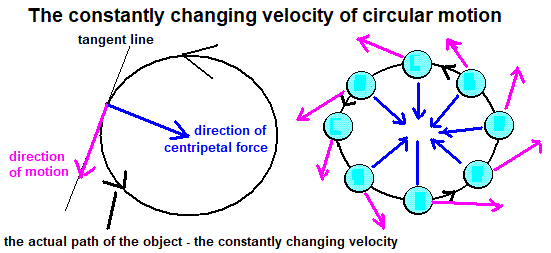
circular motion - velocity & centripetal force
To keep a body moving in a circle there must be a force
directing it towards the centre of the path of motion.
This is called the
centripetal force and produces the continuous change in direction
of circular motion.
Even though the speed may be constant, the object is
constantly
accelerating because the direction is constantly changing via
the circular path - i.e.
the velocity is constantly changing (purple arrows, on the diagram).
For an object to be accelerated, it
must be subjected to a force that can act on it - Newton's 1st law of
motion.
Here the
resultant centripetal force
is acting towards the centre, so always directing the object to 'fall'
towards the centre of motion (blue arrows on the diagram).
But the object is already moving, so
the force causes it to change direction.
SO, the actual
circular path of motion is determined by
the resultant centripetal force (black arrows and circle) and the
circling object keeps accelerating towards what it is orbiting.
The centripetal force stops the
object from going off at a tangent in a straight line.
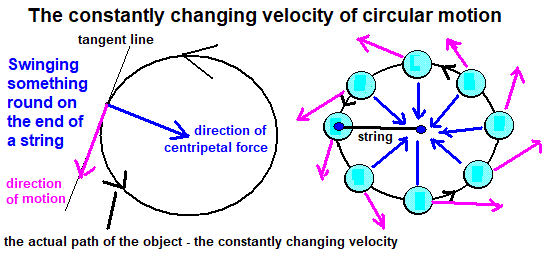
Swinging something round on a string.
When you swing something round on the end of a string, the tension in the string is the centripetal force.
Imagine whirling a conker round on
the end of a string.
You yourself feel this force of tension as the 'pull' in
the string (I've marked in a black line to represent the string).
If you could use a fast action camera to monitor the
motion and the string broke, you would observe the object would fly off
at the precise tangent to the circular path and in a straight line of
constant velocity - the result resultant of Newton's 1st law!
Since gravity and air friction act on the object, you do
have to keep on 'inputting' kinetic energy to keep it swinging round.
The centripetal force will vary with the mass of the object,
the speed of the object and the radius of the path the object takes.
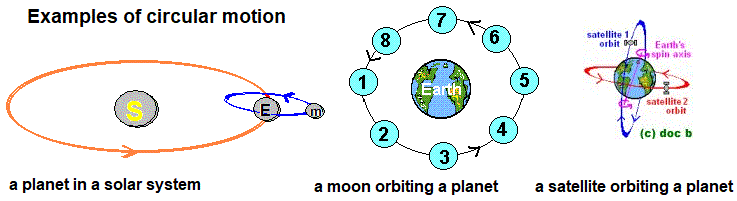
The same arguments on circular motion apply to the movements
of planets around a sun, a moon around a planet and a satellite orbiting a
planet. The orbits are usually elliptical, rarely a perfect circle, but the
physics is the same.
In these cases, it is the force of gravitational attraction
that provides the centripetal force and it acts at right angles to the
direction of motion.
You should also realise that they are moving through empty
space (vacuum), so there are no forces of friction to slow the object down.
This is why the planets keep going around
the Sun and the moon keeps going around the Earth.
When satellites are put into orbit they
are given just the right amount of horizontal velocity so that the resultant centripetal force of gravity keeps the satellite in its a
circular orbit.
You can vary this horizontal velocity to
position satellites at different distances above the Earth's surface.
Notes index on
acceleration, deceleration,
velocity/speed-time
graphs
Key points
about
acceleration and deceleration
Information
sources for Doc Brown's key points: IGCSE-GCSE physics are based on
textbooks & syllabus-specifications for students taking the UK AQA, Edexcel,
OCR 21st Century Science, OCR Gateway science suite, WJEC, CCEA and CIE GCSE
physics 9-1 level science examinations
A structured set of summary revision notes on
Forces and Circular Motion, tailored to the major UK
GCSE/IGCSE exam boards: WJEC, CCEA, CIE, AQA, Edexcel, OCR.
These notes cover key academic content including acceleration,
centripetal force, and orbital motion-plus tips to help
students tackle exam questions with confidence.
Circular Motion: Core Concepts
What Is Circular Motion?
- Motion along a circular path at constant speed
- Velocity is a vector-so even if speed is constant,
changing direction means changing velocity
- Therefore, circular motion involves acceleration
Centripetal Force
- The resultant force that keeps an object moving in
a circle
- Always acts towards the centre of the circle
- Not a new type of force-it can be:
- Tension (e.g. string)
- Friction (e.g. car tyres)
- Gravity (e.g. planets orbiting the Sun)
Centripetal Acceleration
- Formula:
a = v2/r
where:
- (v) = velocity (m/s)
- (r) = radius of the circle (m)
- Centripetal force:
F = mv2/r
where:
- (m) = mass (kg)
- Remember F = ma
Orbital Motion: Moons, Planets
and
Satellites
Natural Satellites (e.g. Moon)
- Orbit due to gravitational attraction
- Speed and radius determine orbital period
Planets
- Orbit the Sun in elliptical paths
- Gravitational force provides centripetal force
Artificial Satellites
- Used for communication, GPS, weather monitoring
- Geostationary orbit: 24-hour period, stays above
same point on Earth
- Low Earth orbit: shorter period, used for imaging
and data collection
Typical Exam Board Specification content
|
Key Focus Areas |
| Forces in circular motion, orbital
motion, gravitational force |
| Centripetal acceleration,
satellite motion, vector analysis |
| Calculations involving F = mv2/r,
orbital speed, applications |
| Real-world examples, graphical
interpretation, Newton’s laws in circular motion |
Student Exam Tips
- Understand vector quantities: velocity changes even
if speed doesn’t
- Learn to apply formulas for centripetal force and
acceleration
- Use real-world examples: satellites, theme park
rides, planetary motion
- Practice explaining why circular motion involves
acceleration
- Watch out for unit conversions (e.g. km to m, hours
to seconds)
- Sketch diagrams showing direction of velocity and
centripetal force
More examples of circular
motion
Circular motion is everywhere once you start looking for it! Here are
some engaging real-life examples that span everyday life, nature, and
technology:
Everyday Examples
- Ceiling fan blades rotating around a central hub
- Washing machine drum spinning during the rinse
cycle
- Merry-go-rounds and Ferris wheels
at amusement parks
- Stirring batter or tea with a spoon in a circular
path
- Analogue clock hands sweeping around the dial
Transport and Engineering
- Car wheels rotating as the vehicle moves
- Cars turning on curved roads, especially banked
tracks
- Rotors in helicopters and propellers in
drones
- Crankshafts in engines converting circular motion
into linear motion
Natural Phenomena
- Earth orbiting the Sun (elliptical but nearly
circular)
- Moon orbiting Earth
- Electrons revolving around the nucleus in atomic
models
- Water spiraling down a drain or forming a whirlpool
Sports and Recreation
- Athletes running on circular tracks
- Figure skaters spinning during routines
- Twirling a lasso or spinning a frisbee
- Hammer throw in athletics, where the hammer moves
in a circular path before release
Space and Satellites
- Artificial satellites in orbit around Earth
- Spacecraft performing orbital manoeuvres
- Geostationary satellites maintaining a fixed
position relative to Earth
Industrial and Technological Applications
- Rotating machinery like turbines and motors
- Hard disk drives spinning to read/write data
- Circular saw blades cutting through materials
- Rotary mixers and blenders used in food processing
Keywords, phrases and learning objectives for
circular motion
Be able to describe and explain the f orces involved in circular motion
and the acceleration and
centripetal force holding one object orbiting another in a
gravitational field.
Revision notes on explaining the
forces and velocities involved in circular motion e.g. satellites based on the syllabus-specifications
for students taking IGCSE/GCSE level physics examinations, summary
revision notes and key points on explaining the forces and velocities
involved in circular motion e.g. satellites for students taking the AQA
igcse/gcse physics notes on explaining the forces and velocities involved in
circular motion e.g. satellites, Edexcel gcse
physics notes on explaining the forces and velocities involved in
circular motion e.g. satellites, OCR 21st century GCSE
physics notes on explaining the forces and velocities involved in
circular motion e.g. satellites, OCR gateway
GCSE physics notes on explaining the forces and velocities involved
in circular motion e.g. satellites, WJEC gcse physics notes on
explaining the forces and velocities involved in circular motion
e.g. satellites, CCEA
gcse physics notes on explaining the forces and velocities involved in
circular motion e.g. satellites for students taking CIE Cambridge igcse
physics, exam revision notes on
explaining the forces and velocities involved in circular motion
e.g. satellites, useful for US grade 9-10 physics courses, importance of
explaining
describing acceleration & centripetal forces for circular motion
e.g. moons & planets
in GCSE level physics, What you need to know about explaining
describing acceleration & centripetal forces for circular motion
e.g. moons & planets for
GCSE level
physics,
Explaining the use of explaining describing acceleration & centripetal
forces for circular motion e.g. moons & planets knowledge in GCSE level physics, Examples of
explaining describing acceleration & centripetal forces for circular
motion e.g. moons & planets explained
when studying GCSE level physics, What is
significant about explaining describing acceleration & centripetal
forces for circular motion e.g. moons & planets, describing the theory of
explaining describing acceleration & centripetal forces for circular
motion e.g. moons & planets when studying
GCSE level physics, revision notes for explaining describing
acceleration & centripetal forces for circular motion e.g. moons &
planets in exams, online exam help
for explaining describing acceleration & centripetal forces for circular
motion e.g. moons & planets, revision notes about explaining
describing acceleration & centripetal forces for circular motion
e.g. moons & planets, what do I need to learn about explaining
describing acceleration & centripetal forces for circular motion
e.g. moons & planets for
by GCSE physics exam?
help to understand the explaining describing acceleration & centripetal
forces for circular motion e.g. moons & planets topic in preparation for GCSE physics exam
question, how to
prepare for questions involving explaining describing acceleration &
centripetal forces for circular motion e.g. moons & planets in a GCSE physics examination?
SITEMAP
Website content © Dr
Phil Brown 2000+. All copyrights reserved on Doc Brown's physics revision notes, images,
quizzes, worksheets etc. Copying of website material is NOT
permitted. Exam revision summaries and references to GCSE science course specifications
are unofficial.
Notes index on
acceleration, deceleration,
velocity/speed-time
graphs
|
