|
GCSE level physics exam revision notes all about forces Part
7
Pressure and upthrust in fluids: 7.4 Explaining atmospheric pressure
and variation with height and how suction
caps!
[Author
©
Dr Phil Brown PhD:
Doc Brown's physics exam revision notes suitable for students of UK
IGCSE & GCSE level physics courses, ~ US grades 9-10 physics
[updated
Mar 17th 2026 *]
[ KEY
POINTS and learning objectives for this page, after initial notes]
email doc
brown: problems?, comments? query?
*
[privacy & cookies policies & disclaimer]
INDEX for physics notes: pressure,
forces, weight, upthrust in fluids
7.4
Atmospheric pressure and variation with height and suction
caps!
What causes pressure in the atmosphere?
Why does atmospheric pressure vary with
height?
The density of gases varies considerably with
temperature and pressure.
Gases are very compressible because of
the space between the particles.
You can squeeze the particles of a gas
closer to together if a force is applied to them.
If you increase the temperature and the
gas can expand, the density will decrease.
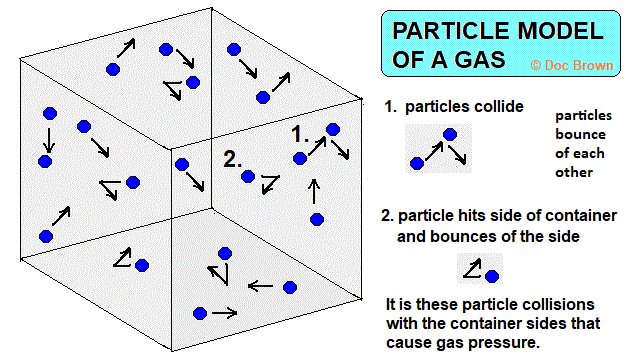
Gas particle model reminder!
Air pressure is caused by the collisions
between and molecules colliding with any surface.
The atmosphere is a mixture of gases (mainly
~1/5th oxygen, 4/5th nitrogen) that surrounds the surface of the Earth.
The atmosphere is relatively thin compared to the radius
of the Earth but does stretch upwards for ~100 km, so there is quite a weight of
air pushing down on us creating what we experience as atmospheric pressure.
However, the force acts in all directions so
the internal pressure inside our body is the same as the external pressure
beyond our skin.
Therefore we do not experience this pressure, we are unaware of
it and we don't change in size!
One of the best demonstrations of
atmospheric pressure is to pump the air out of a big steel can (empty car
oil can is great).
A internal air is removed and the
internal air pressure decreases, the external air pressure crushes the can
inwards.
If you haven't got a suitable pump, if
you boil water in the can and fill it with steam, screw the cap on and leave
to cool.
As the steam condenses, the internal
gas pressure decreases and the greater external air pressure crushes the
can sides in with great sound effects and wicked distortions of its
original shape.
You should observe that the can's
sides collapse in all directions because pressure in a fluid acts in all
directions.
You need to be able to explain this
effect by considering the relative number of particle collisions on
either side of the can walls, hence the relative total force and
pressure differences.
A
mention of suction caps, what do we use them for and how do they work!
Suction caps are used in many commercial and
industrial applications e.g.
To fix objects to nonporous smooth vertical
surfaces such as refrigerator doors and tiled walls.
To safely move large smooth objects such as panes
of glass or automobile windscreens.
You can buy toy darts that will stick on a smooth
dart board.
So, how do they work?
 How a suction
cap works
How a suction
cap works
A suction cap is made of a flexible plastic or
rubber materials.
In sticking the suction cap on a surface you
squeeze out most of the air and on release you create a partial vacuum.
This reduces the number of particle collisions on the 'internal' surface
of the suction cap.
However, the external surface of the suction cap,
experiences all the collisions of air in contact with the surface.
Therefore the external pressure on the outer
surface is much greater than the internal pressure and the pressure
difference sticks the suction cap on the smooth surface.
It must be a smooth surface, otherwise air
molecules will leak out though any microscopic gap, reducing the
pressure and whatever is held by the suction cap falls off.
Atmospheric pressure, causes and
variation with height above the Earth's surface

The graph on the left shows in principle how
the atmospheric pressure varies with height above the Earth's surface (altitude).
Atmospheric pressure is also referred to as barometric pressure i.e. as
measured by a barometer.
At the surface (height of zero km taken as
sea level) it is normally close to an average of 101300 Pa (~101 kPa).
At the top of the world's highest mountain,
Mount Everest in Nepal, the air is much thinner at ~8800 m above sea level. Here
the pressure is only ~33000 Pa (~33 kPa) which is why breathing is much more
difficult. Although your internal and external body pressures are equal, you
take in less air-oxygen in each breath so all physical work is much harder than
at sea level.
The first mountaineers to reach the summit used cylinders of
oxygen, but today's super-fit climbers can manage on just thin air! The local
Sherpa's come from an ethnic mountain population that have evolved in several
ways to cope with the local conditions e.g. their mitochondria are more
efficient at using oxygen in respiration and blood flow in small blood vessels
doesn't decrease as much as happens with non-Sherpa people.
The atmospheric pressure around us is
caused by the collision of air molecules on any surface AND, quantitatively, by the weight of the gas
above you (note there are two contributions to atmospheric pressure).
So why does atmospheric pressure vary with
height?
At very high altitudes there is little air, far
few collisions, less weight of gas above and so the pressure tends towards zero
Pa.
The greater the height/depth of a gas, the
greater the weight of particles that gravity is pulling down to the Earth's
surface, hence the increase
in force per unit area the lower the level i.e. increase in pressure towards the
Earth's surface - where the atmospheric pressure will be the greatest.
As you increase in height above the Earth'
surface (increase in altitude) the atmospheric pressure decreases.
This is because the air is less dense and so
less collisions can take place in a given volume AND there is less weight of
molecules above a given altitude created by the downward force from the Earth's
gravitational field.
Therefore the greatest atmospheric pressure
will be the greatest at the Earth's surface.
To express and explain the trend in another
way:
The increase in pressure the nearer you are
to the Earth's surface, is due to the greater density - hence more collisions
in the same volume AND the greater the weight of air above you - the greater force per unit area.
The
weight of air above a certain height compresses the atmospheric gases below
that level and compression means increase in pressure (ignoring any
temperature differences) from more collisions between molecules.
Just as with liquid fluids discussed
above, gases are fluids and the weight of them acting downwards creates a
pressure in the same way AND acting in all directions.
At a given height above the Earth's surface, there
are relatively small variation in the density and pressure of the atmosphere
around (often <20% variation).
However, most
weather systems are driven by regions of higher or lower pressure
compared to the average atmospheric pressure at that height.
If you look at
weather charts on the TV weather forecast you will see a 'high' (H) area
with a number like 1029 by it, conversely, a 'low' (L) might have a
number like 986 by it.
The average surface atmospheric pressure is ~1000
millibars (but don't worry about this unit, but 1 millibar = 0.1 kPa).
Barometers are used to measure
atmospheric pressure and can indicate weather changes e.g. rise in
barometric (fair weather, more sunny) or fall in barometric pressure (poorer
weather e.g. rain).
Since the atmosphere gets less dense (less
pressure) on breathing you take in less oxygen as you ascend to greater heights
above the Earth's surface.
This is why many early mountaineers
carried cylinders of oxygen to assist more efficient breathing.
Atmospheric pressure can be measured with a mercury barometer,
though this is being replaced by electronic pressure transducers.
INDEX for physics notes: pressure,
forces, weight
and upthrust in fluids
Key points
about
pressure in fluids - atmospheric pressure
Information
sources for Doc Brown's key points: IGCSE-GCSE physics are based on
textbooks & syllabus-specifications for students taking the UK AQA, Edexcel,
OCR 21st Century Science, OCR Gateway science suite, WJEC, CCEA and CIE GCSE
physics 9-1 level science examinations
A structured set of summary revision notes on
what causes atmospheric
pressure and why it varies, tailored to the major UK GCSE/IGCSE
physics exam boards: WJEC, CCEA, CIE, AQA, Edexcel, and OCR.
These notes cover the physics principles, causes, variations,
board-specific content, and student tips.
What Is Atmospheric Pressure?
- Definition:
Atmospheric pressure is the force per unit area exerted
by air molecules colliding with surfaces.
- Cause:
It’s created by the weight of the air above a surface
and the collisions of gas particles in the atmosphere.
- Standard Value at Sea Level:
- Approximately 101.3 kPa
or 1 atm
Why Does Atmospheric Pressure Vary?
| Factor |
Explanation |
| Altitude |
Higher altitude → fewer air
molecules above → lower pressure |
| Air Density |
Denser air → more particles → more
collisions → higher pressure |
| Temperature |
Warmer air → particles move faster
→ more collisions → higher pressure |
| Weather Systems |
High-pressure systems = clear
skies; low-pressure systems = clouds/storms |
| Humidity |
More water vapour → lower air
density → lower pressure |
| Local Conditions |
Pressure can vary with terrain,
buildings, and wind patterns |
Typical Exam Board Syllabus Content
- Covers particle collisions,
pressure variation with altitude, and
weather effects
- Includes barometers,
manometers, and practical demonstrations
(e.g. crushed can)
- Emphasises weight of air,
density, and
pressure changes with height
- Includes real-world
applications and
experimental methods
- Requires understanding of
pressure due to gases, altitude effects, and
barometric readings
- Includes pressure gradients
and force-area
relationships
- Triple science includes
atmospheric pressure, altitude variation, and
weather links
- Higher tier explores
density and particle motion
- Covers pressure from gases,
altitude effects, and
fluid pressure comparisons
- Includes graphical analysis
of pressure versus height
- Includes atmospheric pressure,
density, and
altitude relationships
- Focus on pressure differences,
weather systems, and
practical applications
Student Tips for Exam Success
- Understand particle model:
Pressure is due to collisions of air molecules
- Memorise key facts:
Pressure decreases with altitude; standard pressure at sea level
- Use diagrams:
Show pressure gradients and particle density at different heights
- Revise barometers and
manometers: Know how they
measure pressure
- Link to real-world examples:
Aircraft cabins, weather balloons, mountain climbing
- Practice graph questions:
Pressure versus altitude is a common exam format
- Use past papers:
Spot trends in how pressure variation is assessed
Keywords, phrases and learning objectives for
upthrust in fluids
Be able to explain atmospheric pressure and how it
varies in height above the Earth's surface.
Know you can measure pressure with a mercury barometer,
though this is being replaced by electronic pressure transducers.
Know that mountaineers encounter problems at high
altitude due to low pressure and consequent low oxygen levels.
Be able to explain in terms of atmospheric pressure how a suction caps works.
WHAT NEXT?
TOP of page
INDEX for physics notes: pressure
and upthrust in fluids
INDEX of all my physics notes on FORCES
INDEX of all my physics notes on FORCES
and MOTION
INDEX of all my PHYSICS NOTES
email doc
brown - comments - query?
BIG website, using the [SEARCH
BOX] below, maybe quicker than navigating the
many sub-indexes
Basic Science Quizzes for
UK KS3 science students aged ~12-14, ~US grades 6-8
Biology * Chemistry
* Physics for UK
GCSE level students aged ~14-16, ~US grades 9-10
Advanced Level Chemistry
for pre-university age ~16-18 ~US grades 11-12, K12 Honors
Find your GCSE/IGCSE
science course for more help links to all science revision notes
Revision notes on explaining why
atmospheric pressure varies with height based on the syllabus-specifications
for students taking IGCSE/GCSE level physics examinations, summary
revision notes and key points on explaining why atmospheric pressure
varies with height for students taking the AQA
igcse/gcse physics notes on explaining why atmospheric pressure varies with
height, Edexcel gcse
physics notes on explaining why atmospheric pressure varies with
height, OCR 21st century GCSE
physics notes on explaining why atmospheric pressure varies with
height, OCR gateway
GCSE physics notes on explaining why atmospheric pressure varies
with height, WJEC gcse physics notes on explaining why atmospheric
pressure varies with height, CCEA
gcse physics notes on explaining why atmospheric pressure varies with
height for students taking CIE Cambridge igcse
physics, exam revision notes on
explaining why atmospheric pressure varies with height, useful for US grade 9-10 physics courses,
importance of explaining how a suction
cap works due to atmospheric pressure
in GCSE level physics, What you need to know about explaining how a
suction cap works due to atmospheric pressure for
GCSE level
physics,
Explaining the use of explaining how a suction cap works due to
atmospheric pressure knowledge in GCSE level physics, Examples of
explaining how a suction cap works due to atmospheric pressure explained
when studying GCSE level physics, What is
significant about explaining how a suction cap works due to atmospheric
pressure, describing the theory of explaining how a suction cap
works due to atmospheric pressure when studying
GCSE level physics, revision notes for explaining how a suction cap
works due to atmospheric pressure in exams, online exam help
for explaining how a suction cap works due to atmospheric pressure, revision notes about
explaining how a suction cap works due to atmospheric pressure, what do I need to learn about
explaining how a suction cap works due to atmospheric pressure for
by GCSE physics exam?
help to understand the explaining how a suction cap works due to
atmospheric pressure topic in preparation for GCSE physics exam
question, how to
prepare for questions involving explaining how a suction cap works due
to atmospheric pressure in a GCSE physics examination?
SITEMAP
Website content © Dr
Phil Brown 2000+. All copyrights reserved on Doc Brown's physics revision notes, images,
quizzes, worksheets etc. Copying of website material is NOT
permitted. Exam revision summaries and references to GCSE science course specifications
are unofficial.
INDEX for physics notes: pressure,
forces, weight
and upthrust in fluids
|
