|
GCSE level physics exam revision notes all about forces Part 7 Pressure and upthrust in fluids: 7.2 Some 'kitchen sink' experiments on density in the home using everyday objects! [Author © Dr Phil Brown PhD: Doc Brown's physics exam revision notes suitable for students of UK IGCSE & GCSE level physics courses, ~ US grades 9-10 physics [updated Mar 17th 2026 *][ KEY POINTS and learning objectives for this page, after initial notes]email doc brown: problems?, comments? query? * [privacy & cookies policies & disclaimer] INDEX for physics notes: pressure, forces, weight, upthrust in fluids 7.2 Some 'kitchen sink' experiments on density in the home! Density experiments using an apple, ice and wooden blocks in water.
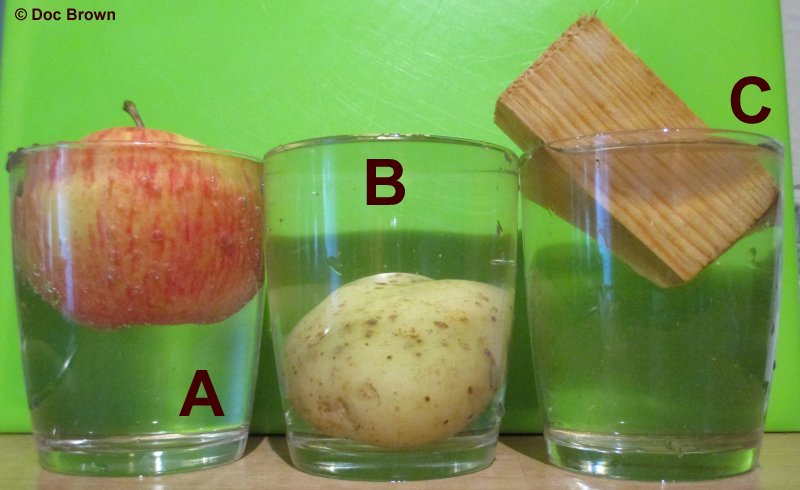
A The apple has a density of ~900 kg/m3 and floats on water, of density 1000 kg/m3
B This particular potato has a density greater than water and sinks, so we have no idea what its density might be.
C The block of wood has density of ~500 kg/m3 (half of that of water) and floats (it toppled over!) - its density is half that of water and is only half submerged - can you reason out why it is only half submerged?
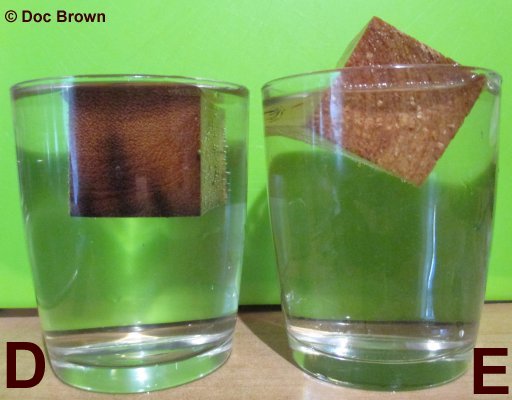
D A block of wood of density ~1000 kg/m3, the same density as water, so it floats with its upper surface coincident with the surface of water.
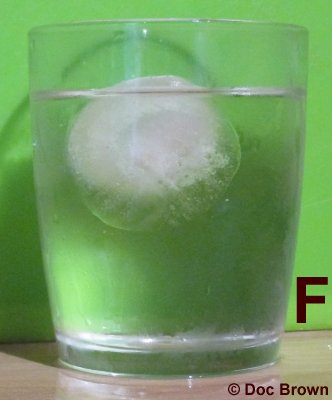
E Another block of wood of density ~600 kg/m3, so more of it is immersed in water than the other less dense bloc of wood above. F I made a small 'barrel' of ice and placed in the beaker of water. Since ice has a density of 917 kg/m3, it floats on water.
INDEX for physics notes: pressure, forces, weight and upthrust in fluids about pressure in fluids - home experiments on density Information sources for Doc Brown's key points: IGCSE-GCSE physics are based on textbooks & syllabus-specifications for students taking the UK AQA, Edexcel, OCR 21st Century Science, OCR Gateway science suite, WJEC, CCEA and CIE GCSE physics 9-1 level science examinations
Core Concept: What Is Density?
Easy Home Experiments on density1. Regular Solids (e.g. book, block, toy brick)
2. Irregular Solids (e.g. stone, key, toy)
3. Liquids (e.g. water, oil, syrup)
Fun Variations of density experiments
Student Exam Tips (for any practical on density!)
Keywords, phrases and learning objectives for simple float or sink experiments in the home
WHAT NEXT? INDEX for physics notes: pressure and upthrust in fluids INDEX of all my physics notes on FORCES INDEX of all my physics notes on FORCES and MOTION email doc brown - comments - query? BIG website, using the [SEARCH BOX] below, maybe quicker than navigating the many sub-indexes Basic Science Quizzes for UK KS3 science students aged ~12-14, ~US grades 6-8 Biology * Chemistry * Physics for UK GCSE level students aged ~14-16, ~US grades 9-10 Advanced Level Chemistry for pre-university age ~16-18 ~US grades 11-12, K12 Honors Find your GCSE/IGCSE science course for more help links to all science revision notes importance of home experiments on density with everyday objects in GCSE level physics, What you need to know about home experiments on density with everyday objects for GCSE level physics, Explaining the use of home experiments on density with everyday objects knowledge in GCSE level physics, Examples of home experiments on density with everyday objects explained when studying GCSE level physics, What is significant about home experiments on density with everyday objects, describing the theory of home experiments on density with everyday objects when studying GCSE level physics, revision notes for home experiments on density with everyday objects in exams, online exam help for home experiments on density with everyday objects, revision notes about home experiments on density with everyday objects, what do I need to learn about home experiments on density with everyday objects for by GCSE physics exam? help to understand the home experiments on density with everyday objects topic in preparation for GCSE physics exam question, how to prepare for questions involving home experiments on density with everyday objects in a GCSE physics examination? Revision notes on home experiments on density with everyday objects based on the syllabus-specifications for students taking IGCSE/GCSE level physics examinations, summary revision notes and key points on home experiments on density with everyday objects for students taking the AQA igcse/gcse physics notes on home experiments on density with everyday objects, Edexcel gcse physics notes on home experiments on density with everyday objects, OCR 21st century GCSE physics notes on home experiments on density with everyday objects, OCR gateway GCSE physics notes on home experiments on density with everyday objects, WJEC gcse physics notes on home experiments on density with everyday objects, CCEA gcse physics notes on home experiments on density with everyday objects for students taking CIE Cambridge igcse physics, exam revision notes on home experiments on density with everyday objects, useful for US grade 9-10 physics courses SITEMAP Website content © Dr Phil Brown 2000+. All copyrights reserved on Doc Brown's physics revision notes, images, quizzes, worksheets etc. Copying of website material is NOT permitted. Exam revision summaries and references to GCSE science course specifications are unofficial.
|