|
GCSE level physics: The
National Grid supply:
Part 6.1
Examples of how the electricity supply system works
from power station to home and industry and how it deals with power demands
through the day - solving the problem of peak demand
[Author
©
Dr WP Brown PhD:
Doc Brown's physics exam revision notes suitable for students studying UK
IGCSE & GCSE level physics courses, ~ US grades 9-10 physics, page updated
Feb 16th 2026 *]
[KEY
POINTS and learning objectives for this page, after initial notes]
*
[email doc b]
*
[privacy]
INDEX for physics notes on
National Grid power supply, use of transformers-calculations and
environmental issues
6.1
Examples of a National Grid System electricity supply - how the system works
from power station to home and industry
The issue of variation of electricity demand
- meeting industrial and consumer needs through the day
Introduction - basic description
How do power stations link up with the
National Grid?
What do we use transformers for in the
National Grid system?
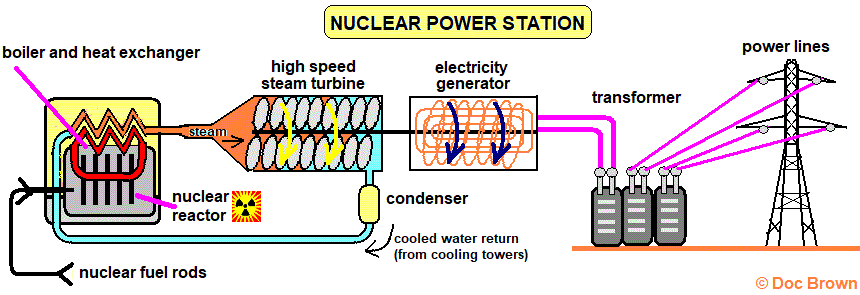
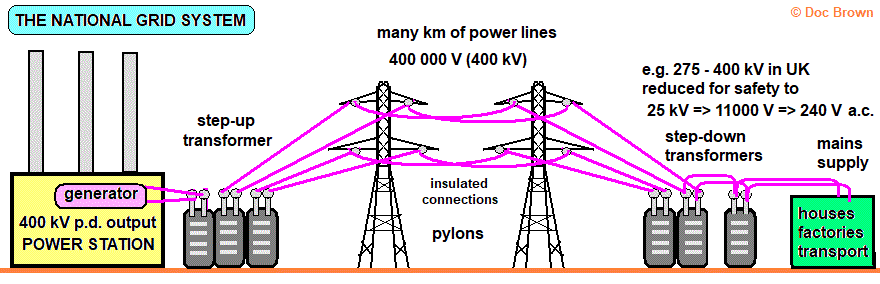
Below are diagrams illustrating
an
overall 'picture' of how National Grid system of electrical power supply works

The power lines and transformers form the
first part of the National Grid
system, a country's electrical power supply.
-
Know that electricity is distributed
from power stations to consumers along the National Grid
-
You should be able to identify
and label the essential parts of the National Grid.
-
The National Grid consists of a
vast electricity distribution network of transformers, pylons and suspended cables
- insulated power lines running for long distances across the landscape.
-
They are somewhat unsightly, but
essential for providing bulk electrical power to towns of homes, shops and
factories.
-
All major power stations feed
into the National Grid irrespective of their geographical location and many
are needed to service millions of users in homes, transport and industry
right across the country.
-
You see them stretching for
miles and miles across the landscape to supply you, the consumer, very
conveniently with a constant (well nearly!) supply of electricity to your
city, town or village across the vast majority of the country.
-
Eventually the power is delivered, very
conveniently, into your home as a consumer or factory etc. via
transformers that reduce the voltage in stages.
-
-
power station: energy resource to
drive turbine ==> to drive generator ==> step-up
transformer ==> grid system of pylons or underground cables ==> step-down transformer ==> user/consume
-
For non-renewable energy power
stations: chemical/nuclear energy store (fuel) ==> thermal energy
store (hot water) ==> kinetic energy store (turbine and
generator) ==> electrical energy (National Grid)
-
The largest power stations are usually
non-renewable fossil (oil, coal, gas) or nuclear fuelled.
-
The heat generated boils water to power a
steam turbine which in turn drives the generator.
-
The generator (a large alternator)
consists of a powerful rotating electromagnet that induces a high p.d.
alternating current in coils of copper wire.
-
There are several copper coils all joined
together in parallel to produce a single output from the generator.
-
Natural gas power stations are the
cheapest to build and relatively rapid start-up time.
-
Nuclear power stations are the most
costly to build and have the longest start-up time.
-
The National Grid system of electricity
supply MUST work off an alternating current (ac) for several reasons,
and one important factor is that transformers only work using ac.
-
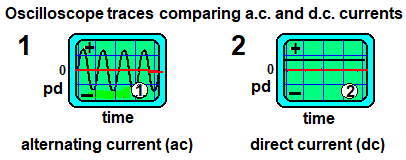
With alternating current (ac), the
current changes direction in a cycle e.g. 5O Hz.
-
With direct current (dc) there is
no reversal in current direction, it flows one way with a constant voltage.
-
-
Oscilloscope traces comparing ac and dc
current signals - showing the alternating + <=> - oscillation of the
alternating current p.d. and the constant p.d. of a direct current.
-
Note that some devices in the home work
off a dc current - but the output from e.g. the transformer in your computer
power supply, is rectified to convert it to a dc supply.
-
In the UK the generator output at the
power station is 25 kV.
-
A step-up transformer increases the p.d.
(voltage) to 400 kV in the UK for power line transmission.
-
A step-down transformer decreases the
p.d. (voltage) of the power line transmission to more suitable and safer
levels for home and industry (typically 230 and 11000 V).
-
A substation will decrease the p.d. even
more down to ~230-240 V that is cabled into your house - your domestic
electricity supply - which operates on a frequency of 50 Hz (50 cycles per
second - the rate of current reversal of the alternating current).
-
See
Electricity section12.
Generator effect, applications e.g. generators
generating electricity
-
Both the function of generators and
transformers depend on the electromagnetic effect.
-
The scheme described above is
similar for most generation, except that initially for hydroelectric, tidal
and wind power generation, the turbine is rotated directly by these
renewable energy resources of water or wind - no fuel required.
-
For renewable energy power stations:
kinetic energy store (water/wind) ==> kinetic energy store
(turbine and generator) ==> electrical energy (National Grid)
-
The only kind of power generation that
does not require a turbine and generator is the solar panel.
-
For solar power: nuclear energy store
(the Sun) ==> electromagnetic radiation (visible light) ==> electrical energy (National Grid)
-
OR if for charging a battery:
nuclear
energy store (the Sun) ==> electromagnetic radiation (visible
light) ==> electrical energy ==> chemical energy store (battery).
-
-
For more details see ....
-
Renewable energy (1) Wind power and
solar power, advantages and disadvantages
-
Renewable energy (2) Hydroelectric and geothermal power, advantages & disadvantages
-
Renewable energy (3) Wave power and tidal barrage power, advantages & disadvantages
-
All of these renewable energy sources
can contribute to the National Grid system.
A note on variation of electricity demand
- meeting industrial and consumer needs
-
The demand for electricity varies through
the day e.g. there are peak times in the morning and evening and low demand
through the night.
-
Peak times are associated with cooking
and transport needs and demands will increase in the winter when more energy
is used for heating.
-
Power companies know the demand patterns
and can adjust to society's needs.
-
Power stations do not run at their
maximum output, there must be spare capacity most of the time, so if there
is suddenly a huge increase in demand, it can be taken care of.
-
There might be an unplanned shut-down of
a power station due to unforeseen circumstances.
-
There are smaller power stations on
standby that can be quickly brought into use.
-
There are also pumped-storage systems
that are very useful to meet electricity demands at peak times.
-
See
Renewable energy (2) including
Hydroelectric power
-
INDEX of notes on
National Grid power supply & use of transformers
Key points about
the
electrical power industry - the National Grid system
Information
sources for Doc Brown's key points: IGCSE-GCSE physics are based on
textbooks & syllabus-specifications for students taking the UK AQA, Edexcel,
OCR 21st Century Science, OCR Gateway science suite, WJEC, CCEA and CIE GCSE
physics 9-1 level science examinations
A comprehensive and
exam-board-friendly set of revision notes on the electricity supply system—from power station to plug
socket—tailored for GCSE/IGCSE Physics students across AQA, Edexcel, OCR,
WJEC, CCEA, and CIE.
The Electricity
Supply System: From Power Station to Home and Industry
1.
Power Stations: Generating Electricity
- Primary energy sources
(e.g. fossil fuels, nuclear, wind, solar) are used to generate electricity.
- Most power stations use thermal
energy to heat water → steam turns turbines → turbines drive
generators.
- Electricity is generated at
~25,000 V.
2.
The National Grid
A network of cables and transformers
that delivers electricity from power stations to consumers.
Key Components after
the generator output:
| Component |
Function |
| Step-up Transformer |
Increases voltage to ~400,000
V to reduce current and minimise energy loss
as heat. |
| Transmission Cables |
Carry high-voltage electricity across
long distances. |
| Step-down Transformer |
Decreases voltage to 230 V
(UK standard) for safe domestic/industrial use. |
| Substations |
Local transformers that further reduce
voltage before entering homes or factories. |
3.
Domestic and Industrial Supply
- Homes
receive 230 V a.c. at 50 Hz.
- Industry
may receive higher voltages depending on demand.
- Appliances are connected via
three-core cables: live (brown), neutral (blue), earth
(green/yellow).
Managing Power Demand Throughout the Day
Daily Demand Pattern:
- Morning peak:
kettles, showers, heating.
- Midday dip:
lower domestic use, steady industrial use.
- Evening peak:
cooking, lighting, entertainment.
- Night:
lowest demand.
Meeting Demand:
- Base load:
constant supply from nuclear or large fossil fuel stations.
- Variable demand:
met by gas-fired stations (quick start-up) or
hydroelectric (instant response).
- Renewables:
contribute when available (e.g. solar during day, wind when windy).
Exam Tips for Students
Key Concepts to Memorise:
- Voltage levels: 25,000 V (generation),
400,000 V (transmission), 230 V (domestic).
- Transformer roles: step-up versus
step-down.
- Why high voltage = low current = less
energy loss (P = I²R).
- National Grid = efficient, centralised
distribution system.
Common Exam Questions:
- Explain how the National Grid reduces
energy loss.
- Describe the role of transformers.
- Interpret demand graphs and suggest how
supply is adjusted.
- Compare base load and variable demand
sources.
Top Tips for students
- Use Sankey diagrams to
show energy transfers and losses.
- Practice calculation questions
involving power, energy, and efficiency.
- Be able to label diagrams
of the National Grid and plug wiring.
- Link to real-world examples
(e.g. why wind power can’t always meet peak demand).
EXTRA: Case study - examples of managing peak demands
Here are some real-world strategies
and examples of how electricity grids manage peak demand across
different regions and technologies:
Real-World Examples of Peak Demand Management
1.
Grid-Level Energy Storage (China, USA)
- Zhenjiang Project, China:
A 24 MWh battery system stores excess energy during off-peak hours and
releases it during peak times to stabilise the grid.
- North Carolina & Indiana, USA:
Energy storage projects reduce peak demand, lower electricity prices, and
improve reliability.
2.
Industrial Load Shifting
- Manufacturing Facilities:
Some factories use automated systems to shift high-energy
processes (like smelting or refrigeration) to off-peak hours, reducing
strain on the grid and saving on tariffs.
3.
Solar plus Battery Integration (Commercial
Buildings)
- Businesses install solar panels
with battery storage to:
- Store energy during the day.
- Use it during evening peaks.
- Reduce reliance on the grid and avoid
peak-time charges.
4.
Smart Grid and AI Forecasting (Global)
- Smart meters and IoT sensors
monitor real-time usage.
- AI algorithms
predict peak times and adjust supply accordingly.
- Example: In the UK, National Grid ESO uses
demand forecasting models to pre-emptively dispatch
fast-response generators or storage.
5.
Demand Response Programs (USA, Europe)
- Consumers are incentivised to reduce usage
during peak times.
- Example: Time-of-use tariffs
or critical peak pricing encourage shifting appliance use
to off-peak hours.
- Some utilities can remotely cycle off
non-essential loads (like water heaters or A/C units) for short periods.
A UK-specific insight examples
- During winter evenings, the UK grid often
relies on pumped-storage hydro (like Dinorwig in Wales) to
meet sudden spikes.
- Gas-fired power stations
are also on standby for rapid ramp-up during the 5-7 PM peak.
Keywords, phrases and learning objectives for National Grid electricity supply
Be able to explain and describe how National Grid System
electricity power supply system works from power station to home and
industry and ways in which variation in power demands are taken care
of.
WHAT NEXT?
TOP of page
INDEX for physics notes on
National Grid power supply, use of transformers-calculations &
environmental issues
ALL my electricity and magnetism
notes
email doc
brown - comments - query?
INDEX of all my PHYSICS NOTES
Basic Science Quizzes for
UK KS3 science students aged ~12-14, ~US grades 6-8
Biology * Chemistry
* Physics for UK
GCSE level students aged ~14-16, ~US grades 9-10
Advanced Level Chemistry
for pre-university age ~16-18 ~US grades 11-12, K12 Honors
Find your GCSE/IGCSE
science course for more help links to all science revision notes
Based on the syllabus-specifications
for students taking the IGCSE/GCSE level physics examinations summary
revision notes and key points on How National Grid electrical power
supply works for students taking the AQA
igcse/gcse physics notes on How National Grid electrical power supply works, Edexcel gcse
physics notes on How National Grid electrical power supply works, OCR 21st century GCSE
physics notes on How National Grid electrical power supply works, OCR gateway
GCSE physics notes on How National Grid electrical power supply
works, WJEC gcse physics notes on How National Grid electrical power
supply works, CCEA
gcse physics notes on How National Grid electrical power supply works for students taking CIE Cambridge igcse
physics, or any other GCSE or IGCSE level physics exams notes on
How National Grid electrical power supply works, useful for US grade 9-10 physics courses,
Explaining the importance of How the National Grid power supply
copes with varied demands like peak demands in GCSE level physics,
What you need to know about How the National Grid power supply copes
with varied demands like peak demands for GCSE level physics,
Explaining what is the use of How the National Grid power supply
copes with varied demands like peak demands knowledge in GCSE level
physics, Examples of How the National Grid power supply copes with
varied demands like peak demands explained when studying GCSE level
physics, What is the significance of How the National Grid power
supply copes with varied demands like peak demands in GCSE level
physics, Describing and explaining the theory of How the National
Grid power supply copes with varied demands like peak demands when
studying GCSE level physics, revision notes for How the National
Grid power supply copes with varied demands like peak demands in
exams, online exam help for How the National Grid power supply copes
with varied demands like peak demands, revision notes for How the
National Grid power supply copes with varied demands like peak
demands, what do I need to learn about How the National Grid power
supply copes with varied demands like peak demands for by GCSE
physics exam? revision summary for How the National Grid power
supply copes with varied demands like peak demands, help in teaching
How the National Grid power supply copes with varied demands like
peak demands, learning notes for How the National Grid power supply
copes with varied demands like peak demands, help to understand the
How the National Grid power supply copes with varied demands like
peak demands topic in preparation GCSE physics exam question, how to
prepare for questions involving How the National Grid power supply
copes with varied demands like peak demands
SITEMAP
Website content © Dr
Phil Brown 2000+. All copyrights reserved on Doc Brown's physics revision notes, images,
quizzes, worksheets etc. Copying of website material is NOT
permitted. Exam revision summaries and references to GCSE science course specifications
are unofficial.
INDEX of notes on
National Grid power supply & use of transformers
|
