HOME PAGE * SEARCH * UK KS3 level Science Quizzes for students aged ~13-14

UK GCSE level BiologyChemistryPhysics ~14-16 * Advanced pre-university Chemistry ~16-18

UK GCSE level age ~14-16, ~US grades 9-10 Biology revision notes

GCSE level biology exam revision notes on RESPIRATION

Respiration: Part 7. An experiment to measure the rate of aerobic respiration of woodlice using a respirometer, investigated at different experimental temperatures

[Author © Dr Phil Brown PhD: Doc Brown's biology exam revision notes suitable for students of UK IGCSE & GCSE level biology courses & ~ US grades 9-10 biology [respiration- page updated Mar 29th 2026 *]

[email doc b: comment? query?] * [privacy & cookies policies & disclaimer] * ]SEARCH]

[Key points and learning objectives for this page, after the main body of notes]

INDEX of biology notes on respiration


(7) An experiment to measure the rate of aerobic respiration of woodlice using a respirometer and how it varies with temperature

This describes how to investigate the rate of respiration of small organisms like woodlice (an arthropod) by measuring their rate of uptake of oxygen that is being used in the organisms metabolism.

A respirometer is a device designed to measure the rate of consumption of oxygen by a living organism.

The rate of oxygen depletion in the air e.g. cm3/min by gas volume or mm/min on some scale is taken as a measure of the rate of respiration.

You can also use germinating peas or germinating beans to investigate the effect of temperature on the rate of their respiration.  Germinating seeds need to respire to provide energy from them to grow and develop into the plant.


The experimental set up - a respirometer system

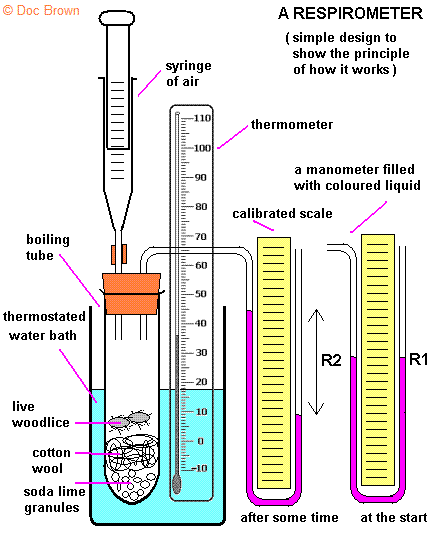
A boiling tube is set up in a thermostated water bath to control the temperature of the experiment - you should use a thermometer to accurately monitor the temperature of the water. A syringe containing air and a manometer are connected via glass tubing through a rubber bung to the boiling tube. Together with the soda lime this set up is called a respirometer.

A manometer is a device to measure pressures. A common simple manometer consists of a U shaped tube of glass filled with some liquid - in this case coloured water NOT poisonous mercury! A ruler scale is placed in between the arms of the U tube so the difference in heights of the liquid can be measured in both arms.

The syringe is used to set the level of the liquid in the manometer and refresh the air between experiments.

At the bottom of the boiling tube soda lime granules are placed to absorb carbon dioxide given out by the respiring woodlice. On top of the soda lime is a wad of cotton wool to prevent contact with the woodlice - they would be harmed by the strongly alkaline soda lime - an ethical point when using live animals in experiments.

The live woodlice are carefully placed on the cotton wool and the rest of the apparatus of the respirometer is carefully assembled so that boiling tube is vertical in the water bath.


Experimental notes

Note 1: The reduction in volume shows a gas is being removed from air, and that gas is oxygen. There would be no change in volume without the soda lime - the volume of CO2 formed would equal the volume of O2 used. But, since the soda lime removes the carbon dioxide given out by the organism's respiration, there is no confusion that the gas volume reduction is due to the uptake of oxygen by respiration and the liquid in the manometer moves towards respiring organism in the test tube.


Note 2: The right-hand limb of the manometer can be connected to a 2nd control test tube set up in the same way as the respiring organism test tube. This test tube is connected to the manometer and a tap is fitted instead of the syringe. A control test tube helps check that movement of the fluid in the manometer is only caused by the respiration of the organism.


Note 3: Instead of soda lime granules, you can use cotton wool soaked in a concentrated solution of an alkali e.g. sodium hydroxide or potassium hydroxide.
 

Investigation procedure

(a) The water bath, and boiling tube without woodlice in the boiling tube, are left for a short time until the temperature of the water bath has settled down to your desired start temperature e.g. 20oC.

(b) The woodlice are then quickly placed in the boiling tube, connect everything up as shown in the diagram.

(c) The syringe is used to equate the liquid levels in the manometer, preferably to zero difference in height (R1 = 0).

R1 doesn't have to be zero as long as you carefully read and record readings in both limbs of the manometer at the start and end of the respiration experiment.

(d) Let the woodlice respire for a fixed time.

As they respire and use up oxygen, carbon dioxide is produced, which is absorbed by the soda lime, decreasing the volume of air.

(e) As the air volume decreases, it temporarily reduces the pressure in the boiling tube containing the respiring organism, therefore, to maintain the constant external pressure ('fair test'), the liquid moves up the left limb of the U tube manometer.

(f) After a set time, you read the two levels to determine R2 (left reading - right reading in the U tube).

The total distance moved by the liquid = the difference between the two readings, R2 - R1, and this gives you a relative measure of the rate of respiration.

(technically it doesn't matter if R1 isn't zero at the start, as long as you subtract the initial differential reading R1 from R2, you obtain the actual numerical change desired.)

(g) You then repeat (a) to (f) with the same woodlice, at a higher temperatures going up 5o at time up to 50oC.

You need to replenish the air in the test tube and move the manometer liquid down and away from the test tube.

The greater the rate of movement of the coloured liquid in the thermometer, the greater the rate of respiration


Further experimental notes:

Theoretically, because the syringe is also calibrated, the syringe 'plunger' can be carefully depressed to return the manometer liquid levels to their original readings.

The volume of oxygen used = final syringe volume - initial syringe volume (e.g. in cm3).

This allows you to calculate the woodlice rate of respiration in cm3/min.

OR, you can just use the manometer level readings as a relative measure of respiration e.g. mm/min.


Ethical note:

The woodlice should not be used at sufficiently high temperatures that they die.

The woodlice should not be left in the respirometer too long so that they run out of oxygen and die.

After the experiment they should be released back into their natural outside habitat.

The woodlice should be allowed to come into contact with the soda lime or any other harmful chemical used to absorb the carbon dioxide.


(c) doc bResults, analysis and conclusions

As described above, the relative rate of respiration is measured as the rate of oxygen consumption in mm/min or cm3/min.

From your data table of results you can plot a graph of rate of respiration versus temperature.

You should find initially the rates increases, passes through an optimum at ~35-40oC and then decreases. steadily as the temperature goes higher.

This is typical of the behaviour of enzyme controlled reactions - which includes the metabolic chemistry of respiration.

Initially, as with any chemical reaction, the rate increases with increase in temperature.

However, as the temperature rises the enzymes become denatured and the rate of respiration will fall and the organism will be harmed.

This is not acceptable - unethical, so you should not raise the temperature too high and obtain just the first half of the graph above.

However, there is no reason why you cannot do higher temperature experiments with respiring seeds and see if you can get the full graphical picture of rates of respiration versus temperature.


Key points - experiment to measure the rate of aerobic respiration of woodlice using a respirometer

Based on the syllabus-specifications for students taking the AQA, Edexcel and OCR GCSE level biology examinations (~US grades 9-10).

Experiment: Measuring Aerobic Respiration in Woodlice Using a Respirometer

This experiment investigates how aerobic respiration in woodlice is affected by temperature, using a respirometer to measure the rate of oxygen uptake.


Apparatus

  • Respirometer (e.g. U-tube or capillary type with scale)

  • Live woodlice

  • Control tube with glass beads or dead woodlice (equal mass)

  • Potassium hydroxide or soda lime (to absorb CO₂)

  • Syringes or rubber bungs

  • Vaseline (to create airtight seals)

  • Stopwatch

  • Water bath or incubator (to control temperature)

  • Ruler or calibrated scale


Method Overview

  1. Assemble the respirometer:

    • Place a known number of live woodlice into one chamber.

    • Use the same mass of non-respiring material (e.g. glass beads) in the control chamber.

    • Add potassium hydroxide or soda lime to absorb any CO₂ produced, ensuring that volume changes are due to O₂ consumption only.

  2. Seal the system:

    • Ensure airtight connections using Vaseline or rubber bungs.

    • Introduce a coloured fluid (e.g. dye or bubble) into the capillary tube.

  3. Place the apparatus at a set temperature:

    • Use a water bath or controlled room temperature.

    • Allow the apparatus to equilibrate before starting the timing.

  4. Record results:

    • Measure the distance the coloured fluid moves over a fixed time (e.g. every 5 minutes for 20 minutes).

    • Repeat at different temperatures (e.g. 10oC, 20oC, 30oC, 40oC).


Variables

Type Examples
Independent Temperature
Dependent Volume (or distance) of oxygen consumed
Control Variables Species and number of woodlice, time, apparatus used, CO2 absorption method

Calculations

To calculate the rate of respiration:

Rate = Volume of O2 absorbed (e.g. mm3) / {Time (e.g. minutes)

If using a capillary tube with known cross-sectional area:

Volume = π r2 h where r is the radius of the capillary and h is the distance the dye moves.


Interpreting Results

  • As temperature increases, the rate of respiration typically increases, due to higher enzyme activity.

  • Beyond the optimum temperature, the rate decreases as enzymes may become denatured.

  • The control tube helps ensure that changes are due to respiration, not temperature effects on air pressure or apparatus.


Summary

  • Woodlice respire aerobically, taking in oxygen.

  • A respirometer measures oxygen uptake as an indirect measure of respiration rate.

  • CO₂ is absorbed, so any volume change reflects only oxygen used.

  • Temperature affects respiration, usually increasing the rate up to an optimal point.


Keywords, phrases and learning objectives for this section on respiration

Be able to describe experiments to measure the rate of aerobic respiration of woodlice using respirometer at different temperatures.

In describing the method to measure the rate of aerobic respiration, you need to know the details of the respirometer apparatus from a diagram and outline the procedure, data collection and calculate the relative rate of respiration.


WHAT NEXT?

TOP OF PAGE

INDEX of biology notes on respiration

INDEX of all my BIOLOGY NOTES

This is a BIG website, so try using the [SEARCH BOX], it maybe quicker than the many indexes!

email doc brown - comments - query?

Basic Science Quizzes for UK KS3 science students aged ~12-14, ~US grades 6-8

BiologyChemistryPhysics for UK GCSE level students aged ~14-16, ~US grades 9-10

Advanced Level Chemistry for pre-university age ~16-18 ~US grades 11-12, K12 Honors

Find your GCSE/IGCSE science course for more help links to all science revision notes


Website content © Dr Phil Brown 2000+. All copyrights reserved on Doc Brown's biology revision notes, images, quizzes, worksheets etc. Copying of website material is NOT permitted. Exam revision summaries and references to science course specifications are unofficial. Explaining the importance of investigation using woodlice to measure rate of respiration at difference temperatures using respirometer in GCSE biology, What you need to know about investigation using woodlice to measure rate of respiration at difference temperatures using respirometer for IGCSE biology, Explaining the use of investigation using woodlice to measure rate of respiration at difference temperatures using respirometer knowledge in GCSE biology, Examples of investigation using woodlice to measure rate of respiration at difference temperatures using respirometer explained for GCSE biology exams, What is the significance of investigation using woodlice to measure rate of respiration at difference temperatures using respirometer in studying for biology exams, What is the use of investigation using woodlice to measure rate of respiration at difference temperatures using respirometer ?  Describing and explaining the theory of investigation using woodlice to measure rate of respiration at difference temperatures using respirometer, revision preparation for AQA GCSE biology, Edexcel GCSE biology, OCR GCSE biology. Website content © Dr Phil Brown 2000+. All copyrights reserved on Doc Brown's biology revision notes, images, quizzes, worksheets etc. Copying of website material is NOT permitted. Exam revision summaries and references to science course specifications are unofficial. These revision notes on investigation using woodlice to measure rate of respiration at difference temperatures using respirometer are suitable for AQA gcse biology, investigation using woodlice to measure rate of respiration at difference temperatures using respirometer revision notes for Edexcel gcse biology, investigation using woodlice to measure rate of respiration at difference temperatures using respirometer revision notes for OCR gcse Gateway science biology, investigation using woodlice to measure rate of respiration at difference temperatures using respirometer revision notes for OCR 21st Century science biology, investigation using woodlice to measure rate of respiration at difference temperatures using respirometer revision notes WJEC GCSE biology, investigation using woodlice to measure rate of respiration at difference temperatures using respirometer revision notes for CCEA gcse biology, investigation using woodlice to measure rate of respiration at difference temperatures using respirometer revision notes for CIE Cambridge IGCSE biology exams. Explaining importance of method details of an experiment to measure the rate of respiration of woodlice in GCSE level biology, What you need to know about method details of an experiment to measure the rate of respiration of woodlice for GCSE level biology, Explaining use of method details of an experiment to measure the rate of respiration of woodlice knowledge in GCSE level biology, Examples of method details of an experiment to measure the rate of respiration of woodlice explained when studying GCSE level biology, What is the significance of method details of an experiment to measure the rate of respiration of woodlice in GCSE level biology, describing explaining theory of method details of an experiment to measure the rate of respiration of woodlice when studying GCSE level biology, exam revision notes for method details of an experiment to measure the rate of respiration of woodlice, online help for understanding method details of an experiment to measure the rate of respiration of woodlice in GCSE biology, what do I need to learn about method details of an experiment to measure the rate of respiration of woodlice? what do I need to know about method details of an experiment to measure the rate of respiration of woodlice for GCSE biology exams, how to prepare for questions on method details of an experiment to measure the rate of respiration of woodlice in GCSE biology examination?


SITEMAP Website content © Dr Phil Brown 2000+. All copyrights reserved on Doc Brown's biology revision notes, images, quizzes, worksheets etc. Copying of website material is NOT permitted. Exam revision summaries and references to science course specifications are unofficial.


INDEX of biology notes on respiration

TOP OF PAGE