(3)
Typical characteristics of animal cells including humans! (eukaryotes, eukaryota)
Animals
(eukaryotic organisms) are multicellular
organisms, but their cells do not contain chloroplasts and so not able to carry
out photosynthesis; animal cells have no cell walls; animal organisms usually
have s nerve system for co-ordination and are usually able to move from place to
place; they often store carbohydrate as glycogen or fat. Examples include
mammals like cattle, humans and insects like houseflies and mosquitos.
 Most animal cells
have the following five parts in these eukaryotic cells - the so called subcellular structures, and, remember,
plants cells usually have the same five components too (1.
to 5. below).
Most animal cells
have the following five parts in these eukaryotic cells - the so called subcellular structures, and, remember,
plants cells usually have the same five components too (1.
to 5. below).
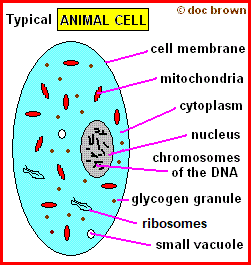
The diagram shows the principal subcellular
structures of an animal cell.
Reminder note: What is an
organelle?
An organelle is a specialized part of a cell having some
specific function, a sort of cell organ. Organelles are only found in eukaryotes
(plant and animal cells). The nucleus, mitochondria, ribosomes and chloroplasts
are examples of organelles.
1.
Cell membrane
Usually from/to blood vessels (in animals), the cell
membrane controls what enters the cell (oxygen, glucose, other
nutrients) and controls what leaves the cell (carbon dioxide and
other waste products).
Transport in plants is
via the xylem and phloem systems.
The cell contents i.e.
the sub-cellular structures like cytoplasm, nucleus, (small vacuoles in
animal cells), mitochondria etc. are
all held together
and enclosed, by
the very thin soft cell membrane which controls the passage of substances in and out of the
cell.
Because not everything can pass through the membrane, it is described
as a semi-permeable or a partially permeable membrane.
The cell membrane allows the free passage of water and gases but may
act as a selective barrier to other chemicals.
The cell membrane also
contain receptor molecules that are used in cell communication e.g. by
hormones and act as a selective barrier to molecules.
Through the cell membranes, specific substances can
diffuse out of one cell and diffuse into another neighbouring cell, from a
cell of higher concentration to a cell of lower concentration.
Reminder: Diffusion is due to the random movement of ions
and molecules in the fluid, from a region of higher concentration to a
region of lower concentration, in this case the regions are separated by the
semi-permeable cell membrane.
e.g. usually, for an animal ...
outside a cell the concentrations of oxygen and glucose
are higher in the blood, so both will diffuse into a cell,
and inside the cell the concentration of carbon dioxide
and other waste products are higher, so these will diffuse out of a cell
through the cell membrane into the blood for disposal via lungs or
kidney.
2.
Mitochondria
(an example of an organelle - a subcellular structure performing a particular
function)
A mitochondria organelle has a double
membrane, the inner one is folded in a complex way
Most of the aerobic energy releasing
chemistry of
respiration occurs in the mitochondria, which is where
most energy is released in respiration - eg the aerobic 'burning' of glucose to release
energy.
e.g. glucose + oxygen == via enzymes ==> carbon dioxide +
water + energy
The equation of aerobic respiration, an
exothermic
chemical reaction and catalysed by the appropriate enzymes.
glucose + oxygen ===>
carbon dioxide + water
C6H12O6(aq)
+ 6O2(g) ===> 6CO2(g) + 6H2O(l)
+ energy
RESPIRATION - aerobic and anaerobic in plants, fungi and animals,
conditions, substrates
Mitochondria are the power house of the cells
and contain all the enzymes needed for the chemical reactions that provide the chemical energy for any of the cells functions.
Cells with a high metabolic rate
need lots of mitochondria to creates lots of energy to power the cell
chemistry.
The energy releasing molecule ATP is made in the mitochondria.
Liver cells carry out lots of metabolic reactions
so lots of energy needed, so they contain a lot more mitochondria.
Similarly, muscle cells need lots of energy eg to
contract, so again, they have a lot more mitochondria than other cells
to supply the energy for the physical work animals perform.
Mitochondria have their own DNA in the form of circular
chromosomes, which is inherited from the mother only.
It is believed that mitochondria where once separate
microorganism - an ancient purple bacteria, that somehow became
incorporated and used by another unicellular organism.
3.
Cytoplasm
Cytoplasm is a jelly like
fluid (gel-like) in which most of the cells chemical reactions take place
and most of these reactions are catalysed by enzymes (biological catalysts)
which facilitate and control the rate of these reactions.
Anaerobic respiration (glycoyslis,
fermentation) take place
in the cytoplasm, but most aerobic respiration takes place in the mitochondria,
another specialised organelle.
4.
Nucleus
The cell nucleus contains
all the genetic material, the deoxyribonucleic acid (DNA codes) of the genes in the
chromosomes which control the cells
functions and the cell division in replication.
The nucleus controls the
activities of the cell by sending instructions to the cytoplasm.
The genetic
material is organised into chromosomes and the
chromosomal DNA
contains the instructions for making proteins e.g. that make up tissue or
enzymes.
Therefore the nucleus is where RNA is made from the double
helix DNA template.
5.
Ribosomes
and rough endoplasmic reticulum
Apart from prokaryotes, ribosomes are
usually found attached to the surface of rough endoplasmic reticulum
structures in cells. The rough endoplasmic reticulum is small
structure, inside the cell, consisting of a network of folded membranes and
the site of protein synthesis via ribosomes which are attached to the
membrane. The roughness look is due to the attached ribosomes.
Ribosomes are involved in the translation
of the genetic material from the chromosomes, they can decode the DNA to
carry out various chemical synthesis e.g. ribosomes are where protein synthesis
takes place -
from amino acids in the cytoplasm of the cell - the protein 'factory'!
This organelle is a tiny structure
and can just be seen as a dot with a
light microscope.
They can be free to move in the
cytoplasm or attached to an internal network of channels in the cell.
6. Vesicle
In cell biology, a vesicle is a small round sac
structure within or outside a cell, consisting of liquid or
cytoplasm enclosed by a double lipid layer and an important basic
tool for the functioning of a cell.
Vesicles perform a variety of functions inside cells
including moving substances into or out of cells (transport),
organizing cellular substances, metabolism reactions, temporary
storage of food and enzymes and can also act as chemical reaction
chambers.
7.
Other features
Glycogen granules
Stored food for
respiration.
Small vacuoles - much smaller than
in plant cells
Some animal cells may have several small vacuoles
of water containing various dissolved substances - might be food or
waste products.
Some differences between animal, plant and
bacteria cells
Animal cells are much larger than bacterial
cells, with important differences from plant cells.
Animal cells, unlike plant cells, do not have
(i) an
outer rigid cell wall for strength, (ii) a large permanent
vacuole and (iii) chloroplasts (for photosynthesis).
Key points -
Summary of ideas
Based on
the syllabus-specifications for students taking the AQA, Edexcel and OCR
GCSE level biology examinations (~US grades 9-10).
Revision Notes: Animal Cell
Structure and Characteristics, and Differences with a Plant Cell
Typical Structure and
Characteristics of an Animal Cell
Animal cells are eukaryotic,
meaning they have a nucleus enclosed within a membrane and other membrane-bound
organelles.
Below are the key components and their functions:
-
Cell Membrane
– A partially permeable membrane that controls the movement of substances in
and out of the cell.
-
Cytoplasm
– A jelly-like substance where chemical reactions occur, facilitated by
enzymes.
-
Nucleus
– Contains genetic material (DNA) in the form of chromosomes and regulates
cell activities.
-
Mitochondria
– The site of aerobic respiration, producing ATP (energy) for cellular
activities.
-
Ribosomes
– The site of protein synthesis; some are attached to the rough endoplasmic
reticulum, while others float freely in the cytoplasm.
-
Endoplasmic Reticulum
(ER):
-
Golgi Apparatus
– Processes and packages proteins and lipids; also involved in the formation
of lysosomes.
-
Lysosomes
– Contain digestive enzymes to break down waste and old cell components.
-
Centrioles
– Involved in cell division (mitosis and meiosis), helping in the formation
of spindle fibers.
Differences Between
Animal and Plant Cells
Though both are eukaryotic, plant
and animal cells have notable differences:
| Feature |
Animal Cell |
Plant Cell |
| Cell Wall |
Absent |
Present, made of cellulose, provides
structure and support |
| Chloroplasts |
Absent |
Present, contain chlorophyll for
photosynthesis |
| Vacuole |
Small or absent |
Large central vacuole filled with cell
sap, maintains cell rigidity |
| Shape |
Irregular, flexible |
More rigid, usually rectangular or
cubic |
| Energy Storage |
Glycogen (in cytoplasm) |
Starch (in chloroplasts or
amyloplasts) |
| Growth |
Cell division through mitosis |
Cell division occurs mainly in
meristems |
| Plasmodesmata |
Absent |
Present, allows direct communication
between plant cells |
-
Be familiar with the
differences between animal and plant cells, as this is a common question in
GCSE exams.
-
Use diagrams to illustrate
cell structures; these are frequently included in exam questions.
-
Understand the functions of
organelles, especially mitochondria (energy production) and ribosomes
(protein synthesis).
Summary of learning
objectives and key words or phrases for the characteristics of animal cells
To appreciate the importance to cell biology, be able to describe the typical characteristics of animal cells,
the structure and function of organelles including the cell membrane. the mitochondria,
the cytoplasm, the nucleus, the ribosomes, the vesicles, glycogen food granules
and the presence of one or more small vacuoles.
WHAT NEXT?
TOP OF PAGE
Index
of biology notes on cell structure
INDEX of all my BIOLOGY NOTES
HOME PAGE of Doc Brown's Science
website
UK KS3 Science Quizzes for
KS3 science students aged ~11-14, ~US grades 6, 7 and 8
Biology * Chemistry
* Physics UK
GCSE level students aged ~14-16, ~US grades 9-10
Advanced Level Chemistry
for pre-university age ~16-18 ~US grades 11-12, K12 Honors
Find your GCSE/IGCSE
science course for more help links to all science revision notes
email doc
brown - comments - query?
Explaining the importance of structure
and characteristics of animal cells
in GCSE level biology, What you need to know about structure and
characteristics of animal cells for
GCSE level
biology,
Explaining the use of structure and characteristics of animal cells knowledge in GCSE level biology, Examples of
structure and characteristics of animal cells explained
when studying GCSE level biology, What is
the significance of structure and characteristics of animal cells in GCSE level biology, describing and
explaining the theory of structure and characteristics of animal cells when studying GCSE level biology, revision
notes for structure and characteristics of animal cells in exams, online help for understanding
structure and characteristics of animal cells, exam revision
notes for structure and characteristics of animal cells, what do I need to learn about
structure and characteristics of animal cells? revision summary for
structure and characteristics of animal cells, learning notes for
structure and characteristics of animal cells, help to pass the
structure and characteristics of animal cells
topic in an exam question, how to prepare for questions on structure and
characteristics of animal cells in a GCSE
biology examination?
Based on the syllabus-specifications
for students taking the IGCSE/GCSE level biology examinations summary
revision notes and key points on structure and characteristics of animal
cells for students taking the AQA
igcse/gcse biology notes on structure and characteristics of animal cells, Edexcel gcse
biology notes on structure and characteristics of animal cells, OCR 21st century GCSE
biology notes on structure and characteristics of animal cells, OCR gateway
GCSE biology notes on structure and characteristics of animal cells, WJEC gcse biology notes on
structure and characteristics of animal cells, CCEA
gcse biology notes on structure and characteristics of animal cells for students taking CIE Cambridge igcse
biology, or any other GCSE or IGCSE level biology exams notes on
structure and characteristics of animal cells, useful for US grade 9-10 biology courses
SITEMAP
Website content © Dr
Phil Brown 2000+. All copyrights reserved on Doc Brown's biology revision notes, images,
quizzes, worksheets etc. Copying of website material is NOT
permitted. Exam revision summaries and references to science course specifications
are unofficial.
