(2)
Examples of specialised animal
cells adapted to their functions
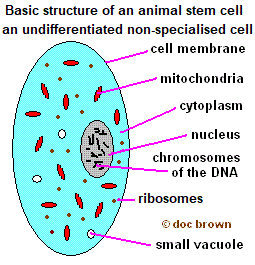
On the right is a diagram of the basic structure
of an animal stem cell which has the features characteristic to most
cells e.g. membrane, nucleus of DNA/RNA for instructions, mitochondria
for respiration, cytoplasm, vacuoles, ribosomes for making proteins etc.
In most animal cells, this ability to
differentiate is lost at early stage of development once the cells have
become specialised. But, most plant cells retain the ability to
differentiate throughout the life of the plant.
The cells that differentiate in mature animals are
mainly used for replacing damaged/dead cells e.g. skin or blood cells.
Skin cells live for 14 to 21 days and blood
cells have a lifetime of 80 to 120 days.
Reminder: Other cells, stem cells, are
undifferentiated.
For more on stem cells see later section on
stem cells
and their potential uses
Note that stem cells are undifferentiated and have not changed
into a specialised cells in the developing embryo.
Note that you can often work out how
the structure of the cell relates to its function in the organism.
e.g. consider its shape, size and
surface area AND the subcellular structure it contains e.g. organelles
like ribosomes and mitochondria, and also food stores like fat cells.
In other words note how specialised cells have
evolutionary adaptations to carry out their function.
Several examples of specialised cells are described below
Gamete cells -
the function of egg cells and sperm cells in sexual reproduction -
adaptations described in detail
Its important to compare male and female gametes
in terms of size, structure, motility, numbers and adaptations
Egg cells and sperm cells are the specialised cells of sexual
reproduction.
In sexual reproduction the nucleus of an egg cell fuses with the
nucleus of a sperm cell to produce a fertilised egg.
The fertilised egg develops into an embryo.
Both the sperm cell and an egg cell are referred to as being
haploid, because their nuclei only contain half the number of
chromosomes that you find in a normal body cell.
This ensures that when the egg and sperm nuclei combine at
fertilisation the created cell will have the right number of
chromosomes (now referred to as a diploid cell see diagram
below).
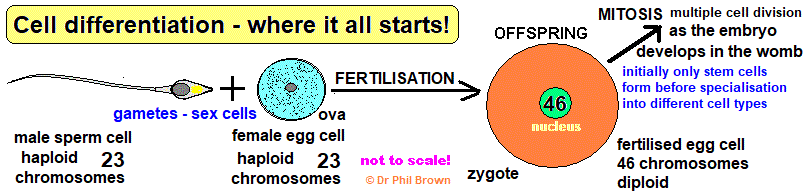
With reference to the human reproduction
diagram above:
The zygote is a diploid cell resulting from
the fusion of two haploid gametes (sperm + egg cells) to give a
fertilized ovum.
For the first 5 days the cells from the
fertilised egg divide by mitosis producing identical cells.
The egg cell - its
structure and its adapted functions
 Simple diagram of human egg cell
The principal function of the female egg cell is to convey the female
DNA and to provide nutrients for the developing embryo in the early
stages of the organism's development.
The egg cell has a haploid
nucleus (half set of 23 chromosomes) and the cytoplasm contains the
nutrients to feed the growing embryo - its nourishment.
Unlike the sperm cell, it has no flagellum to move independently.
Adaptations:
(i) The egg cell has a substantial energy store to
'fuel' the fertilised egg development and lots of accompanying
mitochondria to power the developing cell's chemistry.
(ii) Immediately after
fertilisation the egg cell's extra jelly coating (a
gelatinous layer outside the cell membrane) changes chemically
in structure to stop
another sperm getting into the egg cell and this ensures the right
amount of chromosomal DNA is present in the fertilised cell.
The human egg cell is bigger than most body cells and 10,000
times bigger than the male sperm below!
The egg cells
need to accumulate lots of nutrients to support a growing embryo
after fertilization, plus many mitochondria to power the growth of
the embryo.
At birth, the normal female ovary contains
about ~1.5 million immature eggs.
Females cannot make new eggs, and there
is a continuous decline in the total number of eggs each month.
By the time a girl enters puberty, only
about 25% of her lifetime total egg pool remains, around
300,000.
This contrasts with the millions of
sperm cells the male can produce.
See also
CELL
DIVISION - cell cycle - mitosis and meiosis in sexual reproduction
The sperm cell - its
structure and its adapted functions
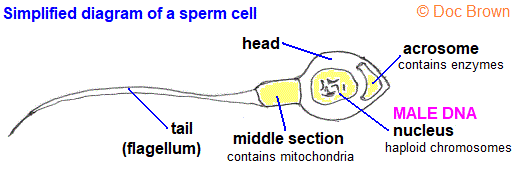
Simplified diagram of
human sperm cell
The sperm cell, like the egg cell has a haploid nucleus (half of
the full set of required chromosomes).
It is about 55
µm long and about 3
µm wide.
The principal function of a male sperm cell is
to convey the male's DNA and combine with the female's DNA in the egg
cell, to fertilise the egg in the female reproductive system - to
produce the zygote.
The
sperm cell has a long tail (flagellum) and streamlined head to enable it to swim
efficiently over relatively large distances to meet the female egg
(the egg cell cannot move of its own volition..
A sperm
cell contains lots of mitochondria arranged in a spiral in
the middle section.
Mitochondria are sites of respiration
- releasing energy to provide the energy for it to
swim to the egg cell, as well as the rest of the cell chemistry.
Three adaptations to 'head' for fertilisation.
At the front of the head of a sperm cell is an
acrosome where enzymes are stored.
These enzymes are needed so that
the sperm cell can digest its way through the membrane of the egg
cell to fertilise it and enable the fusion the of the male and
female nuclei.
Sperm cells are produced in much large numbers than egg cells to
ensure the fertilisation of the egg cell.
A fertile man may produce an average total of 80 to 300 million
sperm per ejaculation.
The total per life time far exceeds the much lower number of
female egg cells - no extra of which can be made in the ovary.
See also
CELL
DIVISION - cell cycle - mitosis and meiosis in sexual reproduction
Ciliated Epithelial Cells
- these line the surface of organs
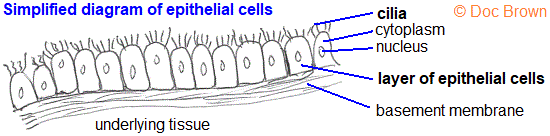
Simple diagram of
epithelial cells
Organ surfaces are lined with epithelial cells.
Some types of
epithelial cells are adapted with hairs called cilia on the top
of the cell's surface.
The function of these ciliated epithelium cells
is to move substances in one particular direction along the surface of
the tissue.
The hair-like structure of the cilia beat
in tandem to move the
material along.
A good example is the lining of your air passage, the
surface of which is covered in lots of epithelial cells.
The 'beating'
cilia move mucous and any particles from air trapped on the surface up
the throat and away from your delicate lungs.
This allows the mucous to
be swallowed or blow out through your nose.
Ciliated epithelial cells contain lots of
mitochondria to power the cells chemistry including the
energy needed to move cilia to move 'stuff' along! - for most
cells this is not an extra energy requirement - but note energy
requirements of muscle cells in the next section.
See also
Introduction to the organisation of cells =>
tissues => organs => organ systems (e.g. in humans)
Muscle cells
 Muscle cells form soft tissue found in most animals,
they are relatively long and must be able to contract quickly.
Muscle cells form soft tissue found in most animals,
they are relatively long and must be able to contract quickly.
Muscle cells have a striped
appearance.
They contain protein filaments of actin and myosin that
can slide past one
another.
This adaptation produces a contraction that changes both the
length and the shape of the cell.
The contraction can be reversed and
allows muscle tissue cells to function in such a way as to produce force
and motion.
Muscle cells contain lots of mitochondria to supply the
larger amounts of energy from respiration needed to work the muscles.
There are actually three types of
muscle cells, all adapted for different movement effects:
(i) heart muscle cells -
found in the walls of the heart and under involuntary control
- automatically work,
cardiac muscle tend to be more chunky (than the
diagram above!).
(ii) skeletal muscle cells
- in muscle tissue and are the most striated in appearance,
muscle tissue is under
voluntary control, and the fibres join up (in development)
to give strength and co-ordinated movement
(iii) smooth muscle cells
- these are 'spindle-shaped' (like the diagram above) and found in
'hollow' organs e.g. stomach, intestine, bladder,
these are also under
involuntary control - automatically work.
See also
Introduction to the organisation of cells =>
tissues => organs => organ systems (e.g. in humans)
and notes on the
skeleton and muscle systems
Nerve cells
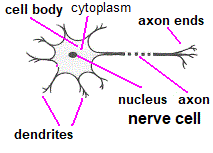 Neurones are nerve cells that
have adapted to carry information as tiny
electrical signals from one part of the body to anther e.g. between the
brain and muscles.
Neurones are nerve cells that
have adapted to carry information as tiny
electrical signals from one part of the body to anther e.g. between the
brain and muscles.
On the right is a simplified diagram
of a nerve cell.
These sensory neurone cells are
elongated and adapted to cover the relatively 'long' distances over
which they have to carry the nerve signals
from receptors to the spinal cord and brain.
Nerve cells have branched connections
at their ends to form a network of connections with other cells throughout the body.
For much more on the structure
of nerve cells and how the nervous system works see
...
An introduction
to the nervous system including the reflex arc
gcse biology revision notes
Blood Cells
Red blood cells
Red blood cells are adapted to carry
oxygen via the haemoglobin molecules inside them.
Their shape is biconcave to give a
larger surface area to absorb oxygen molecules more efficiently to
combine with haemoglobin and transport them around the body where they
needed e.g. in mitochondria.
Without this adapted
cell transportation of oxygen you could not have efficient energy
releasing respiration in mitochondria.
For much more detail see
The human circulatory system - heart, lungs, blood,
blood vessels
White blood cells
White blood cells are part of the immune
system.
White blood cell change shape to
engulf a microbe thereby ingest disease-causing bacteria and destroy them.
White cells can produce antibodies to
destroy pathogens.
For much more detail see
The human circulatory system - heart, lungs, blood,
blood vessels
Some basic examples of specialised cells and examples of features you need to be
able to recognise
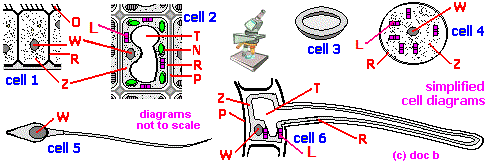
Cell type and function
Cell 1: A ciliated cell - the hairs can move material
e.g. throat tissue cells move mucous along.
Cell 2: A plant cell - unlike animal cells, they have a
cell wall as well as a membrane, plus chloroplasts for photosynthesis.
Cell 3: A red blood cell - contains the haemoglobin
molecule that combines with oxygen, transported for respiration.
Cell 4: A female egg cell (ovum) - carrier of the female
derived genes, lots of mitochondria.
Cell 5: A male sperm cell - carrier of the male derived
genes
Cell 6: A plant root hair cell - by which plants absorb
water and nutrients (e.g. mineral ions from the soil)
Cell features
L: Mitochondria, that power the cell chemistry from
aerobic respiration.
N: The green chloroplasts, large organelles containing
chlorophyll to catalyse photosynthesis.
O: The cilia are flexible hair-like structures
P: The cell wall of plants cells.
R: The cell membrane that controls what enters and exits
the cells.
T: Vacuole
W: The cell nucleus that controls most of the cells
activities.
Z: The cell cytoplasm
|
Key
points
Based on
the syllabus-specifications for students taking the AQA, Edexcel and OCR
GCSE level biology examinations (~US grades 9-10).
Summary of ideas and examples
Specialised animal cells are
cells that have adapted to perform specific functions within an organism.
These adaptations allow the
cells to carry out their roles efficiently. Below are key examples of
specialised animal cells.
Sperm Cell
Function:
To fertilise an egg cell and pass on genetic material.
Adaptations:
-
Head:
Contains a haploid nucleus with genetic material.
-
Acrosome:
Contains enzymes to penetrate the egg cell.
-
Middle Section:
Packed with mitochondria to provide energy for movement.
-
Tail (Flagellum):
Enables the sperm to swim towards the egg.
Egg Cell (Ovum)
Function:
To be fertilised by a sperm cell and develop into an embryo.
Adaptations:
-
Large Cytoplasm:
Contains nutrients for the early embryo.
-
Haploid Nucleus:
Ensures genetic material is combined correctly during fertilisation.
-
Cell Membrane:
Changes after fertilisation to prevent multiple sperm from entering.
Ciliated Epithelial
Cell
Function:
To move mucus and trapped particles out of the respiratory system.
Adaptations:
-
Cilia:
Tiny hair-like structures that beat rhythmically to move mucus.
-
Thin Cytoplasm:
Allows efficient movement of substances.
-
Found in:
The trachea and bronchi to help clear dust and pathogens.
Red Blood Cell
Function:
To transport oxygen around the body.
Adaptations:
-
Biconcave Shape:
Increases surface area for oxygen absorption.
-
No Nucleus:
More space for haemoglobin, which binds oxygen.
-
Flexible Membrane:
Allows movement through narrow capillaries.
Muscle Cell
Function:
To contract and enable movement.
Adaptations:
-
Long and Elastic:
Allows contraction and relaxation.
-
Packed with
Mitochondria: Provides
energy for movement.
-
Protein Filaments:
Help in contraction.
Nerve Cell (Neuron)
Function:
To transmit electrical signals around the body.
Adaptations:
-
Long Axon:
Allows signals to travel long distances.
-
Myelin Sheath:
Insulates the axon to speed up transmission.
-
Dendrites:
Increase connections with other neurons.
Key Concepts
-
Cell
Differentiation: The
process by which cells become specialised.
-
Structure-Function
Relationship: How
adaptations help cells perform their roles.
-
Microscopy:
Used to observe specialised cells.
Summary of learning objectives and key words or phrases
Be able to describe examples of specialised animal cells
that have become adapted to their specialised functions through the course
of evolution.
WHAT NEXT?
TOP OF PAGE
Index for biology notes on
stem cells, cell differentiation and cell specialisation
INDEX of all my BIOLOGY NOTES
HOME PAGE of Doc Brown's Science
website
UK KS3 Science Quizzes for
KS3 science students aged ~11-14, ~US grades 6, 7 and 8
Biology * Chemistry
* Physics UK
GCSE level students aged ~14-16, ~US grades 9-10
Advanced Level Chemistry
for pre-university age ~16-18 ~US grades 11-12, K12 Honors
Find your GCSE/IGCSE
science course for more help links to all science revision notes
email doc
brown - comments - query?
Doc Brown's school biology revision notes: GCSE biology, IGCSE
biology, O level biology, ~US biology science grade 8, grade 9 and
grade 10 school science courses or equivalent for ~14-16 year old students of
biology IGCSE AQA GCSE Biology Edexcel GCSE Biology IGCSE OCR Gateway Science
Biology OCR 21st Century Science Biology Some of these biology revision notes
might be suitable for UK KS3 Science-Biology courses for ages 12-14 (~US biology
science grades 6, grade 7 and
grade 8)
Explaining the importance of
examples of specialised animal cells adapted to their functions
in GCSE level biology, What you need to know about examples of
specialised animal cells adapted to their functions for
GCSE level
biology,
Explaining the use of examples of specialised animal cells adapted to
their functions knowledge in GCSE level biology, Examples of examples of
specialised animal cells adapted to their functions explained
when studying GCSE level biology, What is
the significance of examples of specialised animal cells adapted to
their functions in GCSE level biology, describing and
explaining the theory of examples of specialised animal cells adapted to
their functions when studying GCSE level biology, revision
notes for examples of specialised animal cells adapted to their
functions in exams, online help for understanding examples of specialised animal
cells adapted to their functions, exam revision
notes for examples of specialised animal cells adapted to their
functions, what do I need to learn about examples of specialised animal cells
adapted to their functions? revision summary for examples of specialised animal
cells adapted to their functions, learning notes for examples of specialised
animal cells adapted to their functions, help to pass the examples of
specialised animal cells adapted to their functions
topic in an exam question, how to prepare for questions on examples of
specialised animal cells adapted to their functions in a GCSE
biology examination?
Based on the syllabus-specifications
for students taking the IGCSE/GCSE level biology examinations summary
revision notes and key points on examples of specialised animal cells
adapted to their functions for students taking the AQA
igcse/gcse biology notes on examples of specialised animal cells adapted to
their functions, Edexcel gcse
biology notes on examples of specialised animal cells adapted to
their functions, OCR 21st century GCSE
biology notes on examples of specialised animal cells adapted to
their functions, OCR gateway
GCSE biology notes on examples of specialised animal cells adapted
to their functions, WJEC gcse biology notes on examples of specialised animal
cells adapted to their functions, CCEA
gcse biology notes on examples of specialised animal cells adapted to
their functions for students taking CIE Cambridge igcse
biology, or any other GCSE or IGCSE level biology exams notes on
examples of specialised animal cells adapted to their functions, useful for US grade 9-10 biology courses
