HOMEPAGE * SEARCH * UK KS3 level Science Quizzes for students aged ~13-14

UK GCSE level BiologyChemistryPhysics age ~14-16 * Advanced Level Chemistry age ~16-18

School Biology revision notes: Cell division 3. Mitosis number crunching

Cell division 3. The mathematics of cell division - number crunching replication for mitosis and what are the control factors of the rate of cell division and replication?

[Author © Dr WP Brown PhD: Doc Brown's biology exam revision notes suitable for students of UK IGCSE & GCSE level biology courses & ~ US grades 9-10 biology, page on cell-division updated Feb 10th 2026 *]

[Key points and learning objectives for this page, after the main body of notes]

Sub-index for biology notes on aspects of cell division

[email doc b] * [privacy-policies-disclaimer]  *  ]SEARCH doc b's science website]


(3) Cell division - number crunching replication for mitosis and control factors

How many cells are formed after so many cell divisions?

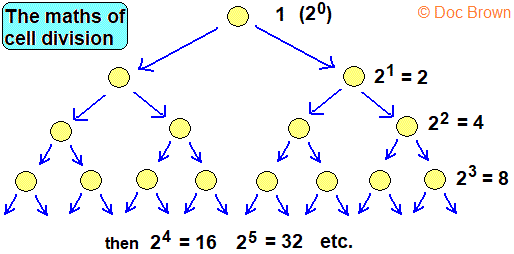
You can quite easily estimate the number of cells produced by mitosis from the simple formula 2n, where n = the number of cell divisions by mitosis.

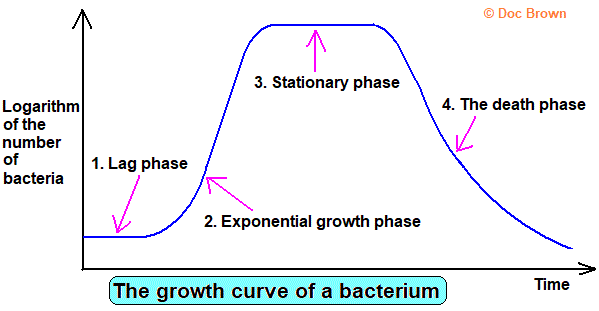
This simple maths expression explains why, if conditions are right, you can get an exponential growth of microorganisms like bacteria (sigmoid growth curve graph below).

For more on this see Part 8 Reproduction in prokaryotes - binary fission - full explanation of growth curve and its different phases

sigmoid growth graph for binary fission in Microorganism reproduction of bacteria


Now some simple maths!

the maths of cell division mitosis growth binary fission of prokaryotes gcse biology igcse 

Starting with a single cell, if you then have two cell divisions,

you end up with 4 cells (22 = 2 x 2 = 4).

By varying n you get a simple arithmetical progression of numbers

Number of cell divisions n 0 1 2 3 4 5 etc.
Number of cells resulting n2 1 2 4 8 16 32 etc.

You can also do some estimates of cell count from the rate of cell division e.g.

Suppose in a culture medium a cell is observed to divide every 10 minutes.

How many cells would be produced from each initial cell in one hour?

1 hour = 60 mins, so number of cell divisions in 1 hour = 60/10 = 6

Therefore each initial cell (from a given point in time) will produce:

26 = 64 cells after 1 hour


What controls the rate of cell division?

Although the estimate calculations of cell numbers is quite simple, in reality, things are never that simple.

The rate at which cells divide by mitosis is controlled by the cell's genes - but how effectively they operate depends on other factors e.g. the environment in which the cells are living and replicating.

You can't be sure the rate of cell division is constant - but the above calculations assumes this.

Different environmental conditions will produce different rates of cell division e.g.

availability of food - nutrition, lack of nutrition will reduce the cell division rate,

cells might die reducing the rate of population increase since less cells to divide,

temperature - warmer conditions may increase the cell division rate,

So, storing food in a refrigerator decreases the rate of bacteria growth,


Key points - Summary of ideas

Based on the syllabus-specifications for students taking the AQA, Edexcel and OCR GCSE level biology examinations (~US grades 9-10).

Mathematics of Cell Division: Number Crunching Replication for Mitosis

Cell division is a fundamental biological process that allows organisms to grow, repair tissues, and reproduce.

Understanding the mathematical aspects of mitosis and the factors controlling the rate of cell division is essential.


1. Number Crunching in Mitosis

Mitosis is the process by which a single cell divides to produce two genetically identical daughter cells.

The number of cells formed after multiple divisions can be estimated using the formula:

Total cells = 2n    where n is the number of mitotic divisions.

Example Calculation
  • If a single cell undergoes 3 divisions: [ 2^3 = 8 \text{ cells} ]

  • If a bacterial cell divides every 20 minutes, how many cells will be present after 2 hours?

    • Number of divisions in 2 hours = ( \frac{120}{20} = 6 )

    • Total cells = ( 2^6 = 64 )

This exponential growth explains why microorganisms like bacteria can multiply rapidly under optimal conditions.


2. Control Factors of Cell Division and Replication

The rate of cell division is regulated by several factors:

A. Genetic Control
  • The cell cycle is controlled by genes that regulate when a cell should divide.

  • Checkpoints in the cycle ensure DNA is correctly replicated before division.

  • Mutations in these genes can lead to uncontrolled cell division (e.g., cancer).

B. Environmental Factors
  • Temperature: Higher temperatures generally increase enzyme activity, speeding up cell division.

  • Nutrient Availability: Cells require sufficient nutrients (glucose, amino acids) for replication.

  • Oxygen Levels: Aerobic respiration provides ATP needed for mitosis.

  • pH Levels: Extreme pH conditions can denature enzymes involved in cell division.

C. Chemical Signals
  • Growth Factors: Proteins that stimulate cell division (e.g., epidermal growth factor).

  • Hormones: Some hormones (e.g., auxins in plants, human growth hormone) regulate mitosis.

  • Inhibitory Signals: Contact inhibition prevents overcrowding of cells.

D. External Influences
  • Radiation: UV radiation can damage DNA, affecting replication.

  • Toxins: Chemicals like carcinogens can disrupt normal cell cycle regulation.

  • Drugs: Some medications (e.g., chemotherapy) target rapidly dividing cells.


Exam Tips

  • Be able to calculate the number of cells after a given number of divisions.

  • Understand how environmental factors influence the rate of mitosis.

  • Be familiar with cell cycle checkpoints and their role in preventing errors.

  • Use graphs to interpret exponential growth patterns in cell division.


Summary of learning objectives and key words or phrases

Be able to number crunch cell division for replication for mitosis.

Be able to describe the control factors of cell division and replication.


WHAT NEXT?

TOP OF PAGE

Index for biology notes on cell division

INDEX of all my BIOLOGY NOTES

HOME PAGE of Doc Brown's Science website

UK KS3 Science Quizzes for KS3 science students aged ~11-14, ~US grades 6, 7 and 8

BiologyChemistryPhysics UK GCSE level students aged ~14-16, ~US grades 9-10

Advanced Level Chemistry for pre-university age ~16-18 ~US grades 11-12, K12 Honors

Find your GCSE/IGCSE science course for more help links to all science revision notes

email doc brown - comments - query?


Doc Brown's school biology revision notes: GCSE biology, IGCSE  biology, O level biology,  ~US biology science grade 8, grade 9 and grade 10 school science courses or equivalent for ~14-16 year old students of biology IGCSE AQA GCSE Biology Edexcel GCSE Biology IGCSE OCR Gateway Science Biology OCR 21st Century Science Biology  Some of these biology revision notes might be suitable for UK KS3 Science-Biology courses for ages 12-14 (~US biology science grades 6, grade 7 and grade 8) Based on the syllabus-specifications for students taking the IGCSE/GCSE level biology examinations summary revision notes and key points on maths of cell division by mitosis for students taking the AQA igcse/gcse biology notes on maths of cell division by mitosis, Edexcel gcse biology notes on maths of cell division by mitosis,  OCR 21st century GCSE biology notes on maths of cell division by mitosis, OCR gateway GCSE biology notes on maths of cell division by mitosis, WJEC gcse biology notes on maths of cell division by mitosis, CCEA gcse biology notes on maths of cell division by mitosis for students taking CIE Cambridge igcse biology, or any other GCSE or IGCSE level biology exams notes on maths of cell division by mitosis, useful for US grade 9-10 biology courses, Explaining the importance of factors controlling cell division replication by mitosis in GCSE level biology, What you need to know about factors controlling cell division replication by mitosis for GCSE level biology, Explaining the use of factors controlling cell division replication by mitosis knowledge in GCSE level biology, Examples of factors controlling cell division replication by mitosis explained when studying GCSE level biology, What is the significance of factors controlling cell division replication by mitosis in GCSE level biology, describing and explaining the theory of factors controlling cell division replication by mitosis when studying GCSE level biology, revision notes for factors controlling cell division replication by mitosis in exams, online help for understanding factors controlling cell division replication by mitosis, exam revision notes for factors controlling cell division replication by mitosis, what do I need to learn about factors controlling cell division replication by mitosis? revision summary for factors controlling cell division replication by mitosis, learning notes for factors controlling cell division replication by mitosis, help to pass the factors controlling cell division replication by mitosis topic in an exam question, how to prepare for questions on factors controlling cell division replication by mitosis in a GCSE biology examination?


SITEMAP Website content © Dr Phil Brown 2000+. All copyrights reserved on Doc Brown's biology revision notes, images, quizzes, worksheets etc. Copying of website material is NOT permitted. Exam revision summaries and references to science course specifications are unofficial.

TOP OF PAGE