|
Pictures of Liverpool (7) The Roman Catholic Metropolitan Cathedral of Christ the King and the Lutyens Crypt North West Index * Liverpool Index Liverpool RC Cathedral: The Catholic Cathedral is situated at the north end of Hope Street where it meets Mount Pleasant. Liverpool became a Catholic Diocese in 1850 and a cathedral was started in Everton in 1853, but never came to fruition. In the 1930, with Liverpool's population swelled by thousands of Irish-Catholics, it was proposed to build a cathedral in a scale and style never seen in Britain before. Sir Edward Lutyens was commissioned and the design exhibited in the Royal Academy London in 1932. However with lack of funds, only the great Crypt was completed by 1958. In the 1960 a world wide competition was launched for a new design more in keeping with the new spirit of the Liturgy then being formulated by the second Vatican Council. The architect Frederick Gibberd's design was chosen and building began in 1962 and the finished cathedral was consecrated on May 14th 1967. Entry is FREE, so PLEASE leave a donation to help with the running of this magnificent building Exterior architecture * Internal Design * Lutyens Crypt Notes on the Roman Catholic Metropolitan Cathedral of Christ the King * Email: chem55555@hotmail.com [Author and photographer © Dr Phil Brown PhD plus notes help from AI these days, page updated May18th 2026]*
The Exterior of the Cathedral
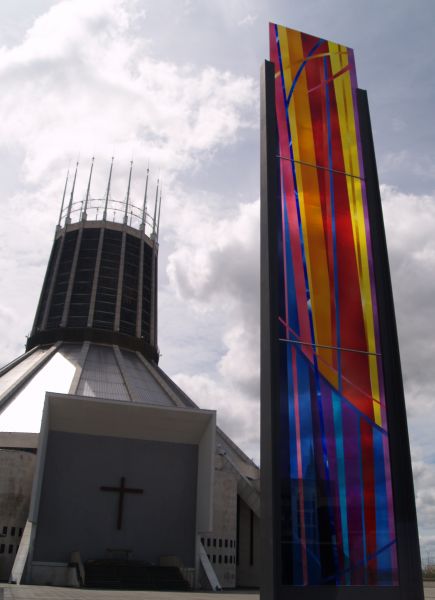
The approach to the Cathedral entrance from Mount Pleasant. Two of the tall stained glass panels are in the foreground. You can also see the Cathedral was being used for one of the graduation days of the universities.
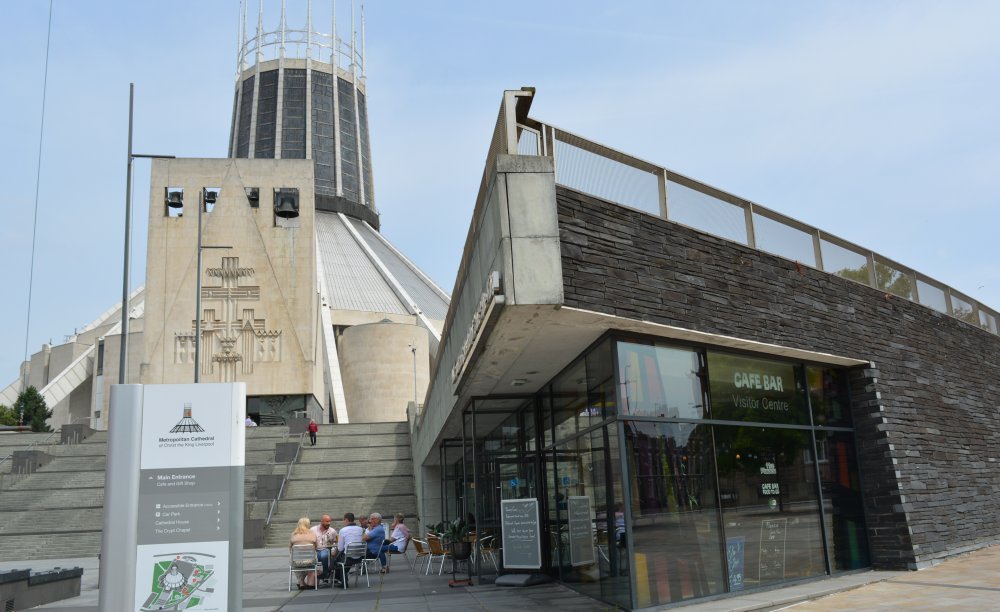
Looking up to the entrance to Liverpool's RC Cathedral from the Cathedral Gift Shop and Pizza Cafe Bar which is set by the Cathedral steps.
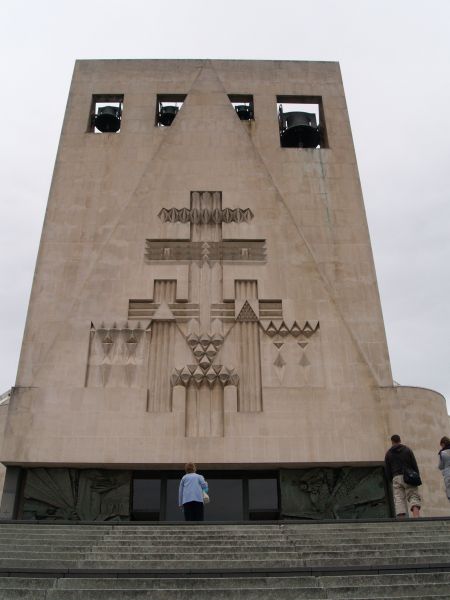
Liverpool RC Cathedral: The concrete sculptures and campanile above the entrance.
Liverpool RC Cathedral: The entrance
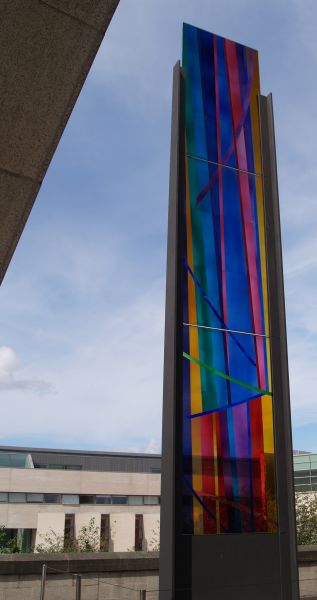
Liverpool RC Cathedral: More of the tall stained glass window panels at the rear' of the cathedral.
Liverpool RC Cathedral: The full pyramidal-circular nature of the Cathedral structure is best appreciated on the Brownlow Hill side of it.
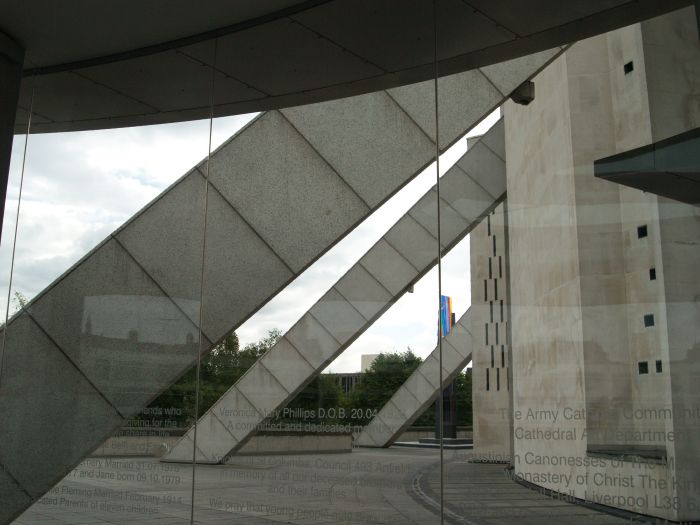
Liverpool RC Cathedral: The angled concrete 'buttresses' supporting the main structure. The Interior of the Cathedral
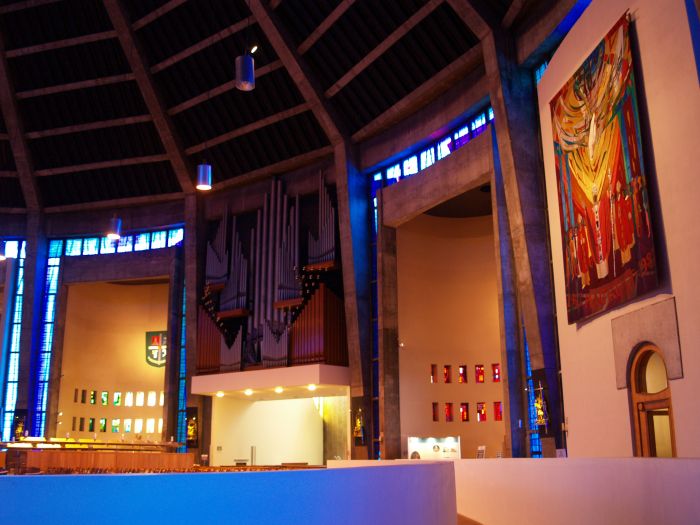
Liverpool RC Cathedral: On the Cathedral interior walls are embroidered hangings designed and made in the Cathedral Art Studio.
Liverpool RC Cathedral:
Liverpool RC Cathedral: View from the entrance foyer to the Sanctuary and High Altar.
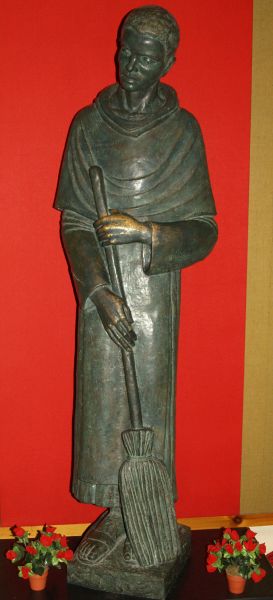
Liverpool RC Cathedral: Left - statue of St Martin de Porres Liverpool RC Cathedral: Right - The sculpture by Stephen Foster in the Children's Chapel
Liverpool RC Cathedral:
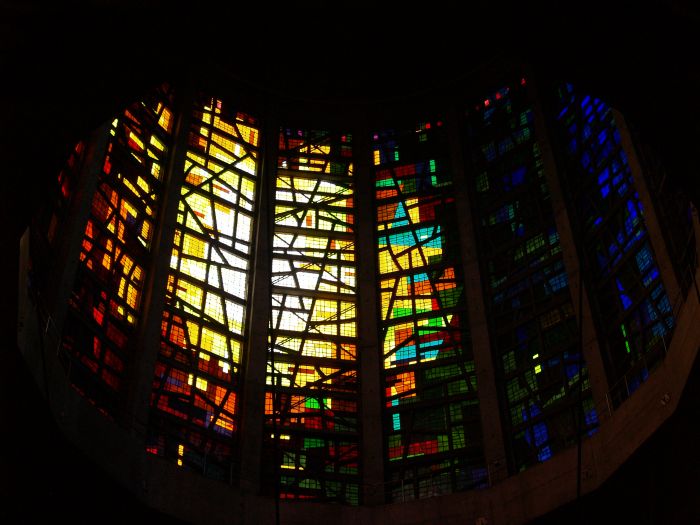
Liverpool RC Cathedral: Some of the blue-cyan coloured stained glass windows The Lantern glass is the design of John Piper and made by Patrick Reyntiens. Other stained glass window artists featured are Ceri Richards and Margaret Treherne who produced panels for some of the chapels
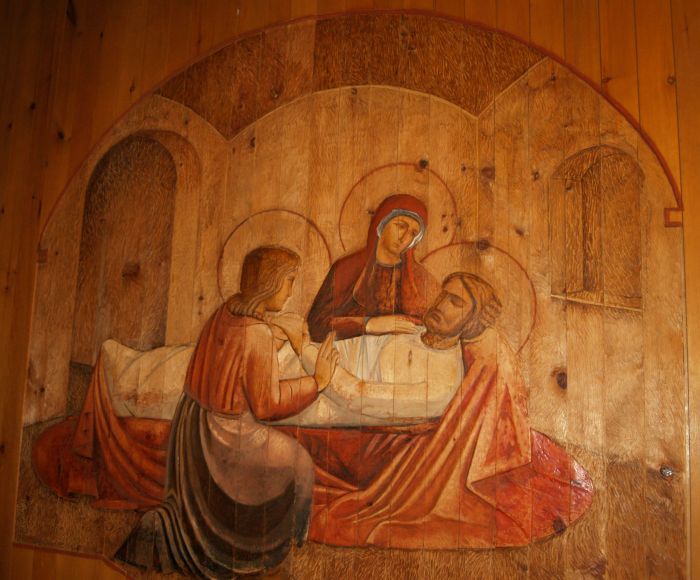
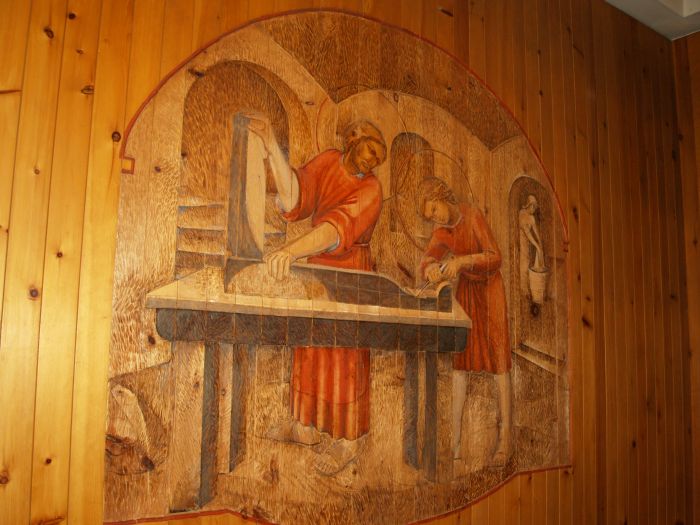
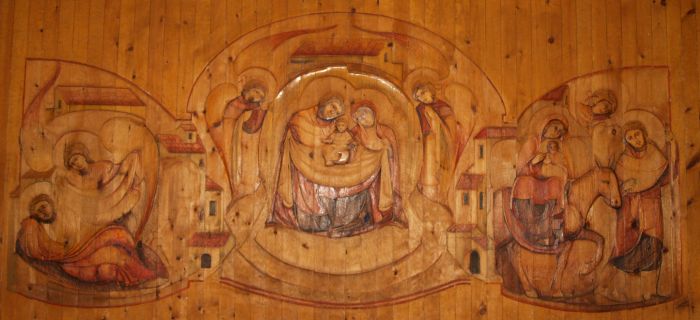
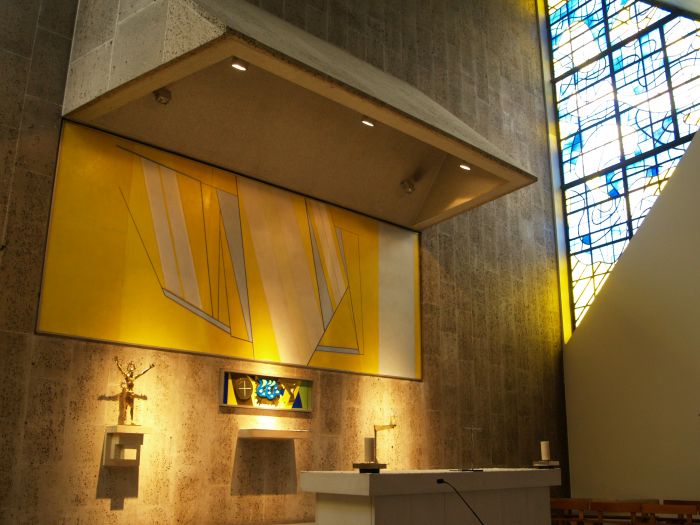
Liverpool RC Cathedral: The beautifully carved and 'lightly' painted wooden panels and stone altar in St Joseph's Chapel.
Liverpool RC Cathedral: The carved and painted panels in St Joseph's Chapel
Above/below - Liverpool RC Cathedral: ? Chapel
Liverpool RC Cathedral: Some of the smaller stained glass windows.
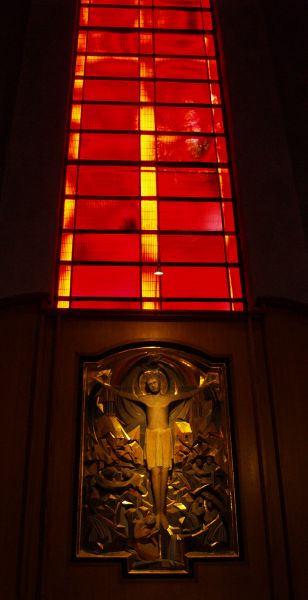
Liverpool RC Cathedral: Chapel of Reconciliation stained glass window and statue of Christ
Liverpool RC Cathedral: John Piper's stained glass window panels of the lantern - effectively the 'dome' of the cathedral.
Liverpool RC Cathedral: The lantern
Liverpool RC Cathedral: The lantern The Lutyens Crypt
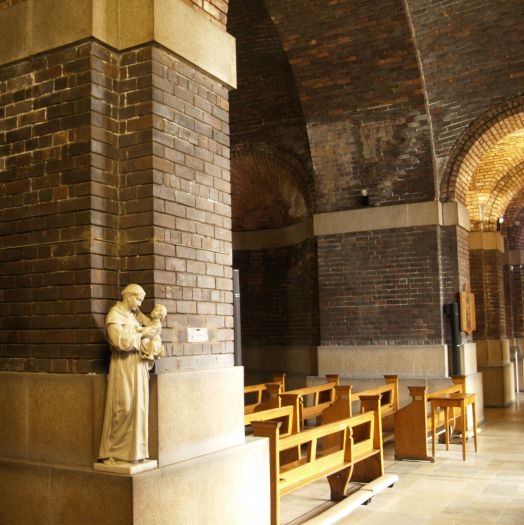
Liverpool RC Cathedral - Lutyens Crypt: The Crypt is effectively the crypt of the Sir Edwin Lutyens (a much renowned architect) cathedral that was never built in the 1930s. The Crypt was built between 1933 and 1958 and is a massive vaulted brick construction. Above is a view of the Crypt Hall.
Liverpool RC Cathedral - Lutyens Crypt: It is one of the biggest crypts in the world.
Liverpool RC Cathedral - Lutyens Crypt: There are four large spaces and each can hold between 300 and 700 people!
Liverpool RC Cathedral - Lutyens Crypt:
Liverpool RC Cathedral - Lutyens Crypt: One of the halls is used as a concert room.
Liverpool RC Cathedral - Lutyens Crypt: Wonderful radial brickwork of the concert room.
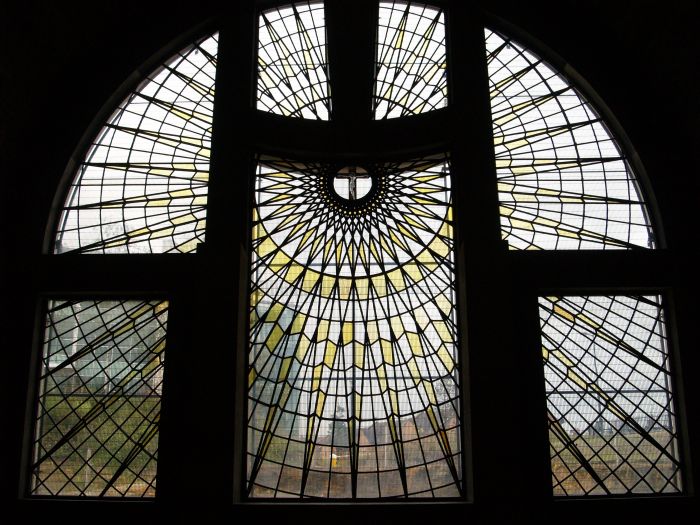
Liverpool RC Cathedral - Lutyens Crypt: The two great windows of the Crypt with a small amount of stained glass.
Looking from Liverpool RC Cathedral to the great square tower of the Anglican Cathedral at the other end of Hope Street. Notes on the Roman Catholic Metropolitan Cathedral of Christ the King and the Lutyens Crypt The essential picture: Liverpool's Roman Catholic Metropolitan Cathedral of Christ the King is one of the most important works of post‑war British architecture — a radical circular cathedral (1962–67) by Sir Frederick Gibberd, built above the monumental 1930s Lutyens Crypt, the only completed portion of what would have been one of the largest churches in the world. The two structures together form one of the most fascinating “layered” cathedral complexes in Europe. Below is a full, structured guide to both the history and architecture, integrating the most authoritative recent sources. 1. Historical Development: Three Cathedral Visions1. Early Catholic Expansion & the Pugin Scheme (1850s–1900s)
2. The Lutyens Era (1930–1941): A Cathedral to Rival St Peter's
3. The Gibberd Cathedral (1962–1967): A Modern Vision
2. Architecture of the Metropolitan Cathedral (Gibberd, 1962–67)Overall Concept
Exterior
Interior
Significance
3. The Lutyens Crypt (1933–41)Purpose & Survival
Architectural Character
The Treasury
Use Today
4. How the Two Structures Relate
Together they form a unique architectural palimpsest: a 1930s classical crypt supporting a 1960s modernist cathedral — two visions of Catholic Liverpool separated by war, economics, and changing theology. Here is a full, structured visitor's guide to the Metropolitan Cathedral of Christ the King and the Lutyens Crypt — written in the same clear, practical, heritage‑focused style you use on docbrown.info, and tailored for visitors exploring Liverpool. Visitor's GuideThe Metropolitan Cathedral of Christ the King, Liverpooland the Lutyens Crypt beneath it1. Why Visit?Liverpool's Catholic Metropolitan Cathedral is one of
the most unusual and architecturally important cathedrals in
Europe.
The contrast between the two is extraordinary: light above, shadow below; modernity above, classical mass below. 2. Practical Visitor InformationOpening Hours
(Times can vary with liturgical events.) Admission
Location
Accessibility
Photography
3. Suggested Visitor Route (45–90 minutes)A. Approach & Exterior (10 minutes)Stand back on the piazza to appreciate:
Best viewpoint: B. Enter Through the Great West Doors (5 minutes)Designed by William Mitchell, these sculptural doors depict the Four Evangelists in bold, textured concrete. Inside, pause to let your eyes adjust — the space is circular, soaring, and filled with coloured light. C. The Central Sanctuary (10 minutes)The high altar stands at the centre, surrounded by seating — a radical design for its time. Look up at the Lantern (“Corona”):
This is the cathedral's greatest artistic achievement. D. The Radiating Chapels (15–20 minutes)Walk clockwise. Highlights include: 1. Blessed Sacrament Chapel
2. Chapel of Reconciliation
3. Lady Chapel
4. St Joseph Chapel
Each chapel has its own character, glazing, and artwork — a miniature art trail. E. The Ambulatory & Artworks (5–10 minutes)Look for:
The cathedral is a showcase of post‑war British religious art. 🧱 4. Visiting the Lutyens Crypt (20–40 minutes)How to Access
What to See1. The Grand Entrance HallA powerful introduction to Lutyens' vision:
2. The Concert RoomOriginally intended as part of the vast undercroft.
3. The Treasury MuseumDisplays include:
4. The Lutyens FoundationsSome tours include access to the surviving foundations of the unbuilt superstructure — a fascinating glimpse of the scale of the original plan. 5. Understanding the Two Cathedrals TogetherAbove: Gibberd's 1960s modernist cathedral
Below: Lutyens' 1930s classical crypt
Together they form one of the most unusual architectural pairings in Europe — a literal layering of two eras, two theologies, and two architectural philosophies. 6. Best Photo Spots
7. Tips for Visitors
Liverpool Index
Email:
chem55555@hotmail.com
North West of England Liverpool scenes docspics images pictures © Phil Brown top tourist attractions in Liverpool, tourist information on Liverpool, student accommodation in Liverpool, luxury hotels, hostels to suit all budgets, B&B, self-catering flats, dining out in Liverpool, pubs, cafes, restaurants, museums, art galleries, guided tours of Liverpool docks, colleges, universities, churches, cathedrals, music concerts, theatres, cinemas, River Mersey, mini-breaks in North-West England
LIVERPOOL PICTURE INDEX: Liverpool (1)
The Albert Dock, Salthouse Dock,
Canning Dock and Wapping Dock Area Liverpool (2)
The
Pierhead and 'Three Graces' Buildings Area Liverpool (3)
The
'NEW' Museum of Liverpool (4)
The
Maritime Museum and The International Museum of Slavery Liverpool (5)
Lime
Street Station, Mount Pleasant and University Area Liverpool (6)
Bold
Street Area, Bluecoat School Chambers and St Luke's Church Liverpool (7)
The
Roman Catholic Metropolitan Cathedral of Christ the King & Crypt Liverpool (8)
The
Anglican Cathedral Liverpool (9)
A
Miscellany of Buildings Liverpool (10)
St
George's Hall Area & William Brown Street Liverpool (11)
The Walker Art Gallery Liverpool (12)
The World Museum Liverpool (13)
YHA Youth Hostel and some places to eat and
drink
Liverpool (14)
A Ferry Trip on the River Mersey Ferryboat
the ROYAL IRIS Liverpool (15)
The Tate Modern Art Gallery,
Liverpool (16)
The Central Library and a wild flower garden! docspics images photos of Liverpool RC Cathedral © Phil Brown Tourist information on Liverpool RC Cathedral, Walks near, Holidays near Liverpool RC Cathedral, England, Top tourist attractions of Liverpool RC Cathedral, luxury hotels in Liverpool RC Cathedral, self-catering holiday cottages near Liverpool RC Cathedral, B&B near Liverpool RC Cathedral, friendly pubs near Liverpool RC Cathedral, cafes near Liverpool RC Cathedral, eating out in fine restaurants near Liverpool RC Cathedral, weekend breaks near Liverpool RC Cathedral, wining & dining weekends near Liverpool RC Cathedral, walking holidays around the Liverpool RC Cathedral, touring coach tours including Liverpool RC Cathedral, pretty villages near Liverpool RC Cathedral, historic town/village of Liverpool RC Cathedral, museums near Liverpool RC Cathedral, local art galleries near Liverpool RC Cathedral, guided walks from Liverpool RC Cathedral, excellent fell hill walking around Liverpool RC Cathedral, rambling, exploring the landscape near Liverpool RC Cathedral. good places to eat near Liverpool RC Cathedral tourist attractions near Liverpool RC Cathedral tourist information for places near Liverpool RC Cathedral good places for wining and dining near Liverpool RC Cathedral good walks near Liverpool RC Cathedral properties for sale near Liverpool RC Cathedral, renting a flat of house near Liverpool RC Cathedral, property for rent near Liverpool RC Cathedral, houses for sale near Liverpool RC Cathedral, lettings near Liverpool RC Cathedral places to rent near Liverpool RC Cathedral holiday cottage accommodation near Liverpool RC Cathedral docspics images photos of Liverpool RC Cathedral northwest England © Phil Brown Tourist information on Liverpool RC Cathedral, Things to do in Liverpool RC Cathedral, What to see in Liverpool RC Cathedral, Walks in Liverpool RC Cathedral, weekend breaks in Liverpool RC Cathedral holidays in Liverpool RC Cathedral, Top tourist attractions of Liverpool RC Cathedral, luxury hotels in Liverpool RC Cathedral, self-catering holiday cottages in Liverpool RC Cathedral, B&B in Liverpool RC Cathedral, friendly pubs in Liverpool RC Cathedral, cafes in Liverpool RC Cathedral, eating out in fine restaurants in Liverpool RC Cathedral, bargain holiday breaks in Liverpool RC Cathedral, wining & dining weekends in Liverpool RC Cathedral, touring coach tours including Liverpool RC Cathedral, pretty villages in Liverpool RC Cathedral, historic towns in Liverpool RC Cathedral, visiting museums in Liverpool RC Cathedral, local art galleries in Liverpool RC Cathedral, guided walks from Liverpool RC Cathedral, history of Liverpool RC Cathedral, architecture of Liverpool RC Cathedral trains to Liverpool RC Cathedral historic houses in Liverpool RC Cathedral historic churches in Liverpool RC Cathedral historic buildings good places to eat in Liverpool RC Cathedral tourist attractions in Liverpool RC Cathedral tourist information for things to do and see in Liverpool RC Cathedral good places to eat out in Liverpool RC Cathedral good walks from Liverpool RC Cathedral tourist attractions properties for sale in Liverpool RC Cathedral, renting a flat of house in Liverpool RC Cathedral, property for rent in Liverpool RC Cathedral, houses for sale in Liverpool RC Cathedral, lettings in Liverpool RC Cathedral places to rent in Liverpool RC Cathedral holiday cottages accommodation in Liverpool RC Cathedral |












 More of the stained glass panel work


















 Enter place, street, building, feature, or anything else about LIVERPOOL!