|
Doc Brown's
Advanced Chemistry: Part 14.7
Isomers of a given molecular formula
Aromatic
constitutional-structural isomers of molecular formula
C7H7F,
C7H7Cl,
C7H7Br
and C7H7I
[Author
©
Dr
Phil Brown PhD:
Doc Brown's advanced level organic chemistry exam revision notes
suitable for students of UK advanced level chemistry courses, IB advanced
chemistry & US K12 grades
11-12 and AP honors chemistry courses: Molecular
spectroscopy and analysing the isomers of C7H7X
(X = halogen atom)
[page updated Mar
1st
2026 *]
email doc
brown - comments - query?
*
[privacy policy, cookies
and disclaimer]
Associated organic chemistry page links
Index of sets of isomers for a given
molecular formula
This is a big chemistry website, please allow time
to explore it
The benzene ring aromatic structural isomers of molecular formula
C7H7Cl
(Mr = 126.5)
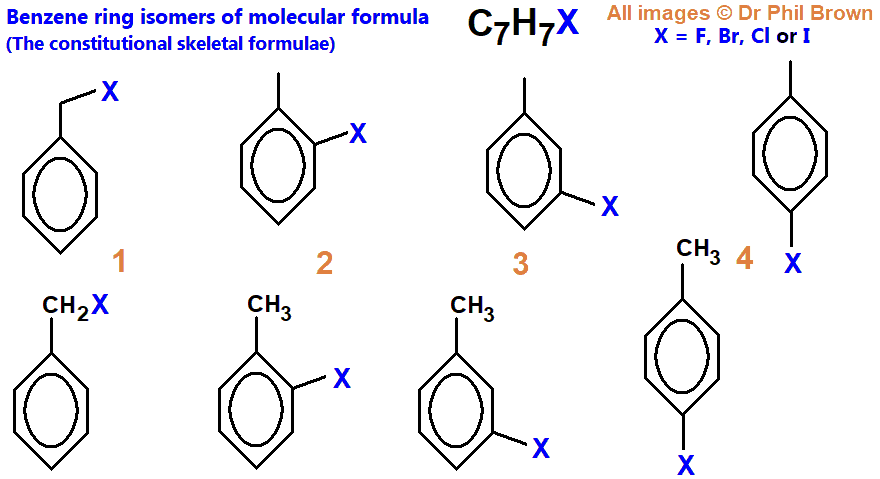
C 12.01,
H 1.01, F 19.00, Cl 35.45, Br 79.90,
I 126.90
|
Formula of compound |
Relative molecular
mass |
%
carbon |
%
hydrogen |
%
halogen |
|
C7H7F |
110.14 |
76.33 |
6.42 |
17.25 |
|
C7H7Cl |
126.59 |
66.41 |
5.58 |
28.01 |
|
C7H7Br |
171.04 |
49.15 |
4.13 |
46.72 |
|
C7H7I |
218.04 |
38.56 |
3.24 |
58.20 |
Empirical formula
= molecular formula
=
C7H7X
(where X = a single halogen atom)
If applicable
(see isomerism
summary at the end of the page)
Types of isomerism (restricted
to 4 benzene ring isomers)
All 4 isomers
are based on the position of the halogen atom in 3
different carbon chain arrangement, so we have positional
isomerism based on the same carbon network namely benzene ring and
alkyl branch, C6-C.
There is
functional group isomerism in the sense that aryl (aromatic)
halides have the halogen directly attached to the benzene ring,
C6-X, versus the
halogen atom substituted into the methyl group to give a primary aliphatic haloalkane,
C6-CH2-X.
I've only
considered isomers with a benzene ring, and they are all
illustrated below for the chlorine compounds, but for the
others, you just swap a Cl atom for a F, Br or I atom to
generate all the sets of 4 structures.
(1)
 ,
,
 (chloromethyl)benzene (benzyl chloride).
It is not a true aryl halogen compound, the
halogen atom is in a non-aromatic side chain (the methyl
alkyl group) so it is a primary aliphatic
alkyl halide (haloalkane, halogenoalkane).
and also for the same
structure, but changing the halogen atom name:
(fluoromethyl)benzene, (bomomethyl)benzene,
(iodomethyl)benzene
(2) to (4)
 ,
,
 ,
,
 , Three positional aryl halide structural isomers of C7H7Cl
Here, the halogen atom is
directly attached to the benzene ring - an aryl or aromatic halide.
1-chloro-2-methylbenzene,
1-chloro-3-methylbenzene and
1-chloro-4-methylbenzene.
and also for the same
structures, but changing the halogen atom name:
1-fluoro-2-methylbenzene,
1-fluoro-3-methylbenzene and
1-fluoro-4-methylbenzene
1-bromo-2-methylbenzene, 1-bromo-3-methylbenzene and
1-bromo-4-methylbenzene
1-iodo-2-methylbenzene,
1-iodo-3-methylbenzene and
1-iodo-4-methylbenzene.
Note that (2)-(4) are true aryl halides with the
halogen
atom attached directly to the benzene ring and they are isomeric
with the (halomethyl)benzene i.e. the halogen NOT attached to the benzene ring.
EXTRA NOTES on
the benzene ring isomers of
C7H7X (X =
halogen atom)
Types of Isomerism in C7H7X
Compounds the C-X or the ring
These molecules show:
-
Constitutional (structural) isomerism: Same
molecular formula, different connectivity.
-
Positional isomerism: The halogen (X) and
methyl (CH₃) group can occupy different positions on the benzene ring.
-
Functional group isomerism (in broader
contexts): If considering benzylic halides versus aryl halides i.e. .
Main isomers:
-
Aryl halides (halotoluene):
-
Benzylic halides:
Differences in Physical Properties
|
Property |
Aryl Halides (o-, m-, p-) |
Benzyl Halides (CHCH₂X) |
|
Boiling point |
Higher (due to ring polarity) |
Lower (less conjugation) |
|
Density |
Slightly higher for heavier halogens |
Similar trend |
|
Solubility in water |
Low |
Low |
|
Dipole moment |
Varies by position (para < ortho) |
Moderate |
Differences in Chemical Reactivity
-
Aryl halides: Less reactive in nucleophilic
substitution due to resonance stabilization and partial double bond
character of C–X in the benzene ring.
-
Benzyl halides: Highly reactive in SN1/SN2
due to resonance stabilization of benzyl carbocation/intermediate.
-
Electrophilic substitution: Methyl is
activating and ortho/para-directing; halogen is deactivating but also
ortho/para-directing.
Uses and Applications
(toluene is the old name for methylbenzene)
Old names are widely used in industry.
-
p-Halotoluenes: Precursors in dye and
pharmaceutical synthesis.
-
Benzyl halides: Alkylating agents,
intermediates in organic synthesis.
-
o-Halotoluenes: Used in agrochemicals and
fine chemicals.
-
Fluorotoluenes: PET imaging agents (e.g.,
fluorine-18 derivatives).
Common Student Misconceptions
-
Confusing constitutional isomers with
stereoisomers.
-
Assuming all halomethylbenzenes have similar reactivity.
-
Overlooking the benzylic position as a
reactive site.
-
Misidentifying ortho/meta/para positions in
ring substitution (2, 3 and 4 positions in disubstituted benzene ring
compounds).
Exam Revision Tips
-
Draw all isomers: Practice with skeletal
and displayed formulas.
-
Use IUPAC naming: Reinforces positional
understanding.
-
Compare SN1 versus SN2: Benzyl halides are
classic SN1 substrates.
-
Highlight resonance effects: Explain why
aryl halides resist nucleophilic attack.
-
Link structure to reactivity: Use reaction
mechanisms to show differences.
-
Practice past paper questions: Especially
those involving isomer identification and reactivity comparisons.
Learning objectives - questions to be answered?
How many aromatic benzene ring isomers are
there for C7H7Cl C7H7Br C7H7I C7H7F?
How do you draw the aromatic benzene ring isomers of C7H7Cl C7H7Br C7H7I C7H7F?
How do you name the aromatic benzene ring isomers of C7H7Cl C7H7Br C7H7I C7H7F?
Know how to draw diagrams of the skeletal formula of aromatic
benzene ring isomers of C7H7Cl C7H7Br C7H7I C7H7F
This page will answer
these questions for molecular formulae
C7H7Cl C7H7Br C7H7I C7H7F
Associated organic chemistry links
Advanced Level pre-university
organic chemistry notes
IR, mass and H-1 & C-13 NMR
spectra of organic compounds
See also
Examples of the effects of isomerism on the similarity or difference
in the physical and chemical properties of structural isomers
Index of sets of isomers for a given
molecular formula
The
molecular structure
& Naming of AROMATIC Compounds,
including isomers
INDEX of ALL revision notes on the
chemistry of AROMATIC COMPOUNDS
Isomerism: introduction, structural isomerism - chain,
positional, functional group, tautomerism
Stereoisomerism:
introduction, definition,
priority rules, E/Z isomerism (cis/trans isomerism)
Stereoisomerism - R/S isomerism (optical
isomerism) -
definition - examples explained
This is a big chemistry website, please allow time
to explore it
A summary chart of isomerism

|
Website content © Dr
Phil Brown 2000+. All copyrights reserved on revision notes, images,
quizzes, worksheets etc. Copying of Doc Brown's pre-university
advanced level chemistry website material is NOT
permitted. Exam revision summaries & references to science course specifications
are unofficial. These organic chemistry revision notes on
isomerism are
suitable for use of pre-university students studying AQA advanced level
chemistry, Edexcel advanced level chemistry, OCR advanced level
chemistry, IB advanced level chemistry, WJEC (Eduqas) advanced level
chemistry, CIE advanced level chemistry, US grade 11-12 AP honors
chemistry courses and they will also prove useful to
1st year undergraduate students of chemistry. |
Keywords or phrases: how many isomers are
there of molecular formula C7H7Cl? how do you name the isomers of
molecular formula C7H7Cl? what is the molecular structure of the
isomers of C7H7Cl, what type of isomerism is exhibited by molecules
of formula C7H7Cl, how do you work out the isomers of molecular
formula C7H7Cl, what are the structural isomers of C7H7Cl, the carbon chain
isomers of C7H7Cl in the homologous series of alkanes, comparing
the spectra of isomers of molecular formula C7H7Cl how many structural isomers of
C7H7Cl can you draw? how many structural isomers does C7H7Cl have?
what are the possible isomers of C7H7Cl? revision notes on
isomerism of C7H7Cl molecules, isomerism in
aliphatic carboxylic acids, isomerism in aliphatic esters,
carboxylic acid
isomers of C7H7Cl, ester isomers of C7H7Cl, the molecular structure of
the isomers of C7H7Cl how to draw the
structural formula of isomers of C7H7Cl, how to draw the displayed
formula of isomers of C7H7Cl, how to draw the skeletal formula of
isomers of C7H7Cl, how to name the isomers of molecular formula C7H7Cl
isomerism in C7H7Cl chloro-aromatic chloroarene compounds,
isomers of C7H7Cl of molecular mass 126.5
How to deduce the isomers of
organic halogen benzene molecules with the formula C7H7Cl C7H7Br C7H7I C7H7F, How to write, draw and name the
substituted halogen compounds
isomers of molecular formula C7H7Cl C7H7Br C7H7I C7H7F,
How to deduce if the isomers of
C7H7Cl C7H7Br C7H7I C7H7F organic benzene halogen compounds can exhibit R/S optical isomerism, How to deduce if the isomers of
C7H7Cl C7H7Br C7H7I C7H7F can exhibit E/Z geometrical isomerism), number of structural isomers of C7H7Cl C7H7Br C7H7I C7H7F, number of
stereoisomers of C7H7Cl C7H7Br C7H7I C7H7F
|
